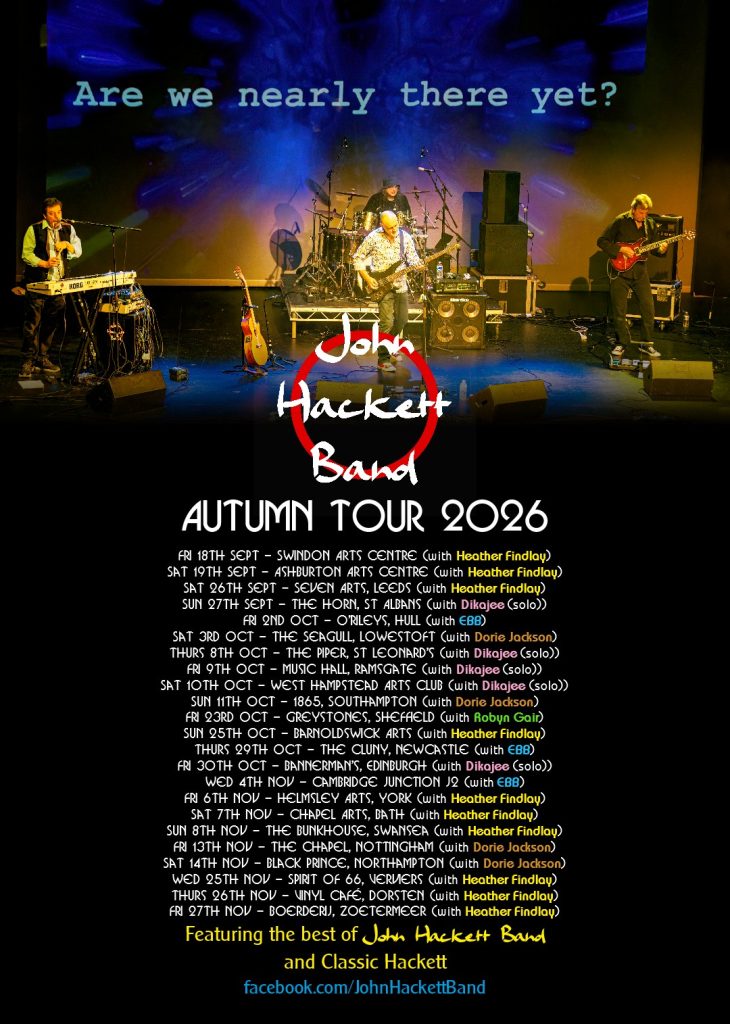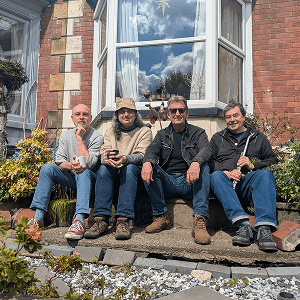
On the occasion of the tenth anniversary of the John Hackett Band, we have the pleasure of meeting its founder and members to celebrate a career that masterfully blends Progressive Rock, Classical Music, and Ambient soundscapes. 2026 marks a pivotal year for the lineup — John Hackett, Nick Fletcher, Jeremy Richardson, and Duncan Parsons — as they prepare to embark on what has been described as their largest tour to date. Beginning in the UK this September and concluding in the Netherlands in November, this tour is not only a celebration of the past but a bridge toward the future of international Prog.
Ten years together is a significant milestone: how has the chemistry between the four of you — John, Nick, Jeremy, and Duncan — evolved since 2016?
John: “Back in 2015 I recorded my second solo rock album “Another Life” for Esoteric Antenna (Cherry Red Records) and the band was formed on the back of that as a vehicle for my song writing. Since then it has become slightly more democratic where all of us contribute to the recordings and what we play live. Obviously in Nick Fletcher we have a world class lead guitarist with an astoundingly fluid technique so he is featured very heavily. It is the perfect contrast to my flute playing so in pieces like Red Hair, for example, there is a lot of interplay between the two instruments. What excites me also about working with these guys are that they are all very strong writers so there is never any lack of material to choose from!“
Duncan: “Jeremy and I have known each other since forever, and what with adulting being one of those things that just drains time, it’s been lovely having oases of mucking about together over the last ten years, seeing each other far more than we otherwise might. Thankfully, John and Nick are at least as equally silly, so the nonsense conversations Jeremy and I have shared for decades have brought in new voices, and it’s just been lovely. Jeremy was the missing piece when this quartet was formed, and after one day’s rehearsal there was no doubt that he was the right person to complete the line up.“
Jeremy: “I didn’t have any significant live experience before JHB and although I have always clicked with Duncan, I was unsure of how I’d fit in a band. Once I’d figured out my job was to set and maintain a groove with Duncan, so John and Nick could fly, it felt a little less daunting. Singing feels more instinctual. I’m very happy to be finding out what kind of musician I am with these three good souls. The more we perform together, the more we understand each other. Laughing a lot is an important part of this!“
Jeremy described this autumn tour as your “largest tour to date.” What are your expectations in bringing your music across the UK, Belgium, and the Netherlands?
John: “We hope lots of people will come and enjoy what is musically a very varied show. We’re playing some of the classic tracks from albums I recorded and toured with my brother some fifty years ago. That music is so well written that it still sounds fresh and connects with audiences. And then alongside that we have our own more recent material. If that means people get up and dance to Burnt Down Trees then that’s great!“
Duncan: “We’re used to playing slightly fewer dates in a year, and spread out across the time, but this year it’s rather more condensed. In terms of performance I suspect we’ll very quickly become a very focussed unit, and one hopes it will bring out some great performances from all of us. However, we’re not getting any younger (well, I am, but that’s another story), so there’s going to have to be some management of energy levels. For the first time we’ve built in the occasional travel day so that it’s not all early mornings and late nights!“
Jeremy: “We wanted to experiment with a more traditional touring schedule – to allow time for writing, yes, but also to build a real momentum into the tour. It can be very frustrating getting into the zone for a weekend of gigs, then not playing for a month or so and trying to pick up that vibe again. I find it hard to switch on and off like that, to be honest. It’s a lot of careful planning and preparation with venues, promoters, and special guests. Dates in Belgium, Germany and The Netherlands are an unexpected and delightful bonus. Since we were travelling over for one show, we figured surely we could fit in a couple more too!“
The tour will conclude on Friday, November 27th, at Poppodium Boerderij. What makes the Boerderij, such an iconic venue for Progressive Music, the ideal stage for the grand finale?
Duncan: “We were invited to play Prog Dreams in 2019, it was our first opportunity to play beyond our native green and pleasant lands – and it was lovely. Fabulous venue – stage is a good size without losing sight of each other, the auditorium welcomes so many people, the tech is well spec’d and operated by consummate artists in their field. What’s not to like from a band or punter perspective!“
Jeremy: “Totally echo Duncan’s words about de Boerderij! It has become the go-to concert hall for progressive artists and not simply because it’s so close to Hook of Holland! We were treated so well at Prog Dreams. The sound and lights were magical. It all felt deliciously surreal then, and it’s the perfect venue for this year’s curtain call.“
You have announced that the set will include tracks from your two JHB releases and John’s solo albums. How did you select the tracks to best represent this decade of music?
Duncan: “We play the things that we feel we’d like to play, really. When new material comes along it’s always a wrench to decide what gets dropped from the set to make room. Sometimes tunes come back. We didn’t play Dreamtown from John’s first rock album for a while, but bringing it back in felt very welcome and brought a lovely arc to the emotional undulation of the set. We started including some of Steve’s classic music last year as part of celebrating John’s part in the creation of Voyage Of The Acolyte. Not only has that been a joy to play, but folk the other side of the speakers seemed to like it too – always a plus! So this year we’ve broadened the repertoire with some others from the albums John was involved in, including at least one song that Steve’s never played live. It’s meant the difficult decision of what tunes to leave behind to make space – martyrs, of course, to the freedom we will provide.“
Jeremy: “We tend to think more in terms of the dynamics of a show rather than showcasing particular albums. The most memorable concerts I’ve been to take you on a journey. Fast and furious one moment; poignant and heartfelt the next. The ‘Acolyte Suite’ is a great example of this – the quirky groove of Ace of Wands to the gorgeous pastoral flute melodism of Hands of the Priestess into the driving riffage of A Tower Struck Down. But it’s equally true of JHB numbers – Who Let The Rain In is a ballad about social media/mobile phones/attention-loss seguing into a minimalist instrumental set ablaze by jazz-fusion guitar pyrotechnics, Clare’s Tango! Does the show have the right shape is almost uppermost in our thinking.“
An exciting feature of these dates is the inclusion of guests such as Heather Findlay, EBB, Dikajee, Dorie Jackson, and Robyn Gair. How did these collaborations come about, and what do they add to the live experience?
Duncan: “It’s varied. Heather, Dorie, and EBB we met via promoters booking us for the same bill, whether local venue or festival, while Dikajee and Robyn came to the band via personal friendships and liking the music they create. Each of them brings things that complement and contrast to who we are – it makes for a well-balanced evening of art for the audience, and we get to hang out for the afternoon and evening with just lovely people!“
Jeremy: “We’ve been truly, truly fortunate to share stages with some startling talent over the past decade. It’s been mesmerising when Heather, Olga, or Amy Birks have joined us in our set on numbers like Dream Town and I Talk To The Wind. Again our planning is shaped by what’s going to be a killer night for people who’ve travelled (sometimes a very long way) and spent to see us. AND I love the point of difference between coming to see us with a band like EBB (is there a band like EBB?!) where it’s incredibly energetic, and often a bit crazy to a date shared with a singer-songwriter, where the atmosphere may be more intimate, more reflective. Spending a few precious hours with folk who are totally on your wavelength is a rare and precious gift too, of course.“
John, you mentioned wanting to put a “JHB spin” on classics like “Voyage of the Acolyte” and “Please Don’t Touch.” How has the band reinterpreted these historic pieces for a modern audience?
John: “I always take the line that if music is well written with strong melody and harmony, it will usually work in various arrangements. You can take a piece by Bach for example and play it on a stylophone and, with all due respect to stylophone virtuosi round the world, it will still sound magnificent. It’s the same with Steve’s music. Ace of Wands from Voyage of the Acolyte is a fantastic piece which works well in its original version for guitar but our arrangement is flute-led. We’re not trying to reproduce the original tracks exactly as they were and, of course, one of the issues we have in JHB is that I am both the keyboard player and flute player so no matter how hard I practise, it’s hard to do both at the same time… We’ve mentioned Nick Fletcher’s virtuosity – at the end of Tower Struck Down, Nick takes the piece to another level with his fluid technique. Similarly at the end of Shadow of the Hierophant with that wonderful repeated chord sequence by Mike Rutherford, Nick makes it build and build with his fabulous improvisation. Also, Jeremy does a great job with the vocals – it’s not easy to fill the shoes of people like Richie Havens and Randy Crawford but Jeremy brings an emotional intensity that makes the songs his own.“
Looking back at the soundcheck photo from the Hammersmith Odeon in 1979 during the “Spectral Mornings” tour, how does it feel today to perform those same songs with your own band?
John: “To be honest, it feels fantastic. At the age of 71 to still be making music, playing live and recording (and writing when I get the chance), is something I am hugely grateful for. With the track Spectral Mornings originally on the tours, I played the second arpeggio guitar part whereas now, I’m having to play those same chords on the keyboard which I don’t mind telling you is a heck of a challenge! But I’m still learning and loving it.“
Your recording career began very early, back in 1970 with Quiet World on the album “The Road.” What is the most important lesson you have learned in over fifty years of making music?
John: “Practise, practise, practise. Natural talent plays its part but there’s no substitute for hard work.“
You are a versatile multi-instrumentalist (flute, guitar, keyboards). How does your classical training influence your approach to Rock composition?
John: “My main instrument is the flute and the flute in classical music usually carries the melody. So whether I’m writing a flute instrumental or a song, I’m always looking to create a strong melody. And of course, harmony is so important. From first getting into classical music, I was drawn to the French composers like Satie, Debussy and loved their use of interesting chords. There’s nothing wrong with a straight C, F and G progression but usually, it’s the added note chords with sevenths and ninths etc. that make things more interesting.“
In addition to Rock, you are part of the ambient trio Symbiosis. Does this exploration of more ethereal sounds influence the “electric” side of the John Hackett Band?
John: “Sometimes we play more ambient textures. In 1589 from Red Institution, for example, written by Duncan, there’s an underwater section where it gets quite ambient before we head back into a more prog-based verse. There’s also the live outro to Ace of Wands which is based on a figure of mine – it’s a good contrast to what’s gone before. I like music to have light and shade with plenty of dynamic contrast so the ambient sections really throw the heavier passages into relief. Genesis were masters of that!“
You have collaborated with many artists, from Anthony Phillips and Nick Magnus to Italian projects like The Rome Pro(G)ject and Ellesmere. Is there a common thread that connects these diverse experiences?
John: “If I had to connect them I would say they all write very well-crafted music with strong melody and harmony. And in good prog tradition, they are not afraid to write pieces that last more than a few minutes!“
Your contribution to your brother Steve’s early solo albums was fundamental. How would you describe the unique artistic bond you have shared for decades?
John: “I guess it all goes back to those formative early years when we shared a bedroom and spent hours playing guitar together. Then I took up the flute so that gave us a lot of scope for playing stuff like the end of the Hermit which we did when Steve did his informal audition for Peter Gabriel and Tony Banks. Steve was always bringing home what for us was new music so we often listened to Erik Satie as well as baroque composers like Bach and Scarlatti. What has always amazed me about Steve is his natural talent – he was completely self-taught whereas I was always going for lessons in flute playing and harmony.“
Many fans indissolubly associate you with the flute on masterpieces like “Spectral Mornings” or “Defector.” Do you feel like a guardian of that “Hackett sound,” or do you strive to distance yourself from it with JHB?
John: “I suppose what was distinctive about that sound is my classical training on the flute which is very much about control of tone throughout all registers of the instrument. It also involves a lot of technique – Jacuzzi is an example of that as it uses a lot of double tonguing (making a rapid tktk or dgdg sound) which is standard for anyone who plays the Poulenc Sonata or the Bach C major. These days I do use more of the skat (singing the note as you play flute) technique which is associated with players like Roland Kirk, Ian Anderson or Thijs van Leer but I’m still very rooted in my classical approach and I don’t distance myself at all from what worked back then.“
Is there a particular track of Steve’s that you remain most emotionally attached to from those 1970s recording sessions?
John: “I would have to say Hands of the Priestess from Acolyte. It was the very first track we recorded for the album. I’d recorded in home studios before but this was my first opportunity recording flute in a fully professional studio. Beyond that it is also a wonderful melody that I never tire of playing. It takes some beautiful twists and turns of harmony that really make it soar. A girl once said to me it sounds like someone taking you in their arms – I wish I’d written it!“
How do you view the health of Progressive Rock today? Do you see a real generational turnover, especially considering the younger artists joining you on this tour?
John: “I think it’s fairly healthy – there are some terrific players out there. And with modern technology, we can all write twenty minute masterpieces in our bedroom if we know how…As you say, we are very fortunate to have some highly talented people joining us on stage.“
After this autumn “marathon,” what are the next steps for the John Hackett Band? Is there a third studio album on the horizon to follow “We Are Not Alone”?
Duncan: “A third outing is certainly being considered! We have already had a bit of a run through a tune I wrote specifically for the band, and I have another historical jaunt ready, just some dots to write out. And Jeremy appears to have something brewing. We all have catalogues of older material as well kicking about that could become something once we start playing the notes. The will is there, but we need to concentrate on being ready for September at the moment 🙂“
Jeremy: “There’s more for us to say, I reckon. And we’re all writing. I think this big tour will shape the energy of what we record alongside the dates we’re building for Spring and Autumn 2027. It’d be lovely to do more dates in Europe. Italy sounds particularly attractive…!“
What is the main goal you have set for the next ten years of the band’s life?
John: “I’ll leave this one to Duncan as I just hope I’m here in ten years’ time, still making music!“
Duncan: “We’re not really ones for goal setting, that I’ve seen, over the years. We’ve hoped to play to more people as time has gone on, and by being consistent, turning up, and keeping a welcoming frame of mind we seem to have managed this. Last year we saw increased audience numbers, which was nice. We’re modest folk, but it’s nice to be appreciated and get a bit more of the roar of the grease-paint.. Perhaps we’ll play to more this year – that would be nice. Ten years, though? At the moment I can see the end of November.. who knows what happens beyond that!“
To conclude, do you have a special message for the Italian readers of Progressive Rock Journal and the fans waiting for you in Europe?
John: “Thank you for all the support you have shown us both in Italy and across Europe by buying the albums and in taking an interest. I assure you we never take it for granted and look forward to seeing everyone in the autumn. Do come and say hello. I always love it when people say they saw me with Steve on the Spectral or Defector tour-though I’ve yet to hear anyone say, “You haven’t changed a bit .”
Duncan: “I had the joy of doing some recording just outside Rome in 2015 with Carlo Matteucci as part of the second Playing The History album. It was my second visit to the wonderful country that brought so much of its own history to Britain – we still have it around us, found in many monuments, roads, and place names. It would be lovely to return and, perhaps, play to an Italian audience, famed as they are for their love of progressive music.“
Jeremy: “As soon as we can make it work, we’re going to play in Italy, rest assured. In the meantime, any of you can get to the German, Belgian or Dutch shows we’d be delighted to see you. Touring like this, and so extensively, is not something we take for granted and it’s certainly not something I imagined I’d ever do. So come and enjoy it with us, wherever you are!!“
We sincerely thank John Hackett, Duncan Parsons and Jeremy Richardson for their time and for opening the doors of the JHB world to us during this celebratory period. We remind our readers that the John Hackett Band tour will visit key locations such as London, Southampton, and Sheffield before arriving on the continent in November. We invite everyone not to miss the opportunity to witness this piece of Prog history that continues to renew itself with timeless elegance.