

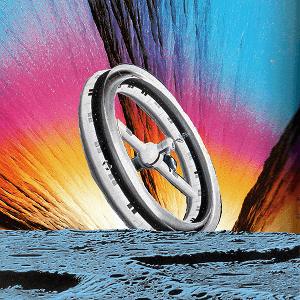
Manchester trio Farfisa (Lucian Thomas, Will Robinson, Luke Shenton) return with “Cosmodrome,” a record that marks a definitive pivot in their sonic evolution. Described by the band as “Wavy, Fuzzy Psychedelic,” the album was captured during the summer of 2023 within the confines of their “Drum Room.” The creative process mirrors the construction of a spacecraft mid-flight: improvisation serves as the lifeblood, while the narrative centre of gravity oscillates between archaic myth and speculative futures. Where earlier outings like “SPACE DEBRIS 001” and “Bontempi Beach House” charted their initial trajectories, “Cosmodrome” crystallises a cosmic narrative that emerged organically from the sessions. It is an album built on momentum, where technical precision meets Cosmic and lysergic exploration. The opener, “Space Race,” establishes the album’s Space Rock foundation without preamble. A propulsive progression mimics a textbook blast-off, layering dense Fuzz with expansive dynamics. The lyrics chart the launch sequence and the explosive chain reaction required to breach Earth’s atmosphere, carrying a near-theological sense of wonder: the astronaut witnesses the face of God and realises how far human ingenuity has reached, only to conclude with a quiet acceptance of insignificance (“we mean nothing at all, and that’s alright”). A driving rhythm section accelerates the tempo, while distorted guitars and a layered vocal refrain build tension. The band pushes into a crescendo where Fuzz expansions collide with continuous time signature shifts, resulting in a dynamic, gripping opener. “Jupiter Bodyguard Part 1” thickens the atmosphere, anchored by Will Robinson’s deep bass lines and Lucian Thomas’s electric guitar interventions, evoking the gas giant’s crushing gravitational pull. The track operates as a fascinating meditation on celestial physics: Jupiter is framed as an elder brother whose gravity shields Earth (“blue apple sanctuary”) from incoming cosmic threats. Orbital velocity and anticyclonic storms are woven into the lyrics, blending astrophysics with myth. After an initial Heavy, riff-driven minute, the arrangement opens up into a more airy Psychedelic Space Rock texture. A solid, intricate rhythm section allows guitar effects and synthesiser patches to intertwine, creating an expanded, cosmic soundscape enriched by precise modulation and spatial effects. Time shifts add compositional depth, showcasing the trio’s technical fluency as instrumental strands weave through the thematic development before the track closes in a Heavy crescendo that echoes the opener. “Jupiter Bodyguard Part 2” continues the motif, diving into more abstract Shoegaze territories. From the opening notes, melodies and vocals move with slow, ethereal grace, establishing a distinctly Psychedelic and Shoegaze-inflected atmosphere. The middle section pivots to heavier Rock textures with Progressive undertones, featuring Thomas’ guitar in sharp relief as he delivers an extended, refined solo. Vocals become more sparse, language dissolving into imagery of titans clashing at the margins, an experience that transcends verbal description. “Tinnitus” pushes further into Shoegaze soundscapes, opening with ethereal tones and a stretched vocal delivery. The track turns inward, exploring biological and visceral imagery: wombs, umbilical cords, and rebirth draw a parallel between space travel and human genesis. Maintaining its dilated tempo and slow pulse, it envelops the listener in Psychedelic Shoegaze textures where guitar and vocals intertwine, enriched by modulation effects that stack arpeggiated layers. Command console ambience transitions into “The Drang.” The title’s reference to “shattered glass like a symphony” frames a sharper, more rhythmic composition. Luke Shenton’s drumming is intricate, while Robinson’s bass lines fuse into a hypnotic motorik pulse. Thomas’ guitar and vocals follow this cadence, drawing out repetitive, enveloping melodies that intensify over the track’s runtime before culminating in a Fuzz-drenched Heavy Rock climax. The piece serves as an analysis of a “broken mind working extraordinarily,” where thoughts project outward like a storm gathering on the horizon. A return to the vocal refrain brings the track to a close. The album’s shortest cut, “Parthenon,” delivers a concentrated burst of Heavy Psych and Space Rock, steeped in Garage-Rock grit and an accelerated, engaging rhythm. Direct and unadorned, it nods to late-’60s proto-Heavy Rock while embracing a more immediate, less dilated form of Psychedelia. The lyrics reference waiting for a blinding star and the “morning martyr,” with a paternal figure (perhaps the Sun or a deity) lying millions of miles away in silence. It bridges the classic and the cosmic with surgical precision. “From Zenith To Azimuth” explores extreme dynamic contrasts, moving from peaks to profound quietude. The track opens with an expansive, immersive atmosphere, thick with nuance and effects. The sensation of drifting through deep space is palpable, translated into music through a sustained crescendo that maintains relentless tension. Oceanic metaphors are applied to atomic existence, as the protagonist questions: “Am I the body or the brain within it?” exploring consciousness duality. In the second movement, Thomas’ electric guitar cuts through the mix with a scratchy, searing solo that carries the track to its conclusion. The piece ends with vocals styled after space communications, layered voices fading into the void. “Household Gods” serves as the perfect epic closer, encapsulating the album’s Psychedelic and Cosmic journey. It expands upon the themes introduced in “From Zenith To Azimuth,” framing the human experience as deeply introspective: a universe observing itself with awe. The track celebrates shared connection and the concept of a “lifetime in the blink of an eye.” Drenched in expanded tones and intricate guitar-vocal interplay, it delivers a lysergic, cosmic finale that closes the record with refinement, leaving the listener eager to retrace the journey alongside Farfisa. “Cosmodrome” is more than a Space Rock album, it is a document of collective sonic exploration. Farfisa have successfully captured the spirit of a machine, the “shuttle,” awakening to reveal a dormant soul. The record excels in its ability to merge the immensity of deep space with the most visceral introspection of the human mind. Technically robust, thanks to the band’s own mixing and Pete Maher’s mastering, “Cosmodrome” confirms the Manchester trio as one of the most compelling forces in modern, fluid, and deeply narrative Psychedelia. Released on July 16, 2026, via Sour Grapes Records, the album is available digitally and on a limited cassette edition for collectors. Highly recommended for listeners who gravitate toward the cosmic drifts of The Flamingo Rise and King Gizzard or the rawer textures of contemporary Psych and Space Rock.
Tracklist
01. Space Race (08:30)
02. Jupiter Bodyguard Part 1 (05:36)
03. Jupiter Bodyguard Part 2 (04:42)
04. Tinnitus (05:03)
05. The Drang (05:22)
06. Parthenon (03:43)
07. From Zenith To Azimuth (04:36)
08. Household Gods (08:14)
Lineup
Lucian Thomas / Guitar, Vocals
Will Robinson / Bass, Synth
Luke Shenton / Drums, Percussion