

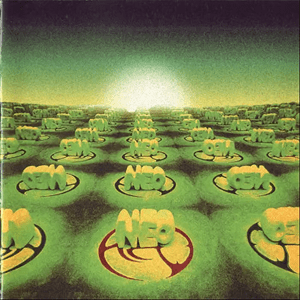
Long before the name “Neo” became synonymous with Cyberpunk cinema, a musical project of rare refinement was taking shape in the heart of French Lorraine. Formed in 1978 in Sarreguemines, Neo represent one of the hidden gems of the European instrumental Progressive Rock scene of the late 1970s. Led by bassist André Paul and saxophonist Didier Erard (already known for his work with French Kiss), the Moselle-based quintet managed to release their sole, self-titled album in 1980, at a moment when the genre itself was undergoing profound transformation. Neo‘s approach is not a simple imitation of the giants of the period, but a sophisticated amalgam of instrumental Progressive Rock, marked by sinuous structures and excellent technical command. The album was later rediscovered and reappraised by Musea Records, the French non-profit label devoted to the preservation of Prog, which oversaw its reissue with the inclusion of additional tracks. The album stands out for its use of complex rhythms, sudden accelerations, and tight instrumental dialogues between guitar, keyboards, and saxophone. The opening track, “Osibirsk,” lays out the stylistic blueprint for the entire album: instrumental Progressive Rock in which melodies are constantly punctuated by rhythmic breaks and dynamic variations. The rhythm section of André Paul and Eric Haven works through intricate interlocking patterns, laying the groundwork for the first dialogues between synth and horns. In “Scène De Chasse” the emphasis shifts toward sophisticated, shifting atmospheres. It is a piece that showcases the quintet’s ability to build toward climaxes through carefully chosen sonic colors, typical of the European school of the period, with a sinuous and never predictable architecture of themes. Didier Erard‘s virevoltant (swirling) saxophone comes strongly to the fore in the track “Joiwind.” His phrasing intertwines with the electric piano lines and the synthesizer textures crafted by Schlapp, creating a contrast between melodic agility and rhythmic rigor. “Néoplasme” is a short piece that condenses the group’s harmonic complexity. The themes are particularly intricate and non-linear,”recalling the mathematical yet evocative structures of artists such as Bo Hansson, transposed here into a more modern Jazz-Prog context. The centerpiece of the original album, “Sortie De Bain” is an epic suite of over ten minutes, in which the instrumental dialogues reach their peak: André Pélerin‘s guitar, described as rageuse ou tranchante (angry or cutting), engages in a tight call-and-response with Schlapp‘s inventive keyboards. The influence of King Crimson‘s Islands period is evident in the handling of sonic space and silence, and in the controlled aggression of the performance. The closing track of the original 1980 session, “Plage 2,” recorded at Oméga Studio in Strasbourg. It serves as an Atmospheric epilogue, maintaining the coherence with the shifting climates that characterize the entire work. Bonus Tracks (Musea Reissue): These pieces feature a reduced lineup compared to the original quintet, having been composed and recorded exclusively by the duo Schlapp and André Paul. “Jazz ‘n’ Roll” is a composition that explores more distinctly fusion territory. André Paul here doubles on bass, guitars, and synthesizers, creating a denser and more layered sonic texture compared to the 1980 tracks. “Song 4 Miles” is an explicit homage that confirms the duo’s openness to avant-garde jazz idioms. The track stands out for its skillful use of synthesizers and string-ensemble, instruments handled entirely by Schlapp, which lend the piece an almost dreamlike and Experimental dimension. Neo‘s self-titled album is a work that deserves to leave the obscurity of collector circles and be celebrated as a pillar of French prog. Their music is not easy or immediate, it demands attention to untangle its complex themes and intricate instrumental dialogues. It is essential listening for anyone who loves instrumental Prog that can be melodic and cerebral at once. The group’s ability to alternate moments of atmospheric calm with sudden bursts of sound keeps the record fresh even today, decades after it was recorded at Oméga Studio in Strasbourg. Thanks are due to Musea Records for bringing this treasure from the Moselle back into the light. For readers of Progressive Rock Journal, “Neo” is not just a name in the catalog, but a listening experience that captures the essence of an era in which music knew no structural boundaries.
Tracklist
01. Osibirsk 06:53
02. Scène De Chasse 07:32
03. Joiwind 03:57
04. Néoplasme 03:13
05. Sortie De Bain 10:42
06. Plage 2 02:58
07. Jazz ‘n’ Roll 07:20
08. Song 4 Miles 05:19
Credits
Artwork [Art], Layout – Alain Robert, Schlapp
Bass – André Paul (Track 2)
Composed By, Recorded By – André Paul (Track 2) (Tracks: 7, 8), Schlapp (Tracks: 7, 8)
Drums, Percussion – Eric Haven* (Tracks: 1 to 6)
Engineer [Sound Engineer], Mixed By [Remix By] – Francis Adam (Tracks: 1 to 6)
Executive-Producer [Re-release Executive Producers] – Alain Robert, Bernard Gueffier, Francis Grosse
Guitar – André Pélerin (Tracks: 1 to 6)
Guitar [Guitars], Synthesizer [Synthesizers] – André Paul (Track 2) (Tracks: 7, 8)
Liner Notes [Biography And Booklet Notes By] – Francis Grosse
Liner Notes [Translation By] – Paul Stump
Percussion [Additional Percussion], Equipment [Sonorisation] – Alfred Boetzlé (Tracks: 1 to 6)
Producer [Produced By] – Francis Adam (pistes : 1 to 6), Neo (5) (Tracks: 1 to 6)
Saxophone – Didier Erard (Track 2) (Tracks: 1 to 6)
Sleeve [Sleeve Design], Design [Sleeve Design] – Schlapp
Synthesizer [Synthesizers, String-Ensemble], Electric Piano [E-Piano] – Schlapp