

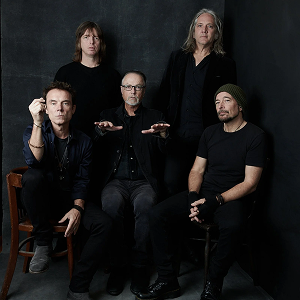
Few bands in modern Rock music have sustained a creative trajectory as bold, Atmospheric, and uncompromising as The Church. Entering their fifth decade of activity, the Australian neo-Psychedelic and Post-Punk pioneers return with ”Lacuna,” their 28th studio album, a sprawling, 17-track opus that builds upon the critical acclaim of 2023’s “The Hypnogogue.” Moving fluidly between shimmering Dreamgaze, Post-Punk urgency, and expansive acoustic textures, “Lacuna“ demonstrates a group still fiercely committed to artistic exploration.
Ahead of our review of the album, we caught up with founder Steve Kilbey and the band to discuss the making of “Lacuna,” the mechanics of their six-piece sonic alchemy, memories from their 45-year history, and the enduring power of the full-length record in a fast-paced world.
“Lacuna” arrives as your 28th studio album, following the widespread acclaim for “The Hypnogogue.” Steve, you have described this new record as “intense, forlorn, and exultant.” How do those three distinct emotional states shape the overarching narrative across its 17 tracks?
That’s a good question and I’m not sure how to answer it. But it’s a very good question. I guess we make a record then I have to stand back and make meaning out of it to explain it to the world. I grasp at straws for these explanations.
The record opens with “Lumbini Grove,” where the ambient sounds of crickets chirping yield to chime-like acoustic guitars and muffled cymbals. What made this particular atmosphere the right entryway into the album’s universe?
I just thought it was interesting to set the scene for this song and the whole album with these sounds. It’s about the spot where Buddhas mother wanted to deliver him when she was about to give birth. I can almost feel that place in my heart of hearts. So those nature sounds are a pointer. Theres no deep reason behind this. It just felt right.
“Sacred Echoes” stands out as an expansive, hypnotic Drone piece, originally spanning nine minutes before being edited for single release. How did that composition take shape in the studio, and how do you preserve a track’s hypnotic weight when distilling it into a single format?
Nick our drummer brought this piece of music into the studio, and we tinkered around with it. No one else really wanted it to be a single. Only me. And sure enough it did not take the world by storm. Maybe I was unsuccessful in the distillation. But man, that’s a very well worded question and again I’m not sure how to give it the answer it deserves.
The album exhibits striking stylistic contrasts, from the “Alt-cowboy” disposition of “Sky And Hill,” written in the garden of Arlyn Studios in Austin, to the bruised piano balladry of “Forever.” How do such wildly different songwriting environments co-exist within the same album ecosystem?
I guess the same way all those songs can co-exist on the Beatles White Album. You just chuck ‘em all on and hope someone will impose some sense on it all
Steve, you mentioned that “Forever” features one of your personal favorite vocal performances because it was unlike anything you had done before. After five decades of recording, what pushed you into new vocal territory on thois track?
The necessity to sing those notes properly that I had written for myself. This was a real song with a real melody and that sing/speak schtick wasn’t gonna cut it for this one.
Musically, “Lacuna” seamlessly weaves through Psychedelic Dreampop, Folkier textures, and Post-Punk drive without ever feeling like a retread of past eras. How do you balance honoring the band’s signature sonic DNA with pushing into genuinely Progressive arrangements?
Well that’s the big question, isn’t it? How do you do that? Because it seems like a contradiction: to remain true to your original thing and yet to expand and grow but not lose touch with what it once was. It’s a fine line and I’ve spent all those years trying to straddle it
“Lacuna” has been likened to a cohesive Post-Punk opera. Was there a unified conceptual framework or recurring lyrical theme binding the material together during writing, or did the narrative surface during production?
Who said that? Did someone really say that? I mean I’ll take that gladly as a compliment. However, there is no narrative at all and the record is really a bunch of songs that don’t have anything much to do with each other (To Be continued.. ).
Tracks like “The Lemurian” and “Rapture” highlight intricate twin-guitar interplay embedded within metaphysical lyricism. How do guitar arrangements typically develop between Ashley Naylor, lan Haug, and Jeffrey Cain to ensure each textural layer retains distinct clarity?
Well, there are a few different ways. One is that the band jams and then the jam is edited into a song. That’s the Lemurian way. Another way is rapture which is musically almost all lan. He wrote the music and brought it in and then the other guitarists kinda work with him to figure out how it’s all gonna hang together and what he’d like to see happen with it.
With Tim Powles continuing his dual role as drummer and producer alongside Nicholas Meredith, how did the rhythm section and studio choices shape the spatial depth of “Lacuna”?
Tim and Nick divvied up the parts between them but on this album, it turned out to be mainly Nick playing the kit and Tim playing around what Nick did. But next album it could be something else. There are no hard n fast rules with whoever might play this or that instrument anymore.
The album closes with “Lumbini Theme (Slight Return)” leading into “Sacred Echoes.” What was the intent behind structuring the tracklist to loop back to these opening motifs?
When we were writing “Lumbini” we recorded it in a number of different permutations. Right towards the end of finishing up the record Jeffrey played me this version of “Lumbini” and I thought it’d be nice to just bring it back for a few minutes. Gives a bit of continuity to the whole thing I thought.
Since forming in 1980 and releasing classic early albums like “Of Skins and Heart,” “The Blurred Crusade,” and “Starfish,” the band’s lineup has evolved into today’s six-piece dynamic. How has this current lineup altered your approach to composing and arranging in the studio?
Well, it’s basically the same approach but with different players. We jam and I edit the jams and put lyrics on and then the players play some more again on top and all the time we are all trying to get to the same place: a great Church song however one might understand what that is!
Many legacy groups eventually default to playing it safe, yet The Church consistently seeks out fresh creative friction. What keeps the desire to explore uncharted musical territory vibrant after 28 records?
We can’t play it safe. It’s not in my nature and never has been. I still want to see what music we can wring from the universe, and we all want to keep moving forward. Not gazing back in nostalgia. We just gotta keep on evolving or we will stagnate and die.
Steve, your lyrics have long drawn from surrealist, esoteric, and metaphysical imagery. How have your literary or conceptual inspirations shifted between your early work and an intricate record like “Lacuna“?
All my life everything read here or see goes into my songs. Everything I experience or feel; I’m sifting thru my life looking for words and feelings to bring into the songs. Nothing much has changed. If my 25-year-old self listened to Lacuna he’d understand where all those words came from.
You have been delivering three-hour sets on the 2025-2026 Singles Tour across Australia and North America. How do you prepare physically and artistically to sustain that level of musical intensity night after night?
Well, there is a Rock’n’roll miracle that takes place every time we go on stage and that is that the energy and willingness of the audience get us over the line despite my age and the 2 or 3 hour sets. Afterwards I am usually exhausted. But a wonderful giving audience can help you stay focused and energized long beyond where you’d normally expect you could go.
Performing a set spanning five decades must offer interesting reflections. How do iconic tracks like “Under the Milky Way” feel when juxtaposed onstage with new compositions like “Western” or “Martian Skyline“?
It all feels like pages in one big book of stories and almost all the songs sit next to each other easily without any contradiction. So, the old ones and new ones go well together and that’s a marvelous thing.
Across 45 years of touring, you’ve experienced countless stages across the world. Is there a specific tour memory or backstage anecdote that you feel best captures the spirit and humor of the band?
Well, we’ve played some shockers and we’ve played some blinders and everything in between. You do gotta keep laughing at the slings narrows of outrageous fortune and not let the good or bad go to your head. So many horrible things have occurred over the years, being spat on and having full beer cans hit you. P.A.s that don’t work. Stuff blowing up. People falling offstage. Drunkenness and drugginess and bad attitudes and blah blah blah. Ya just gotta persevere
In an era dominated by single-track streaming algorithms, you have delivered a 17-track album meant to be experienced as a complete, immersive work. What is your view on the role and future of the full-length album today?
I guess I’ll take whatever I can get. It’d be best if people listened to the whole thing as it’s intended. But these days I imagine a lot of people will just focus in on bits and pieces and I’m happy with that too.
As pioneers of Atmospheric Post-Punk and neo-Psychedelia, how do you view the current revival of Shoegaze, Dreamgaze, and Post-Rock among younger generations of musicians?
I don’t know a lot about them but good luck to any band trying to evoke something other than cars and girls and beer. All those bands have my virtual blessing to carry on being evocative!
For readers of Progressive Rock Journal who value depth, artistic risk, and musical craftsmanship: what core feeling or idea do you hope remains with them after listening to “Lacuna” from start to finish?
Satisfaction. Pleasure. Warmth. Hope. Amusement. Inspiration.
A huge thank you to Steve Kilbey and The Church for their time and generous insights, and to the team at Cooking Vinyl for making this interview possible. Spanning five decades and an incredible catalog of 28 studio albums, The Church stand as undisputed icons and true pioneers of Australian neo-Psychedelia and Post-Punk. “Lacuna“ is out October 30, 2026, via Cooking Vinyl. Stay tuned to Progressive Rock Journal for our upcoming review of the album.
The band have unveiled six singles/videos taken from the new album “Lacuna.” You can watch the official videos here: “Sacred Echoes (Part II),” “Western,” “Martian Skyline,” “Sky And Hill” and “Forever.”
Upcoming Live Shows:
Nov. 7, 2026: Broadbeach, Australia at The Star Gold Coast [Tickets]
Nov. 20, 2026: Melbourne, Australia at Hamer Hall [Tickets]
Nov. 25, 2026: Brisbane, Australia at The Fortitude Music Hall [Tickets]
Nov. 28, 2026: Torrensville, Australia at Thebarton Theatre [Tickets]