

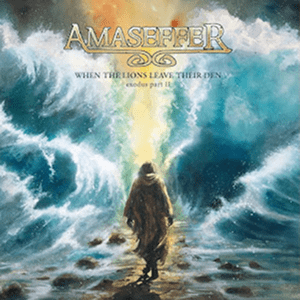
Founded in Tel Aviv in June 2004 by drummer, composer, and producer Erez Yohanan, who has also worked as a producer and collaborator for acts such as Orphaned Land, Tilian, Orpheus Blade, and Scardust, Amaseffer have forged a distinct identity centered on Symphonic Progressive Metal and Folk/Oriental elements, all framed around biblical epics. Following their debut chapter, “Slaves For Life” (2008), the band releases “When The Lions Leave Their Den (Exodus Part II)” on October 08, 2026, in both physical and digital formats, featuring cover art by Mattias Norén. The record picks up the narrative thread from the day of the Exodus through to Moses’ ascent of Mount Sinai to receive the Ten Commandments. The scope is expanded through orchestral arrangements, Folk instrumentation, multilingual narration, cinematic sound design, and the addition of new solo vocalists Lukky Sparxx and Jessica Mercy, who join Erez Yohanan (drums, percussion, programming, vocals) and Yadin Moyal (guitars, bass). My objective is not to celebrate the anticipation or promotional rhetoric, but to assess how the musical composition, the interplay between Middle Eastern tradition and Prog Metal, and the execution of individual tracks hold up across the entire journey. The nine-minute-plus opener, “When the Lions Leave Their Den,” functions as a true collage of the album’s sonic elements, weaving together the narrative of faith’s triumph over oppressive forces, the transition from shadow to light, the desert journey under Moses’ guidance, and the flight toward the Promised Land. Musically, the track begins by intertwining traditional vocal textures before evolving into solid Oriental-rooted Symphonic Progressive Metal. It is driven by violin motifs, a crescendo of massive guitar riffs, a granular rhythmic section, pompous keyboards and orchestration, Symphonic openings with warm, deep narrated parts, and an alternation between melodic passages and incisive verses. The song decisively establishes the album’s framework, though it demands close attention to the transitions between its most imposing moments and its more intimate sections. “A Flame Unbidden” continues the Exodus journey for over six minutes, intensifying the sound with oppressive keyboard tones and traditional Middle Eastern Folk flutes. The track culminates in a finale that descends into darker, more threatening prog metal, characterized by Heavy riffs and brass. It is a piece that thrives on contrast and dynamic drive, maintaining high narrative tension. Moving to a slower tempo than the opening, “Stardust Harvesters” operates in a vocal register that blends narration with dramatic singing, carrying a Cinematic edge. It builds a musical call-and-response that leads to a final, fused, and intense guitar solo. This is a track of broad scope that uses shifts in pace to add narrative depth to the first half of the album. At four minutes and seven seconds, “A Silvered Mist of the Sacred Veil” is the shortest episode on the tracklist. It relies heavily on the violin to amplify the mysterious atmosphere of Oriental Folk, offering a more collected pause in the album’s flow. “Lady of Slaughter” shifts the tone with a harder, more angular approach for over five minutes. It features electro-world rock textures, unsettling choirs, sharp riffs, and a tense central break where percussion fills the space and the riff becomes primal, supported by growled vocals and acoustic guitar. This episode raises the friction and breaks the more Symphonic momentum with direct impact. “Pathway to the Promised Land” is the longest track on the album and one of its central pivots. It unfolds in a cinematic form, featuring waves, seagulls, and a sorrowful choir, making space for the longing for the Promised Land and a relaxed breath that allows the listener to catch their breath before the sonic horizon reopens with an aquatic finale. The sound of “Miriam” turns toward an intimate, melancholic Folk ballad, built on vocal dialogue and a more collected, singable atmosphere. It opens up in the closing section with a guitar solo supported by violin. This passage lightens the pressure and highlights the more melodic side of the writing. The second-longest track, “Valley of the Standing Sun and Moon,” is placed in the final stretch before the close. It is a grand, theatrical fresco that unites didgeridoo, tribal rhythms, screamed vocals, and angelic surges in a broad, epic setup. Here, the scenographic ambition is at its peak, requiring balance to avoid feeling overloaded. “Wooden Staff Part II” opens with an atmospheric intro and expressive vocals before developing into Symphonic Progressive Metal that is enveloping yet Heavy. The compact sound is enriched by orchestration and keyboards, with an interpretation charged with pathos. Through continuous time changes and interweavings of sung parts and instrumental sections, the track builds rich textures until the finale, though it shows a certain repetitiveness in the coda, linked to the melancholic close and acoustic outro. The seven-minute closer, “Foothills of Mount Sinai,” returns the listener to the slopes of Mount Sinai with a relaxed orchestral cut, featuring violins, narration, a distant guitar solo, and a choir accompanying the epilogue. It is a finale that prioritizes pathos and the Symphonic-Melodic dimension over technical exhibition, closing the album’s narrative circle. “When The Lions Leave Their Den” confirms Amaseffer’s intent to pursue an ambitious and recognizable project, founded on the intersection of Progressive Metal, a Symphonic framework, and Oriental suggestions, supported by the contributions of Erez Yohanan, Yadin Moyal, and the new voices of Lukky Sparxx and Jessica Mercy. In my view, the album stands out for the richness of its arrangements, the variety of styles, ranging from more energetic passages to Folk-inspired introductions and Symphonic surges, as well as for the narrative cohesion that characterises all ten tracks. There are still some critical observations regarding the epic scope and certain more repetitive or solemn passages that risk slowing the pace, but the band’s narrative skill as a whole makes the album a rich and coherent listening experience, in keeping with the band’s artistic journey.
Tracklist
01. When the Lions Leave their Den (9:14)
02. A Flame Unbidden (6:45)
03. Stardust Harvesters (6:51)
04. A Silvered Mist of the Sacred Veil (4:07)
05. Lady of Slaughter (5:53)
06. Pathway to the Promised Land (10:16)
07. Miriam (6:01)
08. Valley of the Standing Sun and Moon (9:08)
09. Wooden Staff Part II (6:49)
10. Foothills of Mount Sinai (7:07)
Lineup
Erez Yohanan / Drums, Percussion, Programing, Vocals
With:
Yadin Moyal / Guitars, Bass
Lukky Sparxx / Lead & Backing Vocals
Jessica Mercy / Lead & Backing Vocals
Phillip Freeman / Narration
Yuval Kramer / Additional Guitars
Hanan Avramovich / Additional Guitars
Kobi Farhi / Vocals, Spoken Words
Roman Northey / Child Praying
Ela Kuebler / Sekhmet Spoken Words, Growls
Mats Leven / Backing Vocals
Sharon Cohen / Oriental Violins, Woodwinds
Gil Tzemach / Oud
Yotam Avni / Growling
Alex Wazmo / Backing Vocals, Screams
Inbal Avni / Piano, Backing Vocals
Ravid Avni / Backing Vocals
Shalom Yohanan / Backing Vocals
Cover: Mattias Norén