

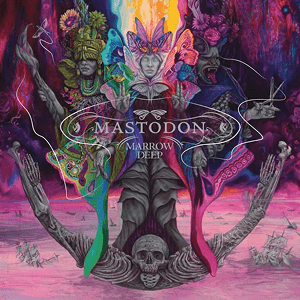
There are records that exist merely to check a box on an already solid discography, and then there are those that take shape when the ground beneath your feet gives way, forcing the musicians to redefine their emotional and executive coordinates. “Marrow Deep,” released on August 28, 2026, via Loma Vista Recordings, belongs unequivocally to the latter category. For Mastodon, the Atlanta, Georgia-based band that has cemented itself as one of the most significant and influential forces in the Progressive and Heavy Metal landscape, this album arrives after a period marked by deep fractures and an unavoidable reorganization. In recent times, following releases such as “Floods Of Triton” in September 2024 and the single “Your Ghost Again” in June 2026, the band has had to contend with events that shook both their internal equilibrium and the private spheres of its members. The passing of founding guitarist and longtime member Brent Hinds, who died last year in a motorcycle accident, left a human and artistic void that the group has addressed openly, including through the roughly thirty-five-minute documentary short “The Mastodon In The Room,” dedicated to their twenty-five-year relationship with him. This loss was compounded by the death of Brann Dailor’s mother, Michele, and the devastating impact of Hurricane Helene on Troy Sanders’ home and family, resulting in nearly two years of forced displacement. In terms of lineup, “Marrow Deep” marks the studio debut of the new configuration: Troy Sanders (bass, vocals), Brann Dailor (drums, vocals), Bill Kelliher (guitars, backing vocals), Nick Johnston (lead guitars, backing vocals), and João Nogueira (keyboards, synthesizers). The permanent integration of a keyboardist in the recording process, alongside Johnston’s presence on guitar, is far from cosmetic. From the critical standpoint of Progressive Rock Journal, the value of this record is measured precisely by its ability to transform a dramatic passing of the torch and a state of genuine grief into writing that is compact, controlled, and charged with expressive urgency. The opener, “Barbarians Blood,” immediately establishes the new lineup’s stability in the studio. The track hits the ground running with intricate, incisive arrangements, setting up the vocal dialogue between Brann Dailor’s more melodic register and Troy Sanders’ harder, more aggressive delivery from the first bars. The rhythmic section built by the core duo supports an articulated and tight progressive framework, while João Nogueira brings keyboard solutions already tested live, and Nick Johnston integrates seamlessly with Bill Kelliher and the keys to create well-balanced guitar textures. Lyrically, the text revolves around a state of alarm and rupture, “We’re in danger / Losing everything / As the fire / Burns all we once loved,” progressing through images of threat and disorientation (“Feral scapegoats / Perched on mountain tops / Avoid the rockslide / Certain death below”), before moving into a trajectory of navigating darkness (“Getting lost in the echo / Finding our way through the night”) and a stubborn reaction against deceit and emptiness (“All inside I feel the void / Stand and face the obstacle / It’s so disgusting / All this fool’s gold”). It is a solid start, demonstrating that the group has quickly found a credible center of gravity without sacrificing the density of their structures. “Poisonous Weapons” continues along a granite, Heavy foundation, opening with Troy Sanders’ aggressive register on Heavy Prog coordinates that immediately unite tightness with harmonic richness. The accelerations and time changes, a historical stylistic signature of the band, construct a technical and incisive architecture where Nogueira’s keys and the guitars of Kelliher and Johnston develop complex, tightly woven patterns. As the track progresses, the harder vocal approach yields to Dailor’s melodic openings, highlighting the modern prog component without ever losing its bite, the piece moves between atmospheric tension and heavy drive, offering a guitar solo in the second half before the vocals return for a crescendo finish. Lirycally, the song oscillates between extreme polarities and a clear refusal of complicity or pity, “Straight from the heavens / Destined to shine your light / Or deep from the bowels of hell / Sent to agonize” and “I can’t relate / Your failures are not my fault / No sympathy / All hail the weakest link,” before shifting toward images of reckoning and alarm, “Poisonous weapons in every hand / I need you to turn, run as fast as you can,” ultimately clinging to a residual bond of blood, memory, and emotional distance: “I can hold / I can hold you in the sea / I can feel / I can feel you watching me / All the hours that we bled / And the arrogance is evident / All of the sacrifice, they were meant / Calling your name, holding a space / In our hearts for you.” With “Your Ghost Again,” analysis cannot stop at musical architecture, as the piece strikes a decisive personal and collective chord: it is the composition dedicated to Brent Hinds, the founding member and brotherly friend who died prematurely in a motorcycle accident. Here, the band focuses on their bond with the artist and the man, immediately evoking that instinctive gesture, turning automatically toward his usual position on stage or in the studio as if he were still there. From an executive and structural standpoint, the track combines strong emotional impact with writing rich in technical nuances, accelerations, complex passages, and openings where the melodic chorus acts as a counterweight to the harder drive. It is in this balance between fury and melody, a trait that also marked the late artist’s path, that Mastodon displays an extraordinary control of timing and execution, transforming a real loss into one of the most intense and focused moments on the album, with a structure designed to withstand the impact of a live performance. The lyrics embody this internal clash between pain, rage, and spectral presence: “Throes of despair / Approach if you dare / When we throw love at this / We let go of all these wasted years,” before opening up to the weight of absence with “I saw your ghost again / Visions of a future / Non-existent / (I saw) I saw your ghost again / Followed by crushing / Feelings of regret.” “Snakes For Dinner,” another lead single for the album, confirms that the band’s technical control and expressive drive have not waned but have found a new maturity. The track alternates enveloping choruses with a tense, articulated rhythmic section, while the interaction between guitars and keyboards opens up in the second half to carefully crafted soloistic ideas. One of the most successful aspects lies in the measure with which sung moments and instrumental developments are dosed, keeping the group’s identity recognizable. Josh Homme of Queens of the Stone Age reinforces the tail end of the piece, his contribution adding energy and tightness to the final section. The text reveals the sense of a sudden fracture within a shared circle, “What’s left to say / Thought I’ve seen it all / Broke our circle / Hitting us too hard,” and the difficulty of recomposing the picture after a separation: “When you left you took the moon and stars / Buried them deep underneath the ocean / When you left you took our hearts and minds / All that I could find amongst the grime were memories,” ending on a suspended question: “Where am I in the lens of your eyes.” “Out Like A Lamb” reveals a compositional approach that leans more visibly into Progressive Rock, while remaining firmly rooted in the band’s distinct, heavy identity. Here, harmonic and melodic elaboration takes precedence over brute heaviness. The track maintains high intensity and dynamic tension, utilizing time signature shifts to introduce heavier choruses where Troy Sanders’ vocals adopt a more aggressive edge. This gives way to a central section that opens up into a carefully woven interplay between vocal lines and instrumental passages. Here, João Nogueira’s synth pads and intricate guitar interlacing craft a prog sound with atmospheric qualities, underpinned by a solid and incisive rhythmic section (with Brann Dailor and Troy Sanders). This leads into a guitar solo insert in the second half, which precedes the return of vocals toward the conclusion. Lyrically, the song lays bare the impotence felt in the face of physical and emotional collapse, and the weight of a rescue attempt that fails to halt the fall: “Somehow with the light creeping in you still stumbled / Propped up from both sides you stood / Knees buckled and fell to the ground.” This is followed by a sense of emptiness and the recurring chorus: “Gone is the weight / Writhing off my skin / All is in vain and you slipped / Lose it all again.” The lirycs continues to dwell on a bond consumed to its extreme, “Bleeding it all together / Breathing it all in as well / We failed to live off each other / We gave up our hearts to you still,” before closing on the echo of night and the fading of light: “Echoes of cries in the night shattered bone and skull / Fleeting moments slip away / Into the void with your light.” With “In The Ruins,” the emotional center of gravity shifts toward the impact of Hurricane Helene and the drama experienced by Troy and his family, who were forced to deal with their home flooding, the destruction of personal belongings, and nearly two years of displacement. Unlike the tribute to a bandmate, the sonic setup here is more restrained and introspective. It begins with a held-back, less aggressive rhythmic section, but is supported by an elaborate structure in the first part and careful interlacing of guitars and keyboards. The words carry central weight in guiding the listening experience, while accelerations gradually lead the piece into more distinctly progressive metal territory, without ever losing emotional intensity or executive rigor. The track moves through a continuous alternation of delicate passages and crescendos that spill into the heaviest sections, finally closing on a guitar solo development that accompanies the final crescendo. The lyrics capture the disaster and the attempt at processing it with stark imagery: “The shelled house where you grew / Is now gone / What was here is filled with dread,” “Where there’s deepened grief there was great love / We don’t get over this / Can we grow around?” and the repeated closing lines: “Now we stand in the ruins / And the morning is cold / There’s nobody home anymore.” This track stands as a peak of the album in terms of human depth and overall coherence. “They’re Coming For You” deploys a broad and articulated progressive metal/rock scope, built on well-calibrated interlacing of keyboards and guitars, and a compact rhythmic section traversed by continuous time signature changes. The piece highlights a more elaborate side of the band, close to modern prog, always filtered through Mastodon’s sonic identity. Accelerations and hard passages dialogue with the keyboard textures and the song’s progressive structure. In the central part, the band accelerates and returns to their most recognizable coordinates, evolving the theme within their classic language and maintaining high tension throughout the track until the guitar solo hints in the finale, which prepare the last chorus and a powerful close. In the text, the perspective becomes sharp and accusatory toward those who feign fragility or build their power on deception and betrayal: “I play the victim and you play the fool / Pretending to come undone / Destruction your only rule,” “Building your house on a land full of lies / Cracking and crumbling down / Sirens of truth will sound.” This leads to the repeated image of betrayal and duplicity: “King of the liars, king with a crooked crown / Becoming the jackal, the jackal, the jackal / Cunning in treachery / The jackal, the jackal, the jackal / Deceit and betrayal,” and the internal fracture: “Swallowing down in the spaces / Between the heart and the mind.” “Golden Spires” starts with a strong Heavy connotation, presenting itself as a concentrate of power and technique built on monolithic riffs and a granite, technical rhythmic section, over which Troy’s aggressive voice is inserted. Thanks to continuous time signature changes, Mastodon interlaces softer openings with Brann on vocals, restoring that stylistic interplay that characterizes the group’s identity. Exceeding five and a half minutes, the composition keeps the intensity of the tracklist high, highlighting the band’s unmistakable style and evolving in the second part through wide instrumental sections that intertwine with the sung parts, with the guitar solo taking the foreground. Lyrically, the text stages the oppression and threat that besieges the subject, “The air has thickened all I breathe / The dance of anger calls to me / Peril approaching from every side,” and the betrayal disguised as welcome, “Led to the slaughter with open arms / See all the faces, they greet you with smiles / Little by little they chip away.” From this tension emerges the drive to free oneself in order to live, “Free yourself to live / All I know / Free yourself to live / Knowing the evils that lie below,” in a gloomy framework where images of ruin and visionary impulse coexist: “The darkness always wins / The time is less than what you think / Let go of the plague you call faith / And fly when sparrows take you away,” up to the stanzas centered on golden fires and animal spirits: “I’ve seen gold fires / Burning and twisting their bones / Destroy incantation of souls / I’ve seen gold fires / Robbing the sun from the sky / Animal spirits arise.” “Moth And Bone” continues the album’s trajectory along progressive rock lines, opening with a more spacious first half grounded in Heavy Prog coordinates. From there, a steady crescendo drives the track toward heavier metal elements in the second half. It is an intense composition that highlights the band’s versatility in navigating prog nuances and harder edges without compromising their core sonic identity. The lyrics immediately convey weariness and the need to release a deep wound: “The grief you hold will turn / Rays of dawn piercing through / A sea of souls have burnt,” followed by the urgency to break the spiral, “Let it break you down / Let it break you / Breathe it out / Let the pulses drown / Bleed it back / Throw the anchor down,” and a painful confrontation: “As our faces hit the wall again / The wound is cutting deeper / A horror scene, a fever dream / It’s bringing sorrow / So I’m letting go.” The track ends suspended between surrender and resistance: “The face has gone / The dream has gone away / The day is done / The fading sun slips away” and “Not yet defeated / I can’t defeat it / I can’t believe it / Let it go.” “A Vampire’s Demeanor” reconnects with the group’s more classic sonic palette, introducing more aggressive passages than the previous track. These are balanced by melodic openings where Brann Dailor’s vocals provide a counterpoint to Troy Sanders’ incisive and aggressive timbre. The piece underscores the band’s maturity and their ability to project their roots into a contemporary framework, integrating the studio contributions of the new permanent members with the rest of the lineup. It leaves space for solo spots in the second part before returning to Troy Sanders’ vocals for a powerful close. The words reveal a sharp divide between what was once solid and a fall marked by deception, denial, and regret: “Running circles / All which used to be strong / And the penalty which you received / Must be paid back,” “Dancing in denial / Celebrate all the praise, so iconic / Follow me where I go / Old guard is gone / Burn this world down.” This leads to the collapse, “I saw you crumble like an avalanche / Screaming at the sky / Our better days thrown away, not unwanted / Beauty turned disaster,” and a final question directed at a shared past: “I’m still dreaming of what we shared / Can you, can you take me there? / Can you take us there?” “The Vanishing” extends the album’s scope into a more expansive and immersive dimension, supported by writing that weaves together suspended visions, affective memory, and the weight of pain linked to love. Lyrically, the register becomes both visionary and intimate: “Floating in a sea of immortality / Crimson ghost is wandering the wreckage / Eyes ablaze with visions of reality.” It then opens up to a familial and cosmic bond, “Looking through the prism of vitality / The lives I loved float elegant in whispers / Watch the universe expand romantically / I see my mother join beloved sister,” before returning to the recurring emotional core: “The pain has left my hand / The more we love we suffer in it / Stay with us ’til the end” and “Will time become my friend? / The more we love we suffer / Can we bear the wound that never mends?” The closer, “The Three Fates,” the album’s longest track, synthesizes the essence of Mastodon’s new trajectory in over seven minutes. It fuses classic and progressive rock elements with the fresher, more modern solutions brought to the studio by Nick Johnston and João Nogueira. Deep bass lines and dark passages intertwine with heavier, more technical openings, enhanced by a strongly evocative spoken vocal section that recalls classic metal. The concluding suite is built on technique and intensity. Lyrically, the piece revolves around destiny, inevitability, and an inner transformation matured in absence: “The thread she pulls is destiny / A random game of chance intertwined / Your path is not a mystery fallout / You’re suffering a premeditation.” This is accompanied by the image of an inevitable design, “This curse that reveals itself over time / It slithers across the floor at a snail’s pace / Its victims cannot tell they’re being woven into the ground,” and a perceptual shift linked to loss: “I can move mountains / Now that you’re gone / I can see colors that I’ve never known.” The track closes on destiny and omen: “Another card is turned / Another domino falls / A bolt of lightning from the sky / The future’s past and present lies / The hand of death and doom / The guide.” Listening to “Marrow Deep” as a whole, what strikes is not a search for easy formal redemption, but the clarity with which Mastodon withstands the impact of personal losses and structural changes. The stable integration of João Nogueira on keyboards and Nick Johnston on guitars, alongside Troy Sanders, Brann Dailor, and Bill Kelliher, does not distort the group’s identity. Rather, it supports a writing style that holds together rhythmic dynamism, time changes, melodic openings, and rougher moments without losing focus. Thematically, the album traverses grief, memory, uprooting, and the need to move forward when not everything can be put back in place, a path that links the memory of Brent Hinds, the wound inflicted by Hurricane Helene, and images of weariness and resilience scattered throughout the tracks. After a journey that saw the band share the stage at Ozzy Osbourne and Black Sabbath’s farewell concert, “Marrow Deep” demonstrates that Mastodon continues to move with authenticity and specific weight in the territory of Progressive and Heavy Metal, offering an intense, carefully crafted, and highly significant work for those following the genre’s most vital evolution.
Tracklist
01. Barbarians Flood (4:37)
02. Poisonous Weapons (5:01)
03. Your Ghost Again (4:35)
04. Snakes for Dinner (4:57)
05. Out like a Lamb (5:38)
06. In the Ruins (5:37)
07. They’re Coming for You (5:14)
08. Golden Spires (5:39)
09. Moth and Bone (4:46)
10. A Vampire’s Demeanor (4:50)
11. The Vanishing (6:43)
12. The Three Fates (7:47)
Lineup
Troy Sanders / Bass and Vocals
Brann Dailor / Drums and Vocals
Bill Kelliher / Guitars and Backing Vocals
Nick Johnston / Lead Guitars and Backing Vocals
João Nogueira / Keys and Synths