
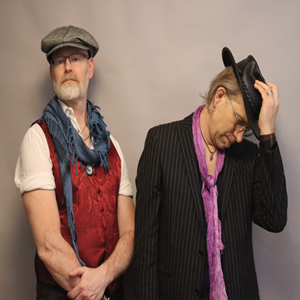
Since their formation, Swedish brothers Peter and Henrik Naglitsch have carved out a distinct space in contemporary Progressive Rock with their band Smashmallows. Known for blending hard-hitting Rock energy with intricate melodies and cinematic atmospheres, the duo has consistently challenged expectations while delivering emotionally resonant music. Their new album, “ALexia,” represents the culmination of years of exploration, a conceptually ambitious work that delves into identity, self-acceptance, and the human experience. With twelve tracks that weave a compelling narrative and showcase their versatility, Smashmallows continue to push the boundaries of neo-prog storytelling. In this interview, Peter and Henrik discuss the origins of the band, the evolution of their sound across albums, the creative process behind “ALexia,” and reflections on their journey within the Progressive Rock landscape.
Can you share the story of how Smashmallows came together? What inspired you both to start making music as a duo?
Henrik: “As brothers, we learned to play guitar together in a slightly competitive situation in our early teens. We had our first band together in the late 1980’s. Spinal Tap is a laughing mirror but it is not far from the truth and like most bands we had problems keeping members in the band and when the bass player quit, again, I picked up the bass and never put it down again. In 2004 it was just the two of us and we decided to make an album because live shows were out of the question. After finishing ‘Phonophobia’ we wanted to play it live and found keyboard player Jonas Eriksson who stuck with us and started to write songs with us. He also shared our vision of a more progressive direction of the band. Very soon drummer Peter Ladan joined and the two stayed with us through the making of ‘Square Peg in a Round Hole’ part 1-12.“
Peter: ”Unfortunately they both quit due to health issues and it was once again down to us two to ask ourselves the question of continuing as a duo or quit. Before we had decided on the future, the songs for ‘Paper Cuts and Genocide’ had starded to manifest themselves and we had no choice but to continue.”
Looking back, what were some defining moments in your early career that shaped the band’s identity?
“One early moment,” says Henrik “was when our then-singer sat with her eyes closed and, we thought, wrote vocal melodies for our latest mega smash riffing masterpiece but suddenly opened her eyes and said “I can sing the same tone all the way through that song.” [laughs!] “I think that made us realise that simplicity may be nice but it can also be bloody boring so why not add another chord and another beat and maybe not have panic if it challenges the listener a bit. Or what do you say, Peter?”
“Oh yes” Peter says. “An album that is easy to listen to the first time is often the one you forget about the fastest. The music you need to dig a little deeper into to get to know is the one that usually stick around with you for a longer time.“
How did your early releases, such as “Phonophobia” and the “Square Peg in a Round Hole” series, influence your approach to songwriting and production?
“‘Square Peg in a Round Hole’ very much evolved from improvisations. It was almost impossible to have proper rehearsals because Jonas and Peter were constantly throwing idéas at each other” laughs Henrik. “The most important thing was to always have the tape recorder rolling so great bits and pieces weren’t missed. When it started to sound like a song I went to a corner and improvised a vocal melody with nonsense words and when I was happy with it I stepped forward to the microphone to get it on tape.” “Today our music is based much more on clear musical concepts that are conceived in our respective home studios before we start working on them together” continues Peter. “In most cases I have the musical background and Henrik adds the vocal melodies but every song has a unique story.”
“ALexia” is a concept album with a deeply personal narrative. Can you walk us through the inspiration behind the story and how it evolved during the writing process?
Henrik explains that it came to him as an idéa of: “what would happen if a Hamish family had an transgender child? Would anybody notice it? From that it evolved very fast to a synopsis of a short story. What would happen if this family tries to assimilate in the western society? I showed it to Peter as the basic story for our next album. He liked it but
found it a bit repetitive so I reworked it a bit and started to create song lyrics from it. At one stage ‘Behind the plow’ had a vocal line too but I convinced Peter that it was stronger as an instrumental tune so I had to rework the lyrics a bit to fit with 11 songs instead of 12.” Peter chips in “In the beginning I had a bit of a hard time getting the complete storyline. You know, working on individual tracks gives you just a part of the story. It wasn’t until we had the full album, sequenced and ready for mixing that i did actually got the story 100%”
How do you approach blending genres—Metal, Folk-like melodies, Cinematic atmospheres—without losing coherence in the overall sound?
Peter: “I’m happy you think we manage that! [chuckles] Sometimes we ask ourselves the same question. A big part is of course Henrik’s lead vocals and adding to that his very melodic bass playing. What I do as the, may I say, main arranger, is to always try to come up with something interesting. Be it a string arrangement, a mandolin line or whatnot. It has to be interesting to listen to. But more on topic, you can trace the influences back to melodic rock from the 80’s and early 90’s. Especially in the 80’s, love it or hate it, the producers had the skills to make a track sound big. Mainly using the then new tech of the era. And that idea of making a track sound big has, to some extent, transcendent into how I try to arrange tracks.“
Tracks like “Living a Lie” and “Sound and New” are both emotionally intense yet melodically engaging. How do you strike that balance in your compositions?
Henrik: “We strongly believe in putting something big besides something small and something dirty besides something beautiful. If you deliver powerful hardcore sounds it starts to get pretty fluffy after some time. How do you recognise a beautiful flower if you don’t step in a turd every now and then? We want to present the whole spectrum of music that we like to listen to and play. The challenge can sometimes be to glue the pieces together, we believe we succeed pretty well.“
Were there any particular challenges or surprises while recording “ALexia” compared to your previous albums?
“We have got better and more daring in our arrangements but I think that we this time went a bit too far in the pre-production process”, Henrik thinks aloud. “When you are 100 % focused, as in a recording process, you can get carried away, always wanting another layer and another texture. We used an external mixing wizard for the first time, Leifi
Isberg of E.M.B. Productions, and he simply edited out some of the instruments. That was sometimes painful but always for the better.”
Peter Laughs and admits: “yeah, guilty as charged! I’m the one responsible for adding
layer upon layer of instrumentation. Leifi did do a marvelous job on handling those dense
mixes and really cleaned them up for us.”
How do you decide which stories or themes are worth exploring in your music?
Henrik: “There is always a discussion. We bring to the table the idéas and thoughts we have and decide together which stories to go through with. There is seldom a long discussion. We are usually interested in similar narratives. There is also a great deal of the power of initiative. There are very few finished lyrics that are rejected. Right” Peter inserts” for the album ‘Inner Mechanix’ I contributed some lyrics. But for this one, Henrik had this consistent and strong story to tell”
As brothers working so closely together, how do you navigate creative differences and maintain a productive workflow?
Henrik: “That is a very good question! In the past we have had a bit of a challenge here. There is no one that can piss you off as a sibling can. And there have been situations when band mates have said ‘do you two always have to be brothers?’ [laugh]. Fortunately we have learned to handle each other’s temper and, to use a non-rock’n’roll compatible word, matured.“
Peter adds: ”I would go so far to say that we have learned to use our differences to our advantages. Today we function better than ever together and are very seldom at each other’s throats. Instead we use our common experiences and taste as a common ground for the creative process. So not that much of a Gallagher-brothers situation here [laugh]”
Have there been any memorable moments in the studio or on the road that have strengthened your collaboration?
Henrik:“It may sound a little bit childish but when the number of streams on Spotify started to reach beyond mum, dad and your pals it gave us a big rush. People are listening to our music! Not millions and we can without a doubt continue our day jobs. But enough people, that we don’t know, choose to listen to OUR music. That is a major motivation.”
Peter: “Yeah, I’m a huge sucker for statistics. When you can see that a certain songs have been played tens of thousands of times, it gives me all that energy to continue and create music.”
Listening across your albums, one can hear a clear evolution in both sound and ambition. How would you describe the band’s growth from “Inner Mechanix” to “Alexia”?
“The bridges!” laughs Henrik. “The most important part of every song is the bridge. The riff, or the verse, grabs your attention. That is pretty easy, every guitar player learns that while practicing. The chorus is what makes people wanna sing along. That is also pretty simple. Most listeners want a simple hook to sing along with. But what makes you stay in the song is the bridge. A god bridge makes your hair rise on the back of your neck. I think we have really strong bridges on ‘ALexis’.” “There were actually a few discussions” adds Peter. “When I had written different bridges and wanted to use them all but Henrik wanted to cut them a bit short. I won, most of the times” grins Peter.
Are there particular songs or albums in your catalog that you feel define the “essence” of Smashmallows?
Peter: “When you are ready to release new music your head, and heart, is really in just one space: the new stuff. So I would have to pick “living a lie”, the first single release. The song has a powerful verse, very melodic and truly catchy chorus and brides. [laughs] The album version has three lengthy bridges with the song clocking in at over 8 minutes. And it still sounds fresh and interesting at the end. I would like to think that is who we are in a nutshell.”
What role do live shows play in your creative process? Do you have any tours or performances planned to support “ALexia”? How do you translate the complex, Cinematic elements of your studio recordings into a live setting?
Henrik: “We really would like to tour but we can not see that happen. To rehearse this music with a live band would be a huge task. We both hate when bands use backing tracks so that will not happen. The final resort would be to play the music as a striped down acoustic set and that does not feel very tempting. But of course, if there would come an invitation to Cruise to the edge…….”
Who are some of the artists or bands that have most influenced your musical direction, and how have these influences shaped your sound?
Peter: “There are of course numerous bands who have influenced us over the years. We grew up with heavy metal and had a few blues fanatic years. It would be ridiculous though not to mention Pink Floyd, Jethro Tull and Deep Purple but today we are very fond of bands like Sons of Apollo, VOLA and A.C.T. We actually sent A.C.T albums to Lefi as some kind of a reference for the timbre of our sound.”
How do you perceive the current Progressive Rock/Neo Prog scene, and where do you see Smashmallows within it?
Henrik: “There are a lot of great prog bands out there today and that makes us very humble. Maybe you can see a gap between the heavy metalish progband, like Nothing More and VOLA, and the dreamy melodic, almost poppy bands, like IZZ and Pain of Salvation, where we can fit in. Even if we like a heavy guitar every now and then we can’t possibly come across as metal.”
Peter: “First I think the Prog Rock scene is extremely healthy right now. I know you are supposed to hate on Spotify as an artist. But I find new, exciting music on Spotify every day. Personally I hope Smashmalows can be part of that movement. I think our strength lies in the tonal qualities and chord structures. And the melodies!”
Looking back over your 20-year career, are there any particular memories, challenges, or achievements that stand out as especially meaningful?
Peter: “Among the challenges, I would strongly put “keeping a band together”! (laughs all around). Nah! I think we are in a very good position here, writing, recording and releasing music I think we would enjoy listening to ourselves”
With “ALexia,” Smashmallows reaffirm their position as fearless storytellers in Progressive Rock, blending technical skill with emotional depth. The album’s ambitious narrative, coupled with their mastery of melodic and cinematic textures, offers a listening experience that resonates long after the final note. As Peter and Henrik continue to evolve as artists, their journey promises more innovative, thought-provoking music that challenges the boundaries of the genre while connecting profoundly with listeners.