

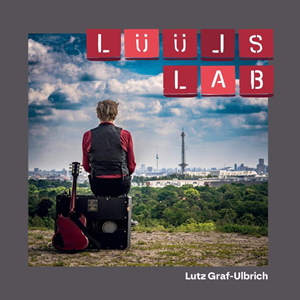
Few names resonate with the weight of history in German experimental music as profoundly as Lutz Graf-Ulbrich, known professionally as Lüül. A cornerstone of Agitation Free and a collaborator with Ash Ra Tempel, Ashra, Manuel Göttsching, and countless other innovators, Lüül has spent decades shaping the avant-garde contours of Krautrock. With his latest release, “Lüüls Lab,” he presents a fully instrumental solo album that is as much a personal exploration as it is a homage to the late Göttsching — a meditation on freedom, spontaneity, and the electric guitar in its purest form. “Lüüls Lab” unfolds across a landscape both familiar and uncharted. From the opening notes of “Morgentau” (“Morning Dew”), the listener is enveloped in an atmosphere of introspective melancholy. The track is a study in restraint and texture: Lüül’s guitar, at once gentle and commanding, weaves through a soundscape tinged with shadow and longing. The slightly dark, reflective aura of “Morgentau” is complemented by “Monolog” (“Monologue”), where the E-Bow extends the sustain of the guitar, crafting long, vocal-like lines that feel cinematic, as if composed to accompany the slow unfolding of a dream or a mythic journey. The durations of these pieces—ranging from just under five to nearly eight minutes—are perfectly calibrated, allowing ideas to breathe while maintaining a compelling narrative arc. The album’s centerpiece, “Der Wilde Ritt” (“The Wild Ride”), is a psychotropic torrent. Here, the guitar roars and writhes over a landscape of unpredictable electronic textures, capturing the exhilaration and chaos implied by its title. By contrast, “April Suite” is a serene reprieve, delicate and meditative, demonstrating Lüül’s skill at balancing intensity with tranquility. His rendition of Göttsching’s “Oasis” (originally from “Correlations,” 1979) is both respectful and transformative: the performance honors the source while infusing it with Lüül’s solo voice, blending nostalgia with innovation. “Mystical Road” ventures into exotic, Eastern-inflected melodies, illustrating the breadth of Lüül’s musical palette, while “Motion Mode” seamlessly fuses electronic experimentation with lyrical guitar lines, exemplifying the dialogue between organic and synthetic sounds that has become a hallmark of his later work. The creative philosophy behind “Lüüls Lab” is as significant as the music itself. In conversation with Progressive Rock Journal, Lüül revealed that the project was driven by the desire to “surprise myself.” Decades of collaboration and structured songwriting had shaped him, but here he sought freedom: unmediated expression, a direct channel from intuition to sound. “I had no plan, nor a structure,” he explained. “I just sat down, turned on the recording system, and began… I wanted to create my own style and was really surprised at what kind of music I was carrying in me.” Every track is the product of this instinctive process, a solo exercise in musical self-discovery, where the guitar—augmented by loops, E-Bow textures, and electronics—becomes both instrument and storyteller. Technically, Lüül embraced the challenges of working entirely alone, from composition to production. Unaccustomed to solo recording, he nonetheless navigated the studio with intuitive confidence, producing a layered, cohesive sound without external input. This autonomy amplifies the raw immediacy of the performances: there are no compromises, no concessions, only a musician in dialogue with his own impulses. The album’s sonic architecture is thus as much a testament to Lüül’s skill as it is to his vision—an intricate latticework of sound in which spontaneity and meticulous craft coexist. “Lüüls Lab” also serves as a tribute to Manuel Göttsching, whose untimely passing three years prior catalyzed the album. Tracks like “Oasis” commemorate his influence, yet the record never lapses into mere homage. Instead, it asserts Lüül’s own voice—wiry, exploratory, and profoundly emotive. In its oscillation between chaos and calm, abstraction and melody, the album encapsulates the essence of Krautrock itself: a constant interplay between structure and freedom, history and experimentation. Berlin, Lüül’s lifelong home, subtly permeates the work. Though he claims to focus inward, the city’s cultural density—the restless energy, the confluence of history and modernity—infuses the album with an ambient vibrancy, a sense of place even in fully instrumental passages. The improvisatory spirit of Berlin’s Experimental scene remains alive here, filtered through decades of experience and distilled into a uniquely personal language. In conclusion, “Lüüls Lab” is a compelling statement from a veteran whose career has continually defied categorization. It is a record that rewards deep listening, revealing new textures, motifs, and emotional currents with each play. For aficionados of Krautrock, experimental guitar, or simply music that refuses to be predictable, Lüül’s latest effort stands as both a masterclass and a revelation. It is, in every sense, a continuation of the pioneering spirit that has defined his life’s work—a bridge between legacy and innovation, past and present, spontaneity and deliberate artistry.
Tracklist
01. Sad and Hopeful
02. Motion Mode
03. The Wild Ride
04. Oasis
05. Morning dew
06. monologue
07. April Suite
08. Mystical Road
Lineup
Lüül / Electric Guitars, E-bow, Sounds, Keyboards, Grooves
“Lüüls Lab” can order the CD through Spheric Music Shop
Read our Exclusive Interview here: [Interview] Lüül – An Exclusive Conversation with a Krautrock Pioneer