

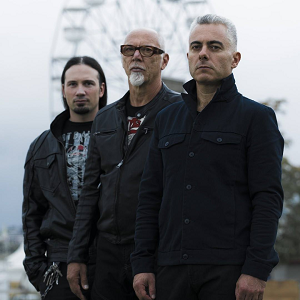
Progressive Rock Journal is proud to feature Aerostation’s latest album, “Rethink,” released worldwide on September 19, 2025 via Independent Artist Records. Following their 2018 debut, the Italian power trio returns with a remarkable collection of eleven tracks that blend Crossover Prog, Heavy Prog, Alt-Rock, and Electronic-Rock, demonstrating a compelling fusion of technical prowess, melody, and visual-driven storytelling. The band, consisting of Alex Carpani (lead/back vocals, keytar, arrangements, production), Gigi Cavalli Cocchi (drums, electronic pad, graphic design), and Jacopo Rossi (bass), explores themes of rebirth, transformation, human emotion, and the search for freedom. With a
meticulously crafted digipak, 16-page booklet, and immersive soundscapes, “Rethink” invites listeners to experience a story as much as an album.
To delve deeper into the creative process behind “Rethink,” Progressive Rock Journal presents the following interview questions for the band:
What inspired the concept of “Rethink,” and how does it build on your debut album?
Musically speaking we wanted to make an album that was in a certain sense the continuation, but also the evolution of the style of the first album “Aerostation.” “Rethink” contains rock songs, despite being a concept album overall, and each song is very direct, with engaging melodies and rhythms. We wanted to make something very “dry,” with few frills, even with a bit of hard rock character, where the band’s sound, which is now very recognizable, would emerge. “Aerostation” was, instead, an album more focused on recreating the atmosphere of space adventure, of exploration, so even the sound here and there brought with it a series of sound effects linked to that context. In “Rethink” we are not talking about humanity conquering space, but about the single individual who tries to find himself, to start over, rethinking everything about his life and hence the title of the album.
How did you approach expressing themes of change, renewal, and human emotion through music?
Especially through the lyrics, which describe events, emotions, and characters, which are deliberately not overly described or identified, because everything must remain on an ideal level: everyone must be able to identify with them. Music is the vehicle, in short, the engine of the narrative, accelerating and slowing down depending on the moment.
Can you describe your collaboration process in composing and arranging the album?
During writing, arranging, and pre-production, I work mostly alone, writing and outlining the parts for all the instruments (that’s my way of working), after which we all evaluate together whether a song can or cannot be included in the album we’re working on. Then we move on to the next phase, in which Gigi and Jacopo delve deeply into their parts, reworking them where necessary, and adding their touch, their sensitivity—in short, their signature.
How do you balance electronic elements with traditional Progressive and Hard Rock influences?
We try to strike a balance between the three elements you mentioned, which distinguish our style, even if there’s perhaps little traditional progressive in it. Everything must serve the project as a whole, its stylistic coherence and sound. Aerostation now has a recognizable sound, and this is achieved through production, where we try to never lose sight of the goal.
Alex, you perform all lead guitar parts through your keytar. How did this approach shape the album’s sonic identity and the trio’s overall sound?
The keytar is sort of the fulcrum of our entire sound because the parts I play were conceived and written from the start with a guitar-based approach: there are no piano or Hammond parts on the Aerostation albums, because my role is not that of a keyboard player on this project. Here, my role is much more fluid (only here, mind you, not in real life… just kidding!): my parts blend the guitar and synth parts through elaborate sounds I’ve created, with an at-times acidic, distorted, and liquid character, positioning themselves halfway between the two instruments, without one dominating the other. This has been the band’s hallmark, right from the start.
Gigi, how do you approach combining technical drumming with emotional expression?
It all stems from an artistic and philosophical symbiosis with Alex. We met many years ago in the prog scene, each with our own projects—I was with Mangala Vallis and he with the Alex Carpani Band—and we agreed on a particular vision of music. So, after an initial experience where I played on his album The Sanctuary, and a subsequent one where I accompanied him live, we realized the time had come to join forces for a new sonic universe, one that would fully represent us and that focused on a personal vision of songwriting, a “non-place” where we could create a sound that would synthesise our backgrounds, but above all, our new take on the term crossover. From then on, everything felt very natural, so very spontaneously, I immerse myself in the sonic worlds Alex describes and the rhythms flow like a raging river. Alex, already at the audition stage, is able to create very focused takes that allow me to draw on my wealth of
experience in a very creative way, where technique is always at the service of emotion, so from the first listens the possible rhythmic scenarios come together in my mind.
Jacopo, how did your bass work contribute to the band’s unique sound?
I think the trick is to incorporate my personal vision of the electric bass into the songs without asking myself what someone else would expect from a bassist in that context. My style is simply a reworking of the peculiarities of the bassists who have most impressed me throughout life, a dynamic shared by many musicians, but what I think makes the
difference when I write bass lines is that I let my composing and arranging side, which I’ve developed in other contexts, run parallel to my bass style.
Were specific emotions or narrative moments considered during the composition of individual tracks?
I usually write the lyrics after the music, and until they’re written, I use invented words, which sound like “English” but have no semantic meaning. This helps me get closer to the final result and also creates phonetic assonances between the music and the lyrics, which are often maintained even when the final lyrics replace the invented words. When I’m working on the lyrics and, therefore, the story, I have the advantage of already having the music available, and this helps me describe the emotions and narrative moments, to answer your initial question.
How did the recording, mixing, and mastering process at Bagnoli Bros Studio influence the final sound?
That’s a great question. The final sound, and therefore the end result, is always the sum of many phases, elements, and choices made throughout the various processes: from the initial writing to the final mastering. If every phase has been meticulously crafted and carefully planned, the final result will highlight what was achieved. If something doesn’t quite work, however, the final mix and mastering can’t work miracles, so flaws may be masked, but they won’t disappear. In our case, the working method with Daniele Bagnoli in his studio is always the same and works very well: when the album is ready to begin recording, everything is already at a fairly advanced stage. There’s a fairly clear and well-defined pre-production process that already gives an idea of what the final sound will be; all the parts are already written and arranged. The studio work mainly involves recording the drums and vocals, while Jacopo records the bass in his studio. The real added value that greatly contributes to the final result is Daniele’s skill, with
whom we’ve developed a collaboration and mutual understanding over the years, allowing us to work very well and very quickly. He knows exactly what we want, and I know exactly what he wants from me, at the pre-production level, before we even enter the studio.
Visuals play a central role in “Rethink.” How do artwork and graphic design enhance the listener’s experience?
The visual aspect has always been another aspect we’ve been particularly sensitive to. It’s likely a legacy we’ve carried with us since the 1970s, when records, seen as a medium, but also the performances of bands that often relied on film and stagecraft, played an important role. Thus, many of the artists we loved and the albums they made became one. And so, Pink Floyd’s prism on a black background, like King Crimson’s scream of the schizoid man, or the Velvet Underground’s banana, took on a much deeper meaning than one might have expected, becoming for many the gateway to a universe of
indelible emotions, which only the sight of those images could reawaken.
How were singles like “Drive My Soul” and “Run As The Sun Goes Down” chosen for release?
Look, for this album, like the first, we decided to perform the music live before the album was even released, and this allowed us to gather the audience’s feedback. We noticed that these two songs, in particular, had an immediate impact on the audience, so wedecided to make them the album’s singles. Then the lyric videos we made, which were by Gigi, helped enhance them, since our music, as has always been said, is very descriptive and visionary and pairs naturally with the visuals.
How important is the physical digipak format and booklet for conveying the album’s concept?
Although physical media no longer enjoys the popularity it once did (to put it mildly), we remain convinced that giving physicality to your work, when it comes to music, ennobles it and gives it importance. Digipacks, like vinyl, represent, thanks to the content they can contain—from graphics to lyrics to other detailed information—a true tool that, along with
concerts, completes the great gesture of love that lies behind the conception and creation of an album. Finally, they take on extraordinary symbolic importance. The fact that a listener or music enthusiast decides to purchase your work on physical media is a testament to their attachment to your project; it’s a piece of you becoming part of someone else’s life. It’s no small gesture.
Did any tracks evolve unexpectedly during production, and how did you adapt to those changes?
We’ll tell you something no one knows yet: this album actually had a very troubled genesis because many years passed between the initial writing (2018) and the mastering (2024). During this time, among other things, both Gigi and I worked on other projects: he released an album with Mangala Vallis and I released three albums as Alex Carpani. So, let’s say that after the initial writing, we left it a bit there, on the sidelines. Why am I telling you this? Because the entire album has actually been reworked and rearranged over the years, for various reasons, so none of the songs were released in their original form. I think I made something like 10 different versions of the album, each with slightly different characteristics and styles. It was an experiment, a search, until the right version came out, one that had all the characteristics we were looking for and brought us back to what we love most: rock, even hard at times, with very direct melodies and choruses and no virtuosic deviations. I think it was worth waiting all this time, waiting for the album to take shape, without rushing to release it at all costs. Time has helped and allowed us to see things more clearly along the way.
Are there musical or lyrical motifs that unify the album conceptually?
We believe that, for the reasons we’ve already explained, what unites the album’s songs, both musically and lyrically, is their dry, direct nature and their ability to appeal to the heart and soul. This album doesn’t leave you indifferent: it stirs something inside you, speaks to you sincerely and without trying to attract your attention with pirouettes and sleight of hand. The drums, bass, vocals, and the sonic mass of the keytar are a single body that takes you by the hand and leads you on a little journey through your mind and emotions.
Do you envision the album being experienced as a narrative journey, a series of standalone songs, or both?
I think the album is both because overall it’s a cohesive narrative and speaks of this change, of the desire to rethink everything from the beginning. At the same time, however, each song can become a story in itself, because it doesn’t need the other songs that come before or after it to have meaning or be narratively complete. Each song, in short, is a micro-story within a larger story.
What do you hope listeners feel or take away after experiencing “Rethink“?
First and foremost, we hope that listeners will experience a beautiful, satisfying feeling after listening to the album, and that they’ll want to listen to it again. The initial satisfaction should be physical, emotional, even before it’s mental. Subsequent listens will allow them to delve deeper into other aspects, more conceptual or more closely tied to the lyrics, the narrative, and the “world” we wanted to describe in Rethink. Naturally, this is our hope; the audience will then decide whether this can happen or not. We can tell you that at the moment, fortunately, everything is going according to plan, and we can see this both from the audience reaction to the concerts we’ve performed in Italy and abroad, and from the sales and reviews we’ve received so far.
Progressive Rock Journal thanks Aerostation for their collaboration and for allowing readers an exclusive insight into the making of “Rethink.” With its fusion of genres, emotive storytelling, and striking visuals, the album stands as a testament to the trio’s creative vision and technical mastery.
We thank you and Progressive Rock Journal for this wonderful interview, which allowed us to delve deeply into the mechanisms that led to the birth, development, and publication of this project. It’s thanks to intelligent and insightful questions like these that we have the opportunity to discuss what we do in a way that’s not superficial, but authentic and comprehensive.
Purchase “Rethink” on Bandcamp: https://aerostation.bandcamp.com/album/rethink