

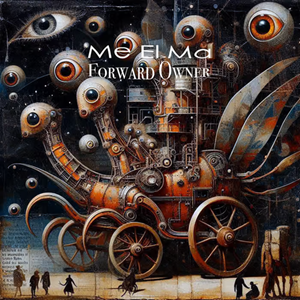
Me El-Ma does not introduce himself with biographical preamble. Forward Owner, released independently on March 8, 2026, announces its intentions through the music alone — eight compositions of structural density and compositional rigour that require no contextual scaffolding to assert their weight. That the record was conceived, performed, recorded, and produced entirely by a single individual makes the achievement more pointed, not merely impressive: this is the work of someone who has spent decades understanding what Progressive music demands, and who has chosen to meet those demands without compromise or mediation. The name Me El-Ma carries its own history for those familiar with the deeper strata of 1970s Israeli Prog. As the drummer of Atmosphera — whose 1976 debut remains one of the more remarkable artifacts of that era’s international underground — he brought both technical precision and compositional instinct to a band operating at a considerable remove from the European centers of the genre’s development. Decades followed: professional studio and live work across the Israeli scene, a period in Germany, a return, and eventually — in 2018 — the first recorded statement under his own name. “Forward Owner” is the continuation and, in several respects, the culmination of that arc. The sole vocal contributions come from VIRJA, whose presence across several tracks provides a human melodic axis within an otherwise entirely self-constructed sound world. The album opens with “My Life is Based on a True Story,” a track that announces its intentions without hesitation. Polyrhythmic frameworks underpin a compositional architecture of genuine sophistication: in the first half, traditional rhythmic patterns are gradually destabilized, introduced into an increasingly complex web of interlocking layers. The drumming — precise and expressive in equal measure — drives a thematic development that favors accumulation over abrupt rupture, building through measured crescendi toward passages of considerable intensity. A violin enters midway, introducing a Folk inflection that briefly grounds the piece in a more organic, human sensibility before the music accelerates back into technical territory. The coexistence of tradition and modern Progressive construction here is handled with the confidence of an artist who has long since internalized both. “Learn from the Heart” navigates a more eclectic terrain. Oriental melodic and rhythmic elements are integrated with electric guitar interjections and a drumming enriched by additional percussion in a manner that never feels superficial or decorative. The cultural dialogue at work is one of genuine structural integration: the non-Western influences are not applied as surface texture but function as compositional constituents, shaping the harmonic and rhythmic logic of the piece from within. VIRJA‘s vocal delivery emerges here with particular impact — a performance of genuine pathos that recalls certain moments in the Avant-Prog tradition, not least in its capacity to inhabit melodic lines with a quality of emotional specificity rare in this genre. The track concludes with a piano passage of considerable refinement, its restraint a deliberate and effective contrast to what precedes it. “Creativity War” is the album’s most ambitious single statement. As the longest track, it bears the structural weight that such a position demands, and it does so convincingly. It opens in a register of deliberate darkness: keyboard textures establish a brooding atmosphere over a rhythmic framework of considerable complexity, and the drumming immediately communicates the physical and intellectual force at the core of Me El-Ma‘s musical identity. What unfolds over the following minutes is a composition of layered intelligence — Jazzy inflections, Experimental keyboard and guitar passages, a rhythmic section in perpetual, disciplined motion. The harmonic trajectory draws the music progressively toward a sonic territory adjacent to Zeuhl, that forbidding and seductive idiom pioneered by Magma, characterized by dense rhythmic drive, modal harmonic language, and an almost ritualistic sense of collective momentum. Solo interjections across keyboards, guitar, and additional instruments are integrated organically rather than inserted as technical interruptions, each contributing a further dimension to an already dense compositional fabric. The title-track, “Forward Owner,” functions as an interior pause of deliberate economy. Acoustic guitar and violin interweave in a duet of understated beauty, with choral elements appearing in the central section before receding. The melodic material draws simultaneously on Jazzy phrasing and Folk-derived melodic contour, while the acoustic guitar arpeggios are executed with a technique that makes even this brief piece feel fully realized rather than transitional. At under three minutes, the track demonstrates that compositional concision, when exercised with confidence, can be as expressive as extended development. “Deeper Die” reasserts the record’s rhythmic identity with particular authority. The drumming here is foregrounded in a manner that communicates both technical mastery and musical intention — time changes, accelerations, and passages of focused polyrhythmic complexity are deployed not as displays of virtuosity but as structural logic, the engine driving the melodic and harmonic material above them. Keyboard and guitar lines develop in close relationship to this rhythmic underpinning, while VIRJA‘s vocal contributions carry distinct echoes of the Classic Prog tradition — a lineage that Me El-Ma, as a contemporary of that era, inhabits with natural authority rather than studied imitation. The second half of the track opens outward into Experimental territory, with keyboard textures and electronic effects ceding space to a violin solo of genuine refinement. “Tabula Rasa” is among the most dynamically concentrated pieces on the record. A frantic rhythmic pulse anchors an intricate web of Jazz-derived melodic phrasing — a combination that places the track decisively within the Jazz Prog and Avant-Garde axis while maintaining the compositional rigor that characterizes the album as a whole. Hypnotic melodic lines accumulate over shifting time signatures in a manner that demands attentive listening, rewarding it with a structural density that gradually reveals itself across the full arc of the track. The closing passage incorporates Heavy drumming with vocal and brass textures, a convergence of modern and vintage timbres executed with deliberate compositional logic rather than eclecticism for its own sake. “The tail tells you the tale” returns to the darker, more atmospheric register established on “Creativity War,” though with a greater emphasis on textural elaboration. Complex arpeggiated figures and the vocal opening give way to an extended instrumental development in which violin, guitar, and keyboards conduct a three-way dialogue of considerable sophistication. The Avant-Prog orientation here is pronounced, and the violin contributions carry explicit associations with earlier Prog traditions — associations that feel earned rather than nostalgic, arising naturally from the logic of the composition. The underlying groove, dense and propulsive, unifies what might otherwise resolve into disparate episodes, maintaining the tension between the track’s multiple expressive registers across its full duration. The closing track, “Cheese for Free You get only in a Mousetrap,” opens with a piano introduction of formal clarity before expanding into a concentrated summation of the album’s principal concerns. Jazz, Avant-Prog, and vocal and instrumental experimentation converge in a passage of sustained compositional ambition. Polyrhythms and continuous time shifts drive the music through thematic developments that move fluidly between pure Experimentation and Zeuhl-adjacent territory, with the drumming — characteristically central — navigating the most sophisticated Jazz-inflected passages of the entire record with equal measures of precision and expressive force. All instruments participate in developments of the central material, creating a final ten minutes that consolidates, without simply reiterating, the artistic logic of everything that precedes it. “Forward Owner” is a work of considerable weight and singular identity. It draws on nearly five decades of musical knowledge — from the Prog underground of 1970s Israel to decades of studio and live experience across continents — without resolving into mere retrospective. Me El-Ma has constructed a record in which Avant-Prog structural discipline, Jazz Prog harmonic intelligence, Folk-derived melodic sensibility, and Zeuhl-inflected rhythmic force coexist within a compositional language that is, unmistakably, his own. That he has realized this vision entirely alone, producing every element of the work with the control and precision of an experienced composer, engineer, and performer, makes the achievement more remarkable rather than less. For those willing to engage with Progressive music at its most uncompromising and self-directed, this album offers an experience of corresponding depth.
Tracklist
01. My Life is Based on a True Story (04:38)
02. Learn from the Heart (05:08)
03. Creativity War (07:26)
04. Forward Owner (02:59)
05. Deeper Die (05:09)
06. Tabula Rasa (05:05)
07. The tail tells you the tale (05:25)
08. Cheese for Free You get only in a Mousetrap (06:28)
Credits
Album Produced by Me El-Ma
(Compositions & Lyrics, Arrangements, Programming,
Performance, Recording, Mix & Mastering, Cover design & more)
Singing by: VIRJA
[…] Israeli drummer-turned-visionary Me El-Ma returns with “Forward Owner,” his latest journey into the labyrinthine corridors of Avant-Prog and eclectic Rock. Eight tracks, 42 minutes, and a relentless refusal to follow any predictable path — from the dissonant tension of “Creativity War” to the absurdist poetry of “Cheese for Free You Get Only in a Mousetrap,” this is music that demands engagement. A singular voice from the Israeli scene, and proof that true originality still exists at the margins. [Read the full review] […]
[…] [REVIEW] […]