

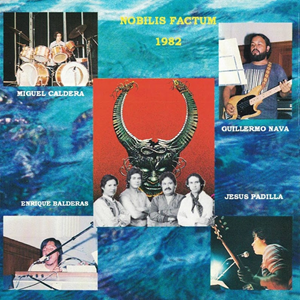
Mexico City, Mexico, 1980. For the average European Progressive Rock listener, Mexico has long remained a blind spot on the map of the great sonic currents of the twentieth century. Yet, beneath the surface of dominant narratives, a vibrant scene was forging a unique identity amid the wreckage of political repression and the indifference of major labels. In this landscape of buried sounds, Nobilis Factum and their sole recorded testament, “Mutante” (1982), represent not merely a collector’s item for completists, but a poetic document of an era in which making “different” music in Mexico was an act of pure cultural resistance — a quiet insurrection pressed into vinyl.
— The Ghost of Paradise: The Death and Rebirth of Mexican Rock —
To understand the expressive urgency behind Nobilis Factum, one must first summon what journalist Víctor Roura famously called the “Fantasma del Paraíso” — the Ghost of Paradise — that spectral presence haunting the entire history of Mexican rock.
From its earliest days in the late 1950s, Mexican Rock was manufactured as a disposable consumer product: emptied of any artistic ambition by television and radio networks that imposed non-threatening models on a young, impressionable audience. The music was neutered by design. But the definitive fracture came in 1968, when tanks crushed the student movement at Tlatelolco. While blood stained the Plaza de las Tres Culturas, the Rock musicians of the era remained largely indifferent, far more preoccupied with dissecting the latest Led Zeppelin tour than engaging with the tragedy unfolding around them.
The fatal blow arrived three years later, with the Avándaro Festival of 1971. What was meant to be Mexico’s answer to Woodstock became instead the pretext for authorities to effectively ban rock music from official media. Musicians were driven into the margins — into the hoyos fonquis (Funky holes), abandoned warehouses and basement venues where music barely survived in conditions of studied neglect. Throughout this decade of enforced silence, Mexican rock became a distant language, stubbornly clinging to English lyrics and losing its capacity to speak to its own society.
Only toward the end of the 1970s and the dawn of the 1980s did a third phase begin to emerge: an authentically Mexican Rock, one that abandoned English for Spanish and actively searched for new expressive territory. The Ghost of Paradise was stirring once more.
— The Flowering of Mexican Prog: The Dawn of the 1980s —
Paradoxically, while in Europe and North America classic progressive rock was yielding to New Wave, in Mexico the genre was experiencing its artistic climax precisely in the early 1980s. This period was defined by a proliferation of independent labels — the only viable alternative to the stranglehold of the television monopoly. Bands like Chac Mool led the way with albums such as “Nadie en especial” (1980), bringing the genre to a wider audience despite occasionally naïve lyrics.
Within this ferment, extraordinary realities took shape: the visionary Flüght with their eponymous 1982 masterpiece, a stunning exercise in virtuosity bridging Krautrock and baroque forms; the Jazz-Rock explorers of the High Fidelity Orchestra; and the experimental Nazca, whose influence drew from darker, more innovative sonic territories. It was into this context of awakening that Nobilis Factum stepped — joining a cohort of musicians who had grasped, as they themselves put it, that there were “other possibilities for doing things, and doing them well.”
The stakes were not merely aesthetic. To create art-music in early 1980s Mexico was to operate against the inertia of a cultural apparatus that had spent a decade systematically suppressing the very idea that Mexican Rock could carry intellectual weight. That Nobilis Factum managed to produce something as architecturally refined as “Mutante” under these conditions is, in retrospect, nothing short of remarkable.
— Nobilis Factum: The Laboratory of Mutant Symphonism —
Founded in 1980 initially as a composition workshop, Nobilis Factum distinguished themselves immediately through a rigorous, almost academic approach to their craft. They performed regularly at universities and casas de cultura — cultural centres — positioning themselves as a serious artistic proposition rather than a commercial one from the very outset.
Their most striking technical peculiarity — utterly unique for the period and geography — lay in the fact that all four members played synthesizers, dividing roles between their respective primary instruments and an arsenal of analogue keyboards. This created a sound of unusual depth and density: not one synthesizer voice coloring the mix, but four, each carrying its own melodic or textural responsibility.
The lineup reads like a manifesto of collective synthesis:
Enrique Balderas Rodríguez handled piano, Mini Korg synthesizer and vocals — the melodic and harmonic anchor of the ensemble.
Jesús Padilla Lechuga played guitar alongside the Korg MS-20 and ARP Omni, bridging the band’s acoustic and electronic dimensions.
Guillermo Nava Cerda covered bass and Ovation guitar as well as the Korg MS-20, providing both rhythmic foundation and compositional architecture — his role in the album’s most ambitious pieces is fundamental.
Miguel Caldera Moreno operated behind the drum kit and percussions while simultaneously commanding a formidable array of synthesizers: the Mini Korg, the ARP Omni and the Korg MS-20 — a configuration that made him one of the most electronically empowered drummers in Mexican rock history.
The band’s declared ambition, as articulated in their press communications of the era, was to “disintegrate the cobwebs of our minds” and combat what they called “patrioterismo ñoño” — a shallow nationalism that viewed rock as a corrupting foreign demon rather than a legitimate vehicle for Mexican creative expression. Their synthesizer-heavy sound was not a concession to modernity but a statement: Mexico could master the same technological vocabulary as any European or North American ensemble, and deploy it with equal, perhaps greater, emotional intelligence.
— Mutante (1982): An Analysis of the Work —
Released on the independent label Pentagrama — a small company dedicated to avant-garde talent — “Mutante” is a fresco of symphonic rock whose production quality stands as exceptional by any local standard of the era. The album was produced by Modesto López, who succeeded in capturing a sound that wove together the magniloquence of Emerson, Lake & Palmer with the romantic and melancholic atmospheres characteristic of the best Latin American Progressive Rock. What López achieved was not a copy of European models but a genuine synthesis: familiar in its ambition, unmistakably its own in texture and temperament.
“Obertura” opens the album as a programmatic manifesto: a cascade of keyboards and classically-inflected structures that immediately establish the virtuosity of Enrique Balderas as the first principle of the record. It is a statement of intent — baroque in architecture, utterly contemporary in execution.
“Me gusta cuando callas” is where the band performs its most profound act of cultural synthesis, setting to music the celebrated “Poem No. 15” by Pablo Neruda — music composed by Guillermo Nava. In this track, the acoustic guitar assumes a primary role, weaving lines that evoke the tonal palette of Camel‘s “Moonmadness,” while the vocal harmonies dissolve into an ethereal, suspended beauty. It is the album’s most intimate moment, and one of the most quietly devastating.
“Quetzalcoatl” represents the band’s engagement with Mexico’s mythological identity — but this is no superficial patriotism. The integration of pre-Columbian imagery is woven into a genuinely modern musical context, where Latin percussion provides an unmistakable cultural signature without reducing the track to pastiche. The lyrics contribute an intellectual dimension that elevates the piece beyond mere symbolism.
“Mutante” — the title-track — places the synthesizers firmly at the compositional centre, building to splendid textural climaxes that by the midpoint of the album have already confirmed the record as something exceptional. The Progressive layering of keyboard voices achieves a density that few four-piece ensembles of the period, anywhere in the world, managed to sustain with such structural coherence.
The second side opens with “Armónicos en crisol” — a piece that originally earned recognition at the Jazz Competition of the Universidad Autónoma Metropolitana, a fact that speaks volumes about the band’s compositional credibility beyond the rock circuit. The track opens with a fresh, lucid electric piano before its contours expand into jazz-tinged territory, generating a swirl of keyboards over which a taut, combative guitar cuts through with decisive energy.
The album closes with “Suite natural para ella” — a composition whose deliberate simplicity allows the ensemble’s melodic sensitivity to surface without obstruction. It is an act of restraint after the album’s more ambitious constructions, and all the more affecting for it. The quartet demonstrates here that their command of texture is matched by an equal command of space.
— A Legacy in the Shadows —
Despite the crystalline quality of “Mutante,” Nobilis Factum remained crushed under the weight of insufficient major-label support and the dramatically limited distribution infrastructure that had plagued Mexican Progressive Rock throughout the preceding decade. The album circulated in small quantities — a private issue in the fullest sense — its audience confined largely to university circles and the small but passionate community of Mexican prog enthusiasts.
Today, “Mutante” is considered a pillar of Mexican Rock: a record that has aged with genuine dignity and that brought a particular lustre to national music at a moment of near-total media blackout. The album received a single official CD reissue, released by Pentagrama in 1997, which included “Visión de triunfo” as a bonus track — the only format in which this additional composition has ever appeared. Since then, no further reissue — official or unofficial — has materialised. The original 1982 LP and the 1997 CD remain the only legitimate documents of Nobilis Factum‘s existence on record, making both increasingly difficult to locate and, when found, increasingly expensive.
The band’s silence after “Mutante” was never fully explained in the public record. Like so many of their Latin American contemporaries — from Argentina’s extraordinary RPI scene to Brazil’s Som Livre-era Experimentalists — they simply dissolved back into the city, their music outlasting the moment that made it possible. No second album. No archival recordings. No reunion. Just the record, and the questions it leaves unanswered.
To rediscover Nobilis Factum today is to do justice to that Ghost of Paradise — the spectral presence that, despite decades of attempted censorship and institutional indifference, never ceased to drift through the best Progressive Rock Mexico ever produced.
“Mutante” is not a curiosity. It is evidence.
— Lineup —
Enrique Balderas Rodríguez / Piano, Mini Korg Synthesizer, Vocals
Jesús Padilla Lechuga / Guitar, Korg MS-20, ARP Omni, Vocals
Guillermo Nava Cerda / Bass, Ovation Guitar, Korg MS-20, Vocals
Miguel Caldera Moreno / Drums, Percussion, Mini Korg, ARP Omni, Korg MS-20, Vocals
— Discography —
(1982) — “Mutante” — [Pentagrama, LP, Cassette]
(1997) — “Mutante” — [Pentagrama CD reissue — sole reissue to date, includes bonus track “Visión de triunfo“]