

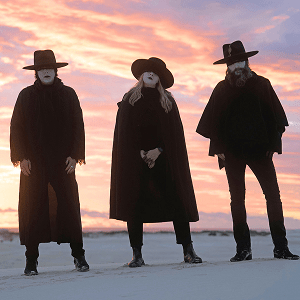
From the sun-scorched “cultural wastelands” of Brisbane, Australia, emerges Holystone, a trio that has rapidly ascended the ranks of the international heavy underground. Following the critical acclaim of their 2024 debut, “East of the Sun, West of the Moon,” the band has shed the “Psychedelic warmth” of their origins to embrace a more visceral, existential darkness. Their sophomore effort, ”Accepting Omega“ — recorded alongside legendary producers Jack Endino and Dave Catching — is not merely an album, but a ritualistic exploration of the apocalypse. We sit down with the band to discuss their evolution from Occult-tinged Psych-Rock to the crushing, character-driven Doom that defines their latest self-released masterwork.
Holystone is comprised of members with “substantial musical histories” and prior international experience. How did these diverse backgrounds coalesce into the specific, ritualistic vision of this band?
Jonny, Madi and I have been playing music together in an array of different bands over the last 10-15 years. I think our experience brings a large amount of tightness to our live shows and sound in both knowing what we should do and having done it together for so long. The HOLYSTONE vision feels concise and singular to us and we push hard toward it, this clarity isn’t always easy to achieve and I feel our experience helps us here.
Your debut, “East of the Sun, West of the Moon,” was noted for its vintage tones and occult themes. What was the primary catalyst for the “darker and heavier evolution” we hear on “Accepting Omega”?
There is a simplistic nature to the songs on East of The Sun, we noticed that when we were writing it and doubled down on it. The more complicated and heavy ideas we put to the side and that is what lead to Accepting Omega. We also grew up listening to bands who tended to get heavier as they evolved and we could see ourselves on that path. That said we are not sure which direction album 3 will be, maybe a bit of both?
The new record trades Psychedelic warmth for something “unnerving and existential.” Was this shift a conscious reaction to the current global climate, or an organic internal progression?
Yes absolutely. The music was already mostly there, except Prophecy, Oracle and Cavitation which were written just before recording. The lyrics slowly emerged out of a dark few years and world events, and what was coming out was very bleak, so yet again we doubled down on it and developed it around the concept that the ‘world is going to end and thank god for that’. Once we had that mindset we finished the lyrics quite quickly.
You recorded portions of the album with Jack Endino in Seattle, even using the guitar amp Kurt Cobain used on “Bleach.” How did that specific piece of history influence the “Alt-Heavy” grit of the new tracks?
Jack Endino was amazing to work with, his drum sound was the best I have ever heard and the tone he pulled on the guitars was ripping. The sounds he pulled ended up very similar to the end result. Kurt borrowed Jack’s fender twin amp for the Bleach era recordings and he still has it. It was a small part of the reason we chose him. You can hear it clearly on 3 of the songs, including using a Doss DS1 with it because…. you got to! We tracked that amp and my usual setup. I think you mostly hear the Bleach amp in songs like Prophecy, Cavitation and Procession.
On the other hand, you worked with Dave Catching at the legendary Rancho De La Luna. How did the desert environment contrast with the Seattle sessions in terms of the record’s atmospheric DNA?
After Seattle we drove down through the western desert to work with Dave. We have worked with him before and we can’t wait to work with him again. Most recording studios are windowless world eaters, but Rancho is a small house right in the desert and it feels open and a part of it. It is an inspiring place but it is Dave who makes the sessions special.
“Accepting Omega” marks a significant change with Madi Morris sharing vocal duties. How has this dual-vocal dynamic altered your approach to songwriting and storytelling?
Yeah it changed it straight away. Madi and I have been singing together for years and I love the way our voices lock together. As soon as she joined the band she started writing and singing harmonies, and we ended up writing many of the lyrics together – which can be hard thing to do with some people, both parties need an open mind and thick skin.
The album centres around a figure known as Omega. Could you elaborate on the origins of this character and how she serves as both a “guide and catalyst” for the end of the world?
Omega was born from the lyrics of Guided by Stones, in which she outlines her own role and promise to the world. After that was written it was clear that this character is the ‘One’ – an anti-saviour for all and a catalyst for us to build the rest of the album. She is there throughout the album listening to other characters and offering peace in the unavoidable end of the human experiment.
You’ve described the tracks as reflecting eight standalone characters experiencing the apocalypse. How did you go about crafting these fragmented perspectives to ensure they felt like a cohesive narrative?
The seed of each character is either in ourselves or someone we know. We considered writing a traditional three-act story, but those kinds of concept albums often compromise a traditional song listening experience, so we settled on vignettes of separate characters experiencing the same world. I feel this results in the songs working by themselves and as a whole concept.
Themes of anxiety, depression, and the collapse of the modern world permeate the lyrics. Is the act of “Accepting Omega” meant to be a form of nihilistic surrender or a ritualistic liberation?
Nihilistic Surrender. God I wish I had thought of that. Can we use that? It said there is peace in letting go – Accepting Omega pushes that as far as it can.
Your live performances involve performing blindfolded in ceremonial attire. What is the psychological intent behind this aesthetic choice for both the band and the audience? How does the “ritualistic and deeply unsettling” nature of your live show translate the complex world-building of the studio recordings into a physical space?
All our musical and aesthetic choices are designed to create an eerie or even supernatural feeling and we have lent into that much more with Accepting Omega. We see our roles as prophets of the story and the Omega message and try to deliver that as much as we can live, while also trying to nail these difficult songs.
Having shared stages with icons like the Brant Bjork Trio and Yawning Man, how have these experiences with Desert Rock royalty shaped your own “repetitive Desert-Rock rhythms“?
Both bands are great and we enjoyed the shows. The biggest influence is we just bought the same bass amp Mario Lalli used as it sounded great as was small.
The album features a mix of tracks recorded in different locations—for instance, “The Prophecy” in Seattle and “Guided by Stones” at Rancho. How did you ensure a unified sonic identity despite the geographic spread?
We recorded the vocals at home and re-tracked a couple of extra guitar bits, other than that all the magic was in the hands of Mike Deslandes who mixed the album in Melbourne. In the rough mixes that I made the two studios differences were more apparent, mostly in the drums. He really brought it all together.
Mike Deslandes mixed the record and Matt Bartlem mastered it, with specific adjustments made for the vinyl dynamics. How involved was the band in the technical nuances of the post-production phase?
I am an engineer/producer myself but I try not to mix the bands I am in because it can quickly become endless and overwhelming. Mike Deslandes has some amazing heavy albums under his belt so we reached out to him. We had a specific vision for how the album was to sound, after a few iterations of one song Mike nailed it. We are so glad we worked with him. Matt Bartlem is a genius and he gets right to the heart of the song. Most mastering engineers don’t improve the song but he finds a way. Top blokes and they brought a lot to the end result.
You’ve chosen to self-release this album. In the current industry landscape, what are the primary advantages—and challenges—of maintaining total independence for a band of your scale?
The biggest advantage is we are on our own timetable and we keep all the money. The downside is we have to do all the work and for what we are trying to achieve it is a huge amount of work. We are still just starting to emerge as a band and maybe we will end up finding a cool team to help us along the way.
The vinyl edition is a “red regrind” pressed by Suitcase Records in your hometown of Brisbane. How important is it for you to keep the physical production of your art rooted in your local community?
It became very important after meeting the Suitcase Records crew. They are lovely and deserve every success. Importantly for us the price is competitive as well. It was really fun visiting the plant when East of The Sun was being pressed and a cool feeling to drive across town and pick up our records.
The track “Lived Too Long” was recorded at Rancho De La Luna but remains a bonus track because it “couldn’t fit on the album.” What was the criteria for the final tracklist in maintaining the record’s conceptual flow?
The main riff in ‘Lived Too Long’ was written by the time we got to Rancho but everything else music wise was written and recorded in three takes in the live room. We kept the structure simple and very ‘desert’ rock and we really just followed each other in the room. The lyrics Madi and I wrote when home in Brisbane. Thematically it is another character’s perspective in the Omega world (a drunken musician) but the song was obviously the odd one out on the album and we had to cut one to make it fit on a 40 min vinyl. It still was a bit sad to let go of. Maybe we will release it later.
Looking at July 17th, where does Holystone go once the apocalypse of “Accepting Omega” has been fully realized? Is there life—or music—after the end of the world?
This question has been bothering me lately! – what art do you make after you’ve ended the world? We have a handful of ideas we are working on. At this stage it may be a mixture of more technical metal and simpler ideas. We definitely would like the record to come together much quicker and painless than Accepting Omega…. but you say that about every record you make.
As the world teeters on the brink, Holystone provides the definitive soundtrack for the descent. “Accepting Omega” is a towering achievement in modern Heavy Music, blending the raw power of Doom Metal with the hypnotic allure of the Desert. The album will be available in LP, CD, and digital formats on July 17th, 2026. For those seeking a sound that is as intellectually challenging as it is sonically crushing, the “apocalyptic promise” of Holystone is one that must be kept.
Purchase “Accepting Omega” on Bandcamp: https://holystonefuzz.bandcamp.com/album/accepting-omega
Read our Review of “Accepting Omega” here: [Review] Holystone – Accepting Omega