

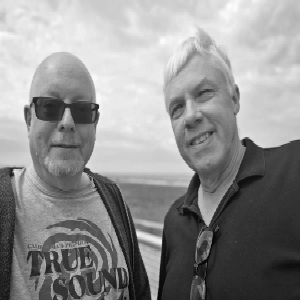
Emerging as one of the most prolific and captivating collaborations in the modern British Progressive Rock scene, the duo Riffstone has maintained an astonishing creative momentum. Composed of multi-instrumentalists Dave Allen (Spirergy) and Colin Powell (A Multitude of One, Nova Cascade), the project has delivered a staggering series of thematic releases in just over a year, from the historical narrative of “Richard III” to the Atmospheric depths of “Sanctuary Sky,” the Folklore of “Mythical Creatures,” and the global odysseys of “Great Journeys.”
Now, the duo turns their gaze toward the cosmos. Their fifth album, (releasing October 2, 2026), is a celestial concept album that charts a musical journey through the twelve astrological signs, from the blazing energy of Aries to the ethereal depths of Pisces. We sat down with Dave and Colin to explore the stellar architecture of their new record, the mechanics of their rapid-fire collaborative chemistry, and the cosmic boundaries of their signature narrative-driven sound.
Riffstone represents a powerful meeting of minds between two established multi-instrumentalists:
Dave coming from Spirergy and Colin from A Multitude of One and Nova Cascade. Since this is our first time sit-down, could you share the story of how your paths initially crossed and what sparked the decision to merge your distinct musical backgrounds into this collaborative project?
Dave: “Thank you for that lovely introduction, yes, this was all down to me in the beginning. Colin had no idea what was coming down the track at him or should I say, Facebook messenger! Several years ago, my wife, Gill, was about to have a significant birthday and I was wondering what to give the woman who has everything? (She might argue with this statement though!). So, for something a bit different, I decided to write and produce a one-off CD of music all about the fifteenth century King Richard III, in whom Gill has always had a very big interest in. At that time, I only had a very basic home recording setup, so the result was ‘very basic’ too, but it sounded ok. So, I designed some CD artwork, burned a one-off CD, put it in a jewel case and gave it to her on her birthday. Voila! Fast forward to 2025, I was considering redoing the album properly, as I felt the songs were worth rerecording and producing more professionally. Then, whilst listening to Progzilla Radio, I heard a song from ‘A Templars Tale’ by ‘A Multitude of One’ a concept album Colin produced with narration. I thought it was fantastic and exactly how I envisioned a progressive rock concept album of Richard III should sound. So, I reached out to Colin to see if he might be interested in a collaboration and the rest, as they say, is history.“
Your geographic bases are situated in different parts of the UK—Dave on the Wirral (Hoylake) and Colin in Greater Manchester (Salford). How does this physical distance shape your daily collaborative workflow, and how do you manage to synchronize your songwriting so seamlessly from afar?
Colin: “In this age of the internet, physical distance doesn’t really matter when making music. I have been collaborating with musicians from all over the world since around 2012 and I have never even met or spoken in person with most of them! Dave lives just over 1 hour drive away and we have met up a few times but usually only to have a CD opening or discuss what we have already recorded. In terms of managing to synchronise our recordings, we each have our own home studio (Dave uses a PC and different recording software to me: I use a Mac and Logic Pro). One of us will record a demo of a track we have come up with and send the stems, or individual instrument/vocal tracks) via Dropbox to the other, who can import those files and add their own music or vocals to the song. Sometimes the demos are complete and don’t need anything adding but mostly we both contribute to each track. Once we are happy, I mix and master the final version on my Mac – often making several revisions after close listening and suggestions from Dave.“
Looking back at your discography, your productivity is nothing short of breathtaking: you debuted with “Richard III” in August 2025, followed by “Sanctuary Sky” in November 2025, “Mythical Creatures” in May 2026, and “Great Journeys” in July 2026. How do you sustain such an incredibly fast-paced, high-output creative cycle without compromising the intricate detail and emotional depth of your music?
Dave: “I started writing music from a very young age, principally in a progressive, symphonic rock style, having fallen in love with the genre in the early 1970’s through ELP, Yes, Genesis et al. Over the years I’ve created a lot of material but due to owning and running a business consultancy for over 35 years, I just didn’t have the time to work on any of it. But Covid came along and put paid to my business, leaving me with a lot of time on my hands and a huge catalogue of songs and ideas to work with. Ironically, I’m also very lucky to be in a rich vein of writing form, so I’m constantly coming up with song ideas and feeding them to Colin for him to add his magic and turn those ideas into albums.“
Colin: “We are both used to working very quickly, although Dave tends to come up with many more initial ideas than me – and we have quite a few tracks that have not yet made it onto any of our albums, which may be released in due time. But turnaround of demo tracks to finished track generally happens very quickly. We both spend a lot of time recording and playing with ideas (I think our wives would say possibly too much time!). It does help that Dave and myself have a similar mindset, musical background and sense of what we want our music to sound like. So once we have an idea it quickly gets processed and only rarely do we disagree or make any significant changes.
Across your first four albums, you’ve traversed historical drama, Atmospheric Sci-Fi, Folklore, and global travel. How do you decide on these overarching themes, and did you always intend for Riffstone to be an explicitly concept-driven project?
Colin: “Well Richard III, our first album was, as Dave has mentioned an existing project of his and the Riffstone partnership was inspired by one of my concept albums (A Templar’s Tale). So we both like the idea of concept albums. Many of my other albums as A Multitude of One and the 25 or so albums I did with Doug Woods are also concept based albums. For me, I find it easier to write music when I have a story or theme. My usual process is to come up with an initial concept and then some track titles that are inspired by that concept. Then I create the lyrics and then record the music and come up with a melody for the lyrics. As for where the ideas for the concepts come from, it is a mix of what interests me (I like history, mysticism, the occult and folklore) and odd ideas that just spring into my mind.“
Dave: “Interestingly and possibly why Colin and I work so well together is, I tend to work in the opposite direction. I always come up with the music first, usually with a melody and chorus that drops into my mind at about 3am. I then turn it into something tangible and send it to Colin, so I think we complement each other’s way of working.“
Moving from the terrestrial and historical themes of your previous works, Zodiac looks directly to the heavens. What inspired you to tackle the twelve astrological signs as the core concept for your fifth album?
Dave: “Like Colin, I’ve always been interested in mythology and folklore. I’m inspired musically by mysticism and all things ‘unknown’. The idea of a concept album featuring the Zodiac came to me when I’d started writing, I think it was the song that eventually became Aries, as it had that kind of feel to it and 12 tracks would be perfect. I suggested it to Colin and he said he had been intending to write an album about the signs of the Zodiac, so I persuaded him to make it a Riffstone project.“
The album structure physically mirrors the astronomical year, starting with Aries; and concluding with Pisces; Did the inherent symbolism and traditional order of the zodiac signs dictate the musical flow and track order from the very beginning of the writing process?
Colin: “Well we always knew what the running order of the album would be because we wanted to follow the journey of the Sun around the Zodiac but we didn’t write the tracks in that order. Basically, we each set to work independently on a subset of the signs, exchanged the demos and added our own parts where we felt they would fit.“
Astrological signs possess vastly contrasting elements, from the fiery drive of fire signs to the introspective nature of water signs. How did you approach translating these varied psychological profiles and elemental landscapes into distinct musical environments while maintaining a cohesive album identity?
Dave: “I relied a lot on Colin for this. He has a much better understanding of the nature of each star sign. I would produce music that I felt created the right mood for a particular sign from my perspective and then run it by Colin to determine if it worked or not. We did make a few changes and I think that led to the right feel for each track.“
Colin: “From my point of view, I have always been interested in Astrology (not the daily horoscope variety though) and used to create birth charts for friends and family, so I already had an understanding of the nature of each of the signs and that inspired my ideas and writing. Because we use a broadly similar set of sounds in our Riffstone music, that helps keep the cohesiveness of the music.“
The opening track “Aries” clocks in at over seven minutes (07:15). Why did you choose such an expansive arrangement to introduce the listener to this cosmic journey?
Dave: “We both agreed that ‘Aries’ as a song worked well as an opener. It just happened to clock in at 7:15 long but as Colin has said, we knew the running order, so we didn’t have a lot of options. As the first track on the album though, I think it makes a great opening statement for what is to come from the rest of the record.“
Your first single, “Cancer,” features beautifully atmospheric and evocative lyrics like faintest lines in the northern sky / where hidden waters of space run high How does this track encapsulate the emotional heart of the album, and why did you select it as the first window into the world of “Zodiac”?
Colin: “We selected this track as the first single because of its catchy chorus: ‘Crab in the Northern Sky’ and the fact that it is upbeat and a happy sounding song, more than anything else. But I think the music and the lyrics capture the essence of the sign and the album, illustrating both the strengths and weaknesses of each sign, as the music alternates between very happy and then slightly darker or more introspective sections.“
Traditional Progressive Rock often utilizes multi-part suites to tell a story. With “Zodiac” being divided into twelve distinct tracks, do the songs bleed into one another to form a singular celestial suite, or did you write them as standalone musical vignettes?
Colin: “The tracks on this album do not bleed into one another and I think they stand as individual tracks but with a common theme tying them together. We wrote them as separate tracks without having the order specifically in mind.“
Since both of you are multi-instrumentalists, how did you divide the instrumental duties during the recording of “Zodiac”? Do you swap roles depending on the specific emotional demands of a track, or do you have clearly defined studio domains?
Colin: “It largely depends on whose initial idea the track was and who made the demo. So if I receive a demo from Dave that has a superb guitar part complete with amazing solo, a driving bass and powerful drums, as well as a range of keyboard parts and multi-part vocals (as is often the case!), I may come up with an idea for a melody or harmony part whilst listening and add it using whichever instrument I think fits best. Sometimes, I will look for any gaps that Dave has left for me and add a keyboard or guitar solo there. Sometimes, either because of the feel we want or because of the key, we will either add vocal harmonies to the demo, or sometimes completely replace the vocals in the demo with the other
person singing. If I record a demo then I will also usually include the bass and drums as well as, guitar, keys and vocals and then ask Dave to add something specific, like his guitar solo at the end of Capricorn. Although we both play multiple instruments and sing, our styles are not the same (Dave’s playing is often more complex whilst I focus on melody and atmosphere). What comes out as Riffstone is often greater than the sum of our individual parts!“
Dave: “I think we’ve reached a stage in our collaboration where we know each other’s strengths and are able to write music with enough space for the other to be creative in. It’s that chemistry that makes Riffstone what it is.“
Colin, you handled the recording, mixing, and mastering for ”Zodiac.“ How crucial is this complete in-house control over the technical production in preserving the raw, narrative integrity of Riffstone’s songwriting?
Colin: “I think it is very important – mainly because we don’t have the budget to get our music professionally mixed and mastered! I have taught myself over many years, and continue to learn. Also, nowadays, the recording software and plug-ins that are available help make the mixing and mastering process more accessible and faster – though you still need to have a good pair of ears and speakers (preferably more than one set of ears and speakers!) Being part of the band and sharing the musical vision of Riffstone means that over the albums we have developed our own Riffstone sound, which in part is due to the mixing as well as the sound selections and songwriting.“
The physical CD edition of “Zodiac” comes accompanied by a beautifully illustrated, Art Nouveau-styled lyric booklet. What drew you to this specific classic design aesthetic to visually represent a cosmic concept album?
Colin: “One of my old Astrology books and a Tarot deck that I have contain beautiful Art Nouveau style illustrations and as soon as Dave suggested doing an album about the signs of the Zodiac, it was that imagery that came to mind.“
The album artwork credits list Colin Powell, Dave Allen and AI. Can you discuss your perspective on integrating AI as a collaborative design tool in Modern Progressive Rock, and how you balanced it with your own hands-on art direction?
Colin: “Artificial Intelligence is a very evocative and emotive subject, particularly within the arts so we have to treat it very sensitively and sensibly. For Zodiac, as I mentioned, I already had the imagery style I thought would fit the album in mind. However, I am not a gifted artist and we don’t have the budget for professional or commissioned artwork so I asked AI to come up with some ideas for the album cover and to illustrate each of the signs. AI has advanced so much nowadays that if you are able to create your prompts in a clear way that matches your vision, it generates something that matches your vision very closely – only rarely does it produce people with 3 arms and 6 fingers on each hand!). So, I was very impressed with the first attempts for the cover and sign images – and so was Dave when I sent them to him. I do also like to use AI to help me research the concept I am working on. It is much quicker than typing search terms into a browser and visiting lots of different sites and manually extracting relevant sections to read later. But asking AI to compose music for you is a different thing altogether. For me, coming up with musical ideas, recording and expanding upon them is what I really love about being a composer and musician and I want to keep doing that myself for as long as I can.“
To celebrate the release, you are hosting a Bandcamp Listening Party on Friday, October 2nd, 2026, to experience all twelve tracks together with your fans. How important is this direct, shared digital experience in connecting with your audience today?
Colin: “I think it is very important because, as a small relatively still unknown band, we rely on the people who listen to and buy, play or review our music to help spread the word. A Listening Party, allows people to interact in real time with the artist, asking questions and making comments as the music is playing and they can get a real time response. It is the next best thing to sitting with someone in their house and listening to the music. It also helps to generate a feeling of community – and that is probably even more true of radio show chat rooms. I am a regular visitor to the chatrooms of Progzilla Radio and progrock.com where there are largely separate communities of listeners, presenters and artists all of whom are generally very supportive of one another. The chat is friendly and often very entertaining and when the station happens to play our music, it can be very gratifying to get positive feedback or perhaps learn about what we might be able to do better next time.“
Between your rapid-fire releases, Bandcamp has been your primary vessel. How vital is the Platform independent community for self-produced Progressive Rock acts in navigating the modern music industry?
Colin: “I think Bandcamp is essential nowadays, especially for independent musicians who do not have a label or promoter. It is a place the artist can direct people who are interested in our music to where they can both listen and buy our music (as CDs or digital downloads ). Yes, there are other places where people can discover, and listen to, and buy, your music but Bandcamp offers the best deal to artists, in my opinion, and even have Bandcamp Fridays when they waive their share of the sales (which is not huge in the first place!). As well as being able to listen to and purchase the music, there are also opportunities to learn a little bit about the artist and their music, reach out to fans by sending messages and for fans to contact the artist as well as interactive things such as the Listening Parties.“
Given the highly layered, symphonic nature of your music, characterized by rich keyboards, Cinematic soundscapes, and intricate arrangements, do you have plans to assemble a live band to bring “Zodiac” to the stage, or do you view Riffstone strictly as a studio-bound project?
Colin: “We would love to perform our music live at some point but because of the multiple layers and complexity of the music, it would require a group of like-minded musicians to be assembled to do the music (and the audience) justice in a live situation. We don’t write any of our music down in any form so it would require potential additional musicians to be able to learn it and play by ear – as well as creating musical arrangements for each part, deciding who will play what as well as the intricacies of having some tracks played on a computer and keeping everyone in time with a click track (something I have no experience with!). Also, because I usually work so fast, and often have more than one project on the go, I can very rarely remember exactly what I played on any particular track so it would also be a learning process for me (and Dave as well, I think!). So, for now, I think we will remain a studio-based project. But never say never!“
As a project rooted in the UK underground, how do you perceive the health of the Modern Progressive Rock scene in Great Britain today? Do you feel a sense of camaraderie with other contemporary independent artists, or do you operate entirely in your own cosmic bubble?
Colin: “The progressive rock scene in the UK today is the healthiest it has been since its heyday in the 1970s but with many more bands! However, it is not as widely known as it was back in the 70s and that is made more difficult because it is not widely advertised or played in the mainstream media. The vast majority of people listen to their independent prog rock on streaming services or internet radio stations and although promoting oneself on social media can help one tends to be preaching to the converted because of the way the algorithm works. It is sad to see regular notices of even small gigs being cancelled due to lack of ticket sales, although there are some wonderful Prog Rock festivals in the UK such as Fusion, Summer and Winter’s End, Soundle Weekend, Nene Valley Rock Festival and Prog for Peart, which are a very
reasonably priced way of seeing lots of very talented prog artists. As far as camaraderie is concerned, the Prog Community in general is largely a warm and friendly group of people, with artists and fans often mixing and becoming friends, either through chat rooms or attending gigs or festivals. We have other artists sharing and commenting on our music and we do the same for them. I don’t see it as competition but companionship and a shared interest.“
Your promo materials carry the evocative phrase: The wheel turns. The journey continues. Now that the grand cycle of “Zodiac” is complete, where does Riffstone travel next? Are you already working on a sixth concept, or are you taking a moment to let the stars align?
Colin: “Unusually, we are taking a moment to let the stars align as far as Riffstone is concerned. I say ‘unusually’ because quite often we have already started work on a follow-up album even before our current album has been released (which is another reason they come out so quickly!). However, this time, we have been working on our own separate projects as well as recording Zodiac. I am working on a new A Multitude of One album, called The Observers, and Dave has a couple of different projects ongoing, which I am sure he will be happy to tell you more about!“
Dave: “As Riffstone, we still have a lot of material to work on, so that’s already in the pipeline but as Colin has said, we both have other projects we want to pursue and having released five albums in quick succession we thought this was a good time to take a natural pause. I’m currently finalising a fourth Spirergy album and also working with the wonderful Mr. John Wilkinson, vocalist for The Swan Chorus and Ellesmere on a new collaboration called, ‘The Duality Engine’. Both albums are due for release in early 2027. However, knowing Colin and I, I don’t think it will be long before the stars start to align themselves again and album six begins to evolve. Watch this space!“
We would like to thank Dave Allen and Colin Powell of Riffstone for sharing such a fascinating look into their creative universe. “Zodiac” stands as a beautifully ambitious testament to the endless possibilities of modern independent Progressive Rock, blending classical narrative structures with stellar sonic production. The album is scheduled for official release on October 2, 2026, and is available for digital and CD pre-order on their Bandcamp.
Pre-Order “Zodiac” on Bandcamp: https://riffstone.bandcamp.com/album/zodiac