

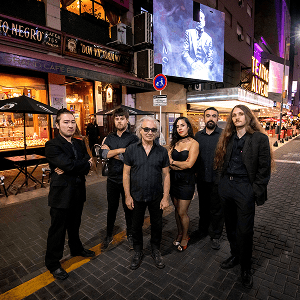
In February 2026, we had the privilege of sitting down with Bubu’s legendary mastermind, Daniel Andreoli, to explore the mythos of “Anabelas,” their 1978 Avant-Prog masterpiece that remains an untouchable beacon of Argentine Progressive Rock. That conversation was a journey through the creative fire of late-1970s Buenos Aires, academic rigor, and the bittersweet memories of an era marked by artistic resistance and exile.
But Bubu has never been a band to live solely on past laurels.
Now, in September 2026, the circle of this extraordinary musical journey is about to close on September 15, via PQR-Disques plusqueréel, Bubu returns with “El Último Cortejo,” the third and final chapter of their studio discography. Born partly out of lost manuscripts from the “Anabelas” (1976) period, discovered in Andreoli‘s parents’ basement, and partly from the modern fire of Buenos Aires’ rampant Neo Prog scene, the album is a staggering Avant-Prog work. It merges classical complexity with deconstructive Tango, Space Rock, Carnivalito, and the streetwise fury of their native city.
Once again, we are joined by Daniel Andreoli to delve deep into the composition, the intergenerational collaboration, and the philosophical weight of Bubu’s final sonic legacy.
You discovered notes and sketches from the “Anabelas” era in your parents’ basement. Could you describe the moment of this discovery and the immediate emotional impact of seeing these fifty-year-old manuscripts?
In 1976, Bubu signed a two-album contract with EMI Odeón. The second album, which we had even premiered with a major stage production at the Teatro Astral on Corrientes Street, was completely disrupted by exile and the dark context of the dictatorship. Those manuscripts remained forgotten in a drawer for five decades. Reconnecting with them felt like an instantaneous return to my youth. It was deeply moving to look back fifty years later and realize the structural clarity with which that “young boy” composed—especially the intricate guitar arrangements that I have now placed into the hands of brilliant contemporary musicians.
Were these rediscovered notes fully completed arrangements that simply didn’t make it onto “Anabelas,” or were they raw, embryonic fragments that required a complete modern reconstruction? When translating sketches written in your twenties into a modern production, how did you balance that irreverent youthful energy with the control and compositional maturity of your seventies?
The centerpiece of this discovery is a track called “El Tren de las Nubes” (The Train to the Clouds), which was already a fully structured piece in my mind. I firmly believe that music is inherently timeless; what changes is the execution and the historical context. Back in the ’70s, we were captivated by wild, free improvisation, which is vastly different from today’s scale-driven, formulaic standards. However, in today’s landscape, gathering six people to play complex music with no financial incentive is an extraordinary challenge. Consequently, I decided to channel those improvisational segments into highly structured collective passages. That is precisely where the raw impulse of my twenty-year-old self meets the definitive experience and control of a seventy-year-old composer.
Unlike the traditional Anglo-American and European avant-garde approaches of the past, “El Último Cortejo” features a heavy blend of deconstructive tango, Space Rock, and carnivalito. What led you to incorporate these specific Argentine regional and Folkloric elements into Bubu‘s architecture? How do you fuse the rhythmic melancholy of tango with the complex time signatures of Avant-Prog?
What drove me to incorporate these sounds was, quite simply, the profound love I feel for my country and my people. In Argentina, we have always had legendary masters who deconstructed the traditional melancholy of tango; my humble contribution was transferring that aesthetic pursuit into an avant-garde progressive rock framework. In tracks like “Originarios” and “El Tren de las Nubes,” I draw directly from the shamanic, earthly pulse of the carnavalito—an influence rooted in the years I spent in northern Argentina (Jujuy) during my youth. The introduction evokes the solitary soul of the indigenous Coya on his land, followed by a collective segment depicting community life, labor, and celebration. It culminates in cosmic space rock textures that represent the perspective of an elder composer gazing at the cosmos through his native roots.
“El Último Cortejo” features some of the finest musicians from Buenos Aires’ rampant Neo-Prog scene. How did this intergenerational collaboration come about, and what did these younger musicians bring to the sessions? Did you approach them with a rigid classical score, or did you encourage them to inject their own neo-prog sensibilities?
There is a pivotal protagonist in this generational bridge without whom this album would simply not exist: my son Ariel Andreoli, the project manager, who brought them in one by one. He successfully coordinated two full years of rigorous rehearsals across two recording blocks spanning late 2024 and 2025. The lineup—Agustín Ogura, Dante Fisi, Fito Lema, Paula Araujo, and Pedro Camerata—absorbed the music as if they had lived through the 1970s themselves. I did not impose a rigid classical format; their neo-progressive additions were entirely welcomed. For instance, the drum parts were not pre-written, so the drummer and I worked closely and independently prior to the full band rehearsals. Seeing them pour their own souls into my compositions was a deeply rewarding and pleasurable process.
The lead single “Camina” has a powerful, driving momentum. What was the creative genesis of this track? On the other hand, at over eight minutes, “Ciudad” is the longest track on the standard edition. Can you explain the structural architecture of this piece?
The genesis of “Camina” lies within a traditional milonga rhythm, which was purposefully deconstructed to fit Bubu’s aggressive sonic identity, vastly elevated by the sheer power of the drum work. As for “Ciudad” (City), its architecture unfolds sequentially: it opens with a brief harmonic introduction that establishes the urban atmosphere of the piece; this leads into the main theme, which shifts and transposes alongside the changing harmonies. Following a sonic bridge, the theme re-emerges with immense power, leading to a final bridge where the main melody is masterfully reinterpreted by the alto saxophone with a distinct jazz-rock character, culminating in an epic, definitive Bubu-style finale.
As the title-track, “El Último Cortejo” acts as the centerpiece. What is the central concept or thematic conflict of this piece? Additionally, the CD version includes two bonus tracks not available on vinyl; how do they expand the main narrative?
The track “El Último Cortejo” (The Final Procession) is an explicit homage to “El cortejo de un día amarillo” from our 1978 debut album, Anabelas. Anyone listening closely will recognize the foundational theme, which respects the hallmark rhythmic shifts and leads into an avant-garde saxophone improvisation mirroring the original spirit. It is a composition whose sheer maturity reflects a lifetime of musical experience, which is why it lends its name to the entire album. Regarding the CD version, we are honored to include “Vuelan” (They Fly), a song composed by our keyboardist Dante Fisi. This marks an unprecedented milestone, as it is the first time another musician has contributed a composition to a Bubu record, beautifully symbolizing the passing of the torch to the new generation. The second bonus track is “Otoño” (Autumn), an avant-tango deeply inspired by the legacy of maestro Astor Piazzolla.
You have confirmed that “El Último Cortejo” is Bubu’s final album, closing a fifty-year circle. Looking at the finished record, do you feel a sense of peaceful closure or a bittersweet sadness?
With every passing day, I am more convinced and resolved: this is definitively the final studio album by Bubu. I do not feel sadness; rather, I am filled with an immense sense of peace and satisfaction for having completed a half-century artistic and spiritual cycle with absolute creative integrity.
As the final notes of “El Último Cortejo” fade into silence, one is left with the overwhelming sensation of having witnessed a monument being completed. Daniel Andreoli and his brilliant, youthful ensemble have closed a fifty-year creative arc not with nostalgic retrospection, but with a vibrant, forward-thinking explosion of avant-garde energy. By blending the archival DNA of 1976 with the deconstructive pulse of modern tango, space rock, and carnivalito, Bubu has proved once again that their music is an untamed, living force that refuses to be categorized. “El Último Cortejo” stands as a beautiful, complex final legacy, a masterclass in artistic honesty and the eternal triumph of free thought.
“El Último Cortejo” is available on CD via PQR-Disques plusqueréel, and on black, magenta, and gold-and-green mix vinyl from September 15, 2026.
Purchase “El Último Cortejo” HERE
Read our previous Interview with Daniel about Bubu‘s history and “Anabelas” album here: https://progrockjournal.com/exclusive-interview-bubu-the-legacy-and-genesis-of-anabelas/