

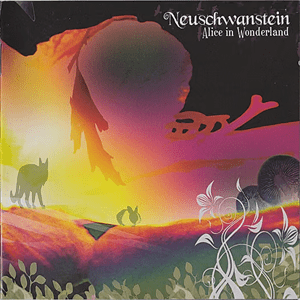
Founded in 1971 in Völklingen, within the Saarbrücken district of Germany, Neuschwanstein built its reputation over decades around a single milestone: the landmark 1979 album “Battlement.” Yet the band’s creative trajectory extends significantly further back, rooted in a conceptual project that predates that release by several years. In 1974, Neuschwanstein secured victory in a Saarbrücken music competition with a Theatrical Rock adaptation of Lewis Carroll’s “Alice’s Adventures in Wonderland.” By April 1976, the group captured their live-in-studio demo of this stage adaptation, a recording that would remain shelved for more than three decades. “Alice in Wonderland” emerges as a work composed prior to Frederic Joos’ tenure with the band, structured almost entirely instrumentally and punctuated by brief German narration from guitarist Roger Weiler. Drawing clear structural inspiration from Rick Wakeman’s Journey to the Center of the Earth, the record navigates the established territories of pastoral and Symphonic Progressive Rock. Its sonic palette recalls the evocative arrangements found in Camel’s The Snow Goose, while also echoing the textural approaches of Focus, Novalis, Anyone’s Daughter, and Eloy. Initially issued on CD through Musea Records and Rock Symphony between 2008 and 2009, and reissued in 2022 with a UK edition featuring Sonja Kristina’s English narration, the album now reaches listeners digitally via Musea Records’ Bandcamp catalog. The opening track “White Rabbit” establishes its narrative frame through Roger Weiler’s spoken German introduction, charting Alice’s descent following the White Rabbit. A meticulously layered instrumental bed lays the groundwork for the journey into Carroll’s imaginative landscape. Crossing that threshold, “Gate to Wonderland,” unfolds through an elegant pastoral framework. Klaus Mayer’s flute engages in precise dialogue with Thomas Neuroth’s keyboards and Weiler’s six- and twelve-string electric guitars, weaving an airy, fairy-tale motif. In “Pond of Tears” the instrumental arrangements take center stage, emphasizing Symphonic delicacy. Piano and synthesizer textures outline the melancholy of the titular tear-filled pool, supported by Mayer’s fluted embroidery and Rainer Zimmer’s grounding bass lines. Serving as the album’s first major movement, “Old Father’s Song,” is an eight-minute suite that allows Neuschwanstein’s structural ambitions to fully materialize. Neuroth and Mayer showcase German-school organ and Moog synthesizer passages, complemented by melodic guitar interludes that recall the harmonic approaches of Novalis and Camel. Dedicated to the Mad Hatter’s famous invitation, “Five-O’Clock Tea,” contains the album’s only sung vocal passage. A quirky, Folk-tavern style choral segment interrupts the prevailing instrumental flow, injecting theatrical irony into the Symphonic architecture. Acting as both narrative and musical fulcrum, the twelve-minute suite “Palace of Wonderland” represents the record’s compositional apex. Following an Atmospheric opening, the second half intensifies through Hans-Peter Schwarz’s dynamic drumming and percussion alongside Zimmer’s bass propulsion. The arrangement subsequently opens into expansive keyboard-flute counterpoint. Carrying forward the momentum of its predecessor, “The Court of the Animals,” highlights Mayer’s flute work while pushing instrumental interplay to the forefront. The group navigates frequent time-signature shifts and tight dialogues between organ, synthesizer, and guitar. The finale “Alice’s Return” reintroduces core melodic motifs, closing the dream’s narrative loop. Over its final two minutes, the music gradually recedes, escorting Alice back to reality with a measured, reflective cadence that concludes the work’s precise forty-minute and forty-six-second runtime. “Alice in Wonderland” stands as a carefully executed exercise in Prog archivalism, spearheaded by Musea Records. While preserving the unvarnished timbre of its 1976 live-in-studio recording, the album offers a compelling glimpse into Neuschwanstein’s compositional maturity and arranging sophistication long before their later commercial breakthrough. It remains an essential document for understanding the development of German Symphonic Progressive Rock during the 1970s, particularly valuable for listeners interested in how literary classics were translated into ambitious Rock formats. For those approaching this reissue with a contextual ear, it delivers precisely what one expects from the era: rigorous craftsmanship, thematic coherence, and an unforced commitment to musical narrative.
Tracklist
01. White Rabbit (01:17)
02. Gate To Wonderland (02:13)
03. Pond Of Tears (02:45)
04. Old Father’s Song (08:31)
05. Five-O’Clock Tea (06:49)
06. Palace Of Wonderland 12:05)
07. The Court Of The Animals (05:01)
08. Alice’s Return (02:05)
Lineup:
Roger Weiler / 6- & 12-string Electric Guitars, Narration
Thomas Neuroth / Piano, Organ, Synth
Klaus Mayer / Flute, Synthesizer
Rainer Zimmer / Bass
Hans-Peter Schwarz / Drums & Percussion