

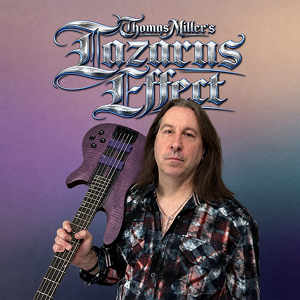
As former Symphony X founding bassist Thomas Miller returns to the Progressive Metal spotlight with his new venture Thomas Miller’s Lazarus Effect, the Progressive community celebrates the rebirth of one of the genre’s most distinctive voices. Ahead of the release of their self-titled debut album via Sensory Records, we caught up with Thomas to discuss the origins of Lazarus Effect, reuniting with longtime friends Michael Romeo and Michael Pinnella, the creation of singles like “When Darkness Falls” and “Closer To The Sun,” and his musical journey past and present.
You began your musical career in central New Jersey performing in cover and original bands influenced by 1970s and 1980s Progressive Rock. What originally drew you to the bass guitar as your primary melodic and rhythmic voice, and which musicians shaped your approach to technique and counterpoint?
I started playing bass because of Gene Simmons of Kiss, but I was initially attracted more to the character he portrayed than his bass playing. As I practiced and became better, I listened to everything from Geddy Lee to Stanley Clarke. Eventually hearing Billy Sheehan in the early eighties opened the door to the tapping on the bass and experimenting with multiple finger plucking styles. The odd meter and counterpoint stuff was more from Rush, UK, Kansas and Yes.
Back in 1986, you connected with Michael Romeo in the local New Jersey scene before co-founding Symphony X in 1994 and signing with Zero Records. Looking back, what was the initial creative spark between you and Michael that laid the foundation for landmark albums like The Divine Wings Of Tragedy and Twilight In Olympus?
We were both influenced by the same bands. When I first heard Mike through a mutual friend, he sounded like Randy Rhoads, he didn’t have the whole neo classical thing woven in his soul yet. But, about 6 months after that he was really into Yngwie and making the transition. So, when we got together for the first time, I sounded a lot like Billy Sheehan and he sounded like Yngwie. Now I think we both have grown and developed our own musical identities. By 1994, when we started Symphony X, we already knew what direction we wanted to go and really developed our playing techniques.
On early Symphony X records, your bass work was a prominent counter-melodic line rather than just rhythmic support. How did you approach carving out your distinct sonic frequency alongside high-density guitar riffs and complex keyboard orchestrations?
I actually used different basses and amps on just about every Symphony X record. So, no matter what bass or amp I use, it still sounds like me. A lot of the tone is actually from my fingers, something I’ve spent a lot of time trying to perfect. On the Lazarus Effect recording I used a little more presence than on the Symphony X, but I think it worked.
After stepping away from Symphony X following international tours across Europe, Japan, and New York, you spent years honing your writing and recording away from the public spotlight. How did your compositional style evolve during those years outside a traditional band schedule?
Well, I no longer write from just a bass players view point, where everything would evolve around a bass riff or something like that. My vocal melody writing and arranging harmonies has evolved enormously as well.
In 2017, you began collaborating on a project with vocalist Howard “Hollywood How” Portney. At what point during your work with How did you realize you had the chemistry and material to launch a full-fledged new project in Lazarus Effect?
Pretty much immediately, we were playing out in cover bands and I eventually decided to do this recording because I thought we could do some great original material. With How, Romeo, Pinnella and myself, I was confident we could do something substantial.
The title Thomas Miller’s Lazarus Effect carries a strong metaphorical weight. Does the name refer directly to your personal resurgence in the Progressive Metal scene, or does it also connect to the overarching thematic concept of the music?
Your absolutely correct in that, it’s a direct analogy to my re introduction into the prog/heavy metal world, a musical resurrection if you will.
For the debut record, you brought in your former Symphony X bandmates Michael Romeo on guitars and digital programming, and Michael Pinnella for select keyboard solos. How natural was it to re-establish that studio dynamic with them after all these years?
Incredibly easy, we’ve been in contact over the years and everything flowed, just as I anticipated. It’s always great to work with those guys, we always had a wonderful creative chemistry and get along wonderful.
You enlisted producer Eric Rachel to mix and master the album, the same producer who worked on Symphony X’s first six albums. What specific sonic qualities did Eric bring to the mixing console to ensure the record sounded both classic and contemporary?
I enjoyed working with Eric in the early days. He really listens to the artist and works very hard to achieve what the artist is looking for and brings it to fruition. I wanted a big sound, but with clarity and musical separation between instruments, kind of a hybrid between old and new school.
Your lead single “When Darkness Falls” introduced the band’s Havy baseline, whereas “Closer To The Sun” showcases a broader Progressive scope. What made “Closer To The Sun” the ideal showcase for the album’s Progressive complexity?
Closer to the sun was actually supposed to be the third release and “Fear no evil”, the first. “Fear no evil” will be a lyric video and much more complicated than the first two releases, that’s why it’s taking much longer to make. I think it’s a more accurate representation of the album and sits more middle ground among the songs on the record.
On “Closer To The Sun,” you blended Middle Eastern tonalities, mythological themes, and layered acoustic guitars with violin. How did you structure the arrangement so those acoustic textures build organically into the heavier rhythmic themes?
Once I had the tonal color of the song, I used instruments and layers to create a Kashmir/Rainbow texture and used the heavy riffs as a contrast to make the other parts stand out. I love using harmonic minor scales to achieve that Egyptian, middle eastern ambiance.
Michael Pinnella contributes keyboard solos to both “Closer To The Sun” and the closing track “Sailing To Utopia.” How were those solo sections structured during composition, and did you craft specific bass movements underneath his leads?
At first, I wasn’t sure if I wanted Pinnella to trade solos with Romeo or have him have his own solo spots. After I had all the rhythms completed, I sat down and listened to all the songs and solo sections and designated where I felt Pinnella would be soloing and where it would be Romeo.
The album runs as an epic 49-minute Progressive Metal piece across eight tracks. Titles like “Dark Horse,” “Fear No Evil,” “All The King’s Horses,” and “Culmination” evoke strong narrative imagery. Is there an underlying storyline or conceptual thread connecting these songs?
It’s not a concept album, but each song has it’s own lyrical identity. “Closer to the sun” was inspired by a painting entitled “Close to the sun” of Icarus. “All the kings horses” has a medieval theme in it’s lyrical and musical content and “Fear no evil” has hints and shadows of the temptations of sin and evil.
A track title like “Aria Etude” suggests classical structural roots. How do classical étude forms influence your songwriting and technical bass line construction on this album?
Aria Etude was written as a contrast to the heavy and sometimes complex arrangements of some of the other songs. It’s not a classical piece in the sense of not having ostinatos or arpeggio type structures, but a piece meant to take the listener into a celestial realm, open and timeless. I used a fretless to add to that big open sound, and the end bass solo was a last second idea suggested by Mike Romeo.
The album artwork and 12-page booklet were designed by Rodrigo A. Gudiña. How closely did you work with Rodrigo to align the visual art with the majestic overtones of the music?
Very close, I would create Photoshop type templates for the artwork that I envisioned to give him a more accurate description of the artwork I was trying to convey to him verbally. We would go back and forth with a few edits, but usually when he sent something, it was very close.
How Portney’s vocal range introduces a Classic Rock edge into a Heavy Progressive metal framework. How did you approach writing vocal melodies to fit his timbre and delivery?
I recorded and played out with How prior to this recording, so once I found the range and highlights that would compliment his voice, I capitalized on those aspects, giving him spaces to put screams and embellishments on the vocal parts. He has a lot of diverse qualities in his voice, so I would give him suggestions on what tone or vocal style I wanted for each particular song.
Releasing the record through Sensory Records / The Laser’s Edge Group connects you with a label renowned for high-caliber Progressive Metal. How did this partnership come together for the CD, LP, and Hi-Res releases?
I initially met Ken around 1998, while I was still in Symphony X. He came over to Romeo’s house and we discussed having him possibly distribute the Symphony X catalog, which at that time had no US distribution. When the album was complete I contacted him to see if he would be interested and after a few conversations we decided it would be great to work together. Ken’s a straight shooter and I felt he was sincere in everything he wanted to do for this album and beyond that.
Having toured extensively in Japan, Europe, and North America during the 90s, are there plans to assemble a touring lineup and perform Thomas Miller’s Lazarus Effect on stage?
Yes, I’m currently working on that and will do everything in my power to make that happen.
Having been an active contributor to Progressive Metal since the mid-1990s, how do you view the evolution of the Progressive Metal scene today compared to when you started out?
I’m not too familiar with the scene today, I hear a little bit here and there but I’m more of an old school prog person. Rush, Kansas, UK, Yes and bands like that.
Your return has generated widespread excitement among Progressive Rock and Metal enthusiasts worldwide. What message would you like to leave for the fans who have followed your work from Symphony X to Lazarus Effect?
First, I’d like to give the fans my sincere gratitude for the support over the years. I’ve received many requests to come back and do something and I’m grateful to be in the position I’m in. If this record is successful, they can expect new music on a regular basis and hopefully see some of their faces on stage.
Thomas Miller’s Lazarus Effect releases on October 30th via Sensory Records on CD, LP, and digital platforms. We would like to extend our sincere thanks to Thomas Miller for taking the time to share his journey and insights with Progressive Rock Journal. Be sure to check out our album review and pre-order the album on Bandcamp.