

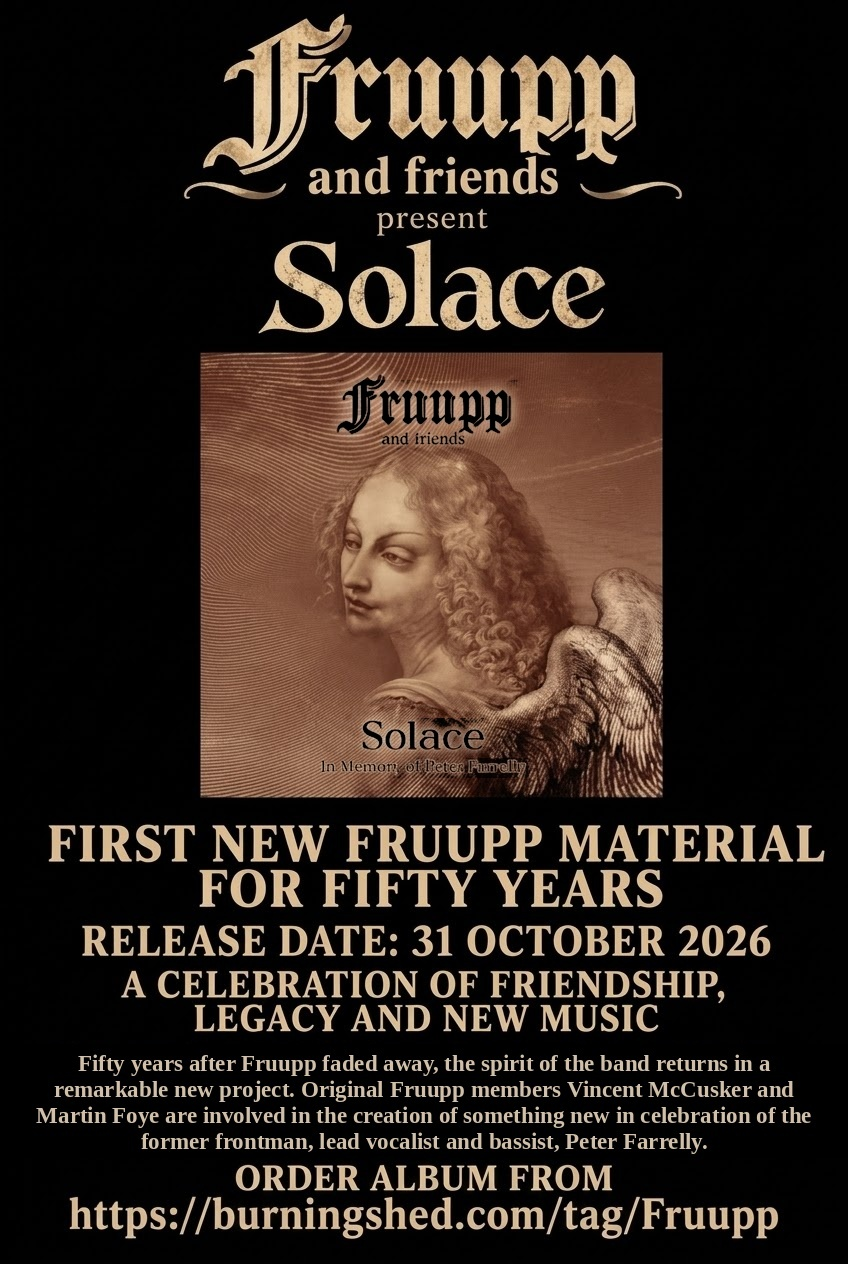
Fifty years after their last original recordings, Northern Irish Progressive Rock pioneers Fruupp return to the spotlight with “Solace,” a multi-faceted 13-track album released via Bad Pressings and Burning Shed. More than a simple nostalgia trip, “Solace” is a lovingly assembled tapestry combining new recordings, unearthed live tapes, post-Fruupp material, and tribute pieces by contemporary musicians inspired by the band’s rich legacy. Dedicated to the memory of late vocalist/bassist Peter Farrelly, the album also serves a noble purpose, with all proceeds directly aiding the surviving original members and Peter’s family.
To unpack the history, sound, and emotional weight behind this landmark project, we brought together key figures behind “Solace”: founding guitarist and primary composer Vincent McCusker, original drummer Martin Foye, album producer Ian Wright, and Thomas Klarmann of German Prog outfit ARGOS.
Part 1: Vincent McCusker (Fruupp Founder, Guitarist & Composer)
It has been half a century since the last original Fruupp studio recordings. What was the definitive spark that turned the concept of a retrospective project into creating brand-new music under the Fruupp banner?
One of Peter’s art pieces was kindly donated to the Fruupp project team and subsequently bought by a young Dutch lad, Xander Pass a fan indeed, as he had already purchased one of Peter’s bass guitars . Nigel Wade and Rob Cochrane from the project team decided that it would be nice to use this piece as a basis for a tribute to Peter. Nigel asked me if I would be willing to record Steam Machine, an old encore favourite of Fruupp. As it had never been recorded I thought it might be the perfect time so I agreed to include it in the project. I had several sets of lyrics and musical ideas in my portfolio from the Fruupp era and onwards. I thought it would be nice to use some, particularly from the point of view that the earlier pieces were a real spiritual link to Peter.
Fruupp’s 1970s discography, from “Future Legends“ to “Modern Masquerade,”stood out for its delicate balance of Symphonic grandeur, Folk lyricism, and classical complexity. When writing new music for “Solace,” how naturally did that classic composition style return to your fingers?
To be honest it didn’t. My musical career had taken several turns in the interim. Over the last several years most of my compositions were composed on acoustic guitar. Back in the day my creativity was sparked by mixing with wonderful musicians like Peter,Martin,Stephen and John, so I had to dust off the old electric and re learn some of my old licks.Also I hadn’t worked in a recording studio for over 20 years but was blessed to find a wonderful recording engineer,Matt, who guided me through the digital maze that recording studios have become.
“Solace“ is deeply dedicated to the memory of Fruupp’s original frontman, Peter Farrelly. How did Peter’s musical legacy and vocal identity influence the overarching mood and direction of this album?
There have been and are many many good bands but for me the ones on the next level are the ones with the charismatic front man(or woman). Queen, the Doors ,Jethro Tull etc. Peter was that. Oftentimes on stage I’d almost lose concentration just watching his antics. Peter had a distinctive vocal character—gentle, emotional and almost otherworldly at times—and that quality helped give the original Fruupp recordings their particular atmosphere. In making Solace, we wanted to honour that sense of melody, emotion and imagination rather than trying to imitate him.
Your guitar arrangements in the 70s were renowned for their Melodic interplay with keyboards and orchestral textures. How did you approach tone and guitar orchestration on “Solace” compared to your workflow in the 1970s studio environment?
Strangely enough I was never particularly comfortable in a recording environment back in the 70s. We would play live in the studio as a band but the emphasis was always on getting the bass and drums down really tight. Then Stephen (or John) would do their thing working with a guide vocal and finally the guitar. It usually would have taken me 2 or 3 runs to get into the feel. Then on the 4th run when the feel was perfect I’d fluff the final bar. Nowadays it’s so much easier to correct and finding good guitar tones is a dawdle. I really enjoyed the whole experience.
Looking back at Fruupp’s peak years, the band shared stages with giants like Genesis, Queen, and King Crimson. Is there a specific live moment or tour anecdote from that era that captures the true essence of Fruupp on stage?
Nowadays with modern technology bands can recreate their sound almost perfectly from one gig to the next. Back then there were so many variables but we were always a very rocking band on stage. Some of the homecoming gigs were wonderful. I remember playing the Ulster hall Belfast. Ever the showman Stephen decided to perform an intro piece on the wonderful pipe organ above the stage. It went down a storm but while making his way back down to the stage he had to climb over a barrier fence. His leg got caught and he consequently ripped the arse out of his pants. That went down a storm (with the rest of the band)
The title-track “Solace” carries significant emotional weight. What does the word Solace represent to you personally at this stage of your life and musical career?
Solace of course is a giving word. I guess one just gets on with life and I hadn’t reflected a lot on Fruupps active years until the sadly missed Brian O Neill a great friend of the band started a Facebook page dedicated to all things Fruupp. My wife Teresa kept me informed and pushed me towards getting involved more, especially when Nigel Rob Keith and Ian entered the arena. I realised these guys were giving up so much of their time simply to keep the Fruupp flag flying and I wanted to be involved, particularly when the tribute to Peter was floated. Most especially I wanted to give something to The fans and followers who have remained so loyal to the memories.
How does it feel to see Fruupp’s original compositions being reinterpreted and celebrated by a new generation of musicians on this release?
It’s wonderful and an absolute privilege to be associated with such fine musicians as the German Prog band Argos and their leader Thomas Klarmann, who were of course so ably assisted in the lyrics department by Rob Cochrane. One of the biggest thrills I’ve experienced with the project is my first listen to Ian Wright’s version of my composition “Why” from Modern Masquerades. Ian , an excellent musician songwriter and producer in his own right, and fellow band member of Nigel Wade in “Flight 76”,has contributed several of his own songs to the project and written an extended piece to the Fruupp intro music as well as his superb version of Why.
Part 2: Martin Foye (Original Fruupp Drummer)
As the original drummer of Fruupp, your rhythmic foundation gave the band its distinctive drive. How did it feel to revisit and reconnect with the band’s sonic identity after so many years?
It was very very good and very surprising after not listening to it for such a long time , I actually got a nice burst of warmth and love in my heart of what we all did not just me I was so happy to be a part of that band and still am so proud of the music that we created !
Side D of “Solace” features live recordings including “Tuesday Night at No 11,” “Banshee Woman,” and “Steam Machine.” What do you recall about the venue atmosphere and stage energy when those specific tracks were captured live back in the 70s?
Steam machine was amazing it was one of my favourite numbers I wish we had of released it as a single ! I also loved decision I jst loved all the music to be honest ! And I feel so proud of all of it , the atmosphere was electric it was electric we were so lucky to get the support we did playing with bands like geniaus , focus , mathahoople , it was jst amazing to play alongside those bands and the energy was electric something you had to be there to capture the feeling .
Peter Farrelly’s bass playing and your drumming formed the core rhythm section of Fruupp. How would you describe the natural chemistry you two shared on stage and during rehearsal sessions?
We were brothers from the starts ! He was an amazing base player and before joining fruipp he was a lead guitarist and took up bass and the reason being the troubles Belfast where he was rife with war and troubles Peter joined the band to get away from the war and the troubles that were in Belfast ! Me and Peter were and still are brothers we could read eachother like a book we connected instantly and I hold him close to my heart always !
Touring in the 1970s UK Progressive Rock circuit was demanding and relentless. What were the biggest challenges and rewards of maintaining Fruupp’s intricate arrangements night after night in live venues?
We had a great energy if you look back into the history of Fruupp we really did work we did so many gigs and so many support gigs to some amazing , famous bands , the mechanics jst worked ! It could onli make you better with the support we did and the gigs we played night after night we jst got better and that was down to the sheer amount of gigs we got the opertunity to play .
Hearing the newly remixed live material alongside fresh studio pieces on “Solace,” how well do you feel the album preserves the authentic spirit of Fruupp?
I think it really does ya know I’m sorry we didn’t do more recordings ! Me and Peter shared flats and houses all over London and he was always writing some amazing songs ! I’m going through my own archives atm to see if I can find some things to put out to the frump fans! The new album definitely presicwrs the authentic spirt of grupp and the technology we have now is amazing at bringing it all back to life .
All proceeds from “Solace” go directly to the surviving band members and Peter’s sister Mary. How important was this community-focused, independent approach to honoring the band’s legacy?
Keeps a sense of community and all who where involved to be paid for being involved ! It was never really about money for us it was about music and our love of music and the brotherhood we created ! And the fact that we get to enjoy whether big or small we get to enjoy it now with our families and friends! Peace and love. Martin Foye ✌
Part 3: Ian Wright (Album Producer & Artist ‘i-a-n’)
Working closely with Vincent McCusker, what was your overarching production philosophy when curating a 13-track double album that blends new tracks, archival live audio, and guest contributions?
I had two audiences in mind that were critical to all my efforts on Solace: Vincent and the Fruupp Family and also all the long-patient, ever loyal Fruupp fans out there and in the Facebook group particularly. Above all though it was the thought of staying true to the memory of Peter Farrelly: his talents and his interests.
Restoring and mixing decades-old live recordings alongside pristine modern studio tracks presents unique audio engineering challenges. How did you ensure a cohesive sonic narrative across the entire record?
As best as I could, using the best audio technology I could muster (i.e. afford), the intent was to bring out the true sound of the music and musicians in the older, live tracks – recorded as they were in less than ideal circumstances. The Argos tracks and Vincent’s new recordings needed no effort on my part, being so well put together in the first place. The only thing I was able to do in the mastering was attempt to give all the tracks an equal voice. Splitting LP sides and the track order itself was a team effort to provide a sort of timeline from Fruupp live to the intervening years with other bands, tributes from firends, and then back to Fruupp with Vincent and Martin in the studio again after 50 years!
You also contribute musically to Side C under the project name ‘i-a-n‘ with the track “Why“. Could you tell us about the creative process behind this piece and how it connects to the Fruupp lineage?
The song itself is Vincent’s from the Masquerades album. In later years he made an “unplugged” version, recorded with friends locally. There is a video doing the rounds of this. I heard this version and thought it exceptional. I had just been welcomed into the project with enthusiasm and warmth from Vincent and Teresa and was feeling really honoured and grateful. At the same time, I’d made a little recording of the song initially for my own benefit and just wanted to share this with the two of them. Somehow, despite my protests, it’s ended up on the album!
How did the collaboration with post-Fruupp projects, such as MGM, Minx, and Flight76, come together for Sides A, B, and C?
Nigel Wade first had the idea of taking the guitar motif written by Vincent and used for the band introductions and making a Fruupp-inspired track out of it. I drew the short-straw and had a bash at trying to do that with Lady-in-Waiting, the track itself being inspired by Peter’s drawing that had been recently found and sold by the family. That essentially was the catalyst for the very ambitious idea of collating a whole album in tribute to and in memory of Peter. The MGM and Minx tracks were taken from very rough or old versions of recordings that had been made over the years as representative of what happenned to Fruupp members after 1975. Vincent and his studio colleague, Matt, did a marvellous job rejuvenating them. It was obvious that we had to ask Thomas if we could include something from the great Argos tribute album, itself a product of Fruupp admiration and influence, and he very graciously agreed to versions of the two tracks we’ve got on there.
“Solace” is being released in an extremely limited physical run, 200 double gatefold vinyl copies and 500 CDs globally via Bad Pressings and Burning Shed. Why was a strictly physical, limited-edition release the right home for this project?
I’m not sure I’ the right person to answer that quesstion. It’s well above my paygrade (if I were paid).
From a producer’s perspective, what was the most surprising or rewarding moment during the assembly of “Solace”?
For me, the most rewarding aspect of participating in the project has been the contact with Vincent and the honour of working with him, albeit remotely, on the album but, significantly, his excitement and enthusiasm for getting back in the studio with revitalized and new Fruupp music. Hearing what he achives with his guitar tone and his playing still being exceptional, his song-writing undiminished, has been inspiring.
Part 4: Thomas Klarmann (ARGOS & Project Collaborator)
ARGOS contributes two prominent tracks to Side C: “Moytura House (Solace)” and “Under the Influence.” How did you initially discover Fruupp, and what role did their music play in shaping your musical upbringing?
This track (“Moytura House”) was actually the initial spark that led to the creation of our ARGOS concept album about Doctor Wilde. The song takes the listener on an emotional and musical rollercoaster ride, much in the way FRUUPP so masterfully did in their longer pieces, such as “The Perfect Wish,” “Gormenghast,” or “Sheba’s Song.” The symphonic section towards the end, and especially the closing guitar solo by Akos, our Romanian guitarist, are, to my ears, very much in the tradition of Vincent McCusker’s electric guitar style. At the same time, there are also those jazzier and quieter passages that are more characteristic of ARGOS.
When composing and recording “Moytura House (Solace),” how did you balance ARGOS’ established sound with paying direct homage to Fruupp’s Symphonic and Celtic-infused style?
This track (“Moytura House”) was actually the initial spark that led to the creation of our ARGOS concept album about Doctor Wilde. The song takes the listener on an emotional and musical rollercoaster ride, much in the way FRUUPP so masterfully did in their longer pieces, such as “The Perfect Wish,” “Gormenghast,” or “Sheba’s Song.” The symphonic section towards the end, and especially the closing guitar solo by Akos, our Romanian guitarist, are, to my ears, very much in the tradition of Vincent McCusker’s electric guitar style. At the same time, there are also those jazzier and quieter passages that are more characteristic of ARGOS.
“Under the Influence” suggests a direct artistic line back to 70s Progressive Rock. What specific Fruupp elements, structural, harmonic, or thematic, were you keen to weave into this track?
This piece was written by Robert Gozon. Since he is more than ten years younger than I am, he—like the other ARGOS musicians Ulf and Akos—only discovered and grew to love FRUUPP later on, through myself and the internet. The more pop-oriented, melodic Beatles influences that can be heard in FRUUPP songs such as “Janet Planet” or “Annie Austere” are also a defining element of Robert’s own approach to songwriting. That enthusiastic, boldly forward-moving spirit that FRUUPP’s music so often possesses is something he particularly tried to capture in this song as well.
The continental European Prog scene has always held a deep appreciation for 70s British Progressive Rock. From your perspective in Germany, how was Fruupp perceived compared to the larger mainstream Prog acts of that era?
Those who, like me back then, were lucky enough to discover lesser-known bands such as FRUUPP were every bit as fascinated by their music as they were by YES or GENESIS. The music of the progressive rock bands of the 1970s, whether famous or obscure, simply had this wonderful escapist quality, both lyrically and musically, that really spoke to us as teenagers growing up in the rather grey atmosphere of the 1970s, with the oil crisis and the RAF era in Germany. And, by the way… the musicians of the well-known German prog band GROBSCHNITT must have been FRUUPP Fans as well. On their albums “Jumbo” and “Rockpommel’s Land,” you can discover a surprising number of similarities to “Seven Secrets” and “The Prince of Heaven’s Eyes.”
What does participating in a tribute and continuation project like “Solace” mean to you as a contemporary Progressive Rock musician?
It is one of the most wonderful things I have had the privilege of experiencing in my career as a musician. To appear on an album alongside my heroes from the 1970s means an enormous amount to me. And it is simply fantastic to have the opportunity to hear new music from FRUUPP. At this point, I would also like to express my heartfelt thanks, on behalf of all the other ARGOS musicians—Robert, Ulf and Akos—for the wonderful support and enthusiasm shown by everyone from FRUUPP involved in this project, and especially to Nigel Wade and Robert Cochran. A dream has come true.
“Solace“ stands as a poignant, beautifully crafted tribute to one of progressive rock’s most poetic bands. By bridging half a century of history with new musical creation, Fruupp and Friends have ensured that the legacy of Peter Farrelly and the timeless music of Fruupp continues to resonate with clarity and heart. “Solace” is available now in strictly limited physical editions via Burning Shed and Bad Pressings.
Read our Review of “Solace” here: [Review] Fruupp and Friends – Solace