

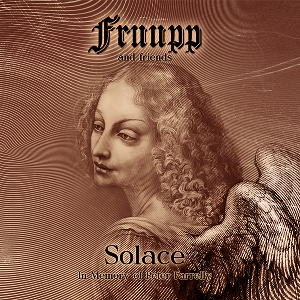
Formed in Belfast in 1971 by guitarist Vincent McCusker, Fruupp stands as one of the most refined and seminal acts of the 1970s Irish and British Progressive Rock movement. Alongside lead vocalist and bassist Peter Farrelly, keyboardist/oboist Stephen Houston, and drummer Martin Foye, the Northern Irish quartet carved out a distinctive sonic identity defined by pastoral sophistication, classical elegance, and rich thematic narrative. Across a remarkable run on Pye’s underground label Dawn Records, producing four landmark studio albums between 1973 and 1975 (“Future Legends,” “Seven Secrets,” “The Prince of Heaven’s Eyes,” and the Ian McDonald-produced “Modern Masquerades“), Fruupp earned widespread critical respect and a dedicated international following, sharing stages with genre titans such as Genesis, Queen, and King Crimson. Following the passing of founding vocalist and bassist Peter Farrelly in March 2025, the band’s enduring artistic lineage reaches a poignant new chapter. Released under the umbrella title Fruupp & Friends, “Solace” is a monumental 4-sided double vinyl tribute dedicated explicitly “In Memory of Peter Farrelly.” Spanning 13 tracks and over 54 minutes of music, the album gathers original band members Vincent McCusker and Martin Foye alongside allied projects and musical collective Flight76, MGM, Minx, i-a-n, and ARGOS. Far from a conventional retrospective or a mere exercise in nostalgia, “Solace” proves to be a vibrant, multi-faceted continuation of the band’s creative vision. Adorned with evocative Renaissance-inspired artwork, the record honors Farrelly’s memory through an ambitious suite of new compositions, archival interplay, and thematic depth that seamlessly extends the sophisticated Progressive Rock path forged over five decades ago. What distinguishes it from the group’s other recent output is its architecture of collaboration. The album opens, fittingly, with a track that performs the act of introduction in the most literal sense. Farrelly’s spoken-word address, recorded voice preserved in the arrangement, sits above McCusker‘s harmonic scaffolding, and the effect is immediately potent: a thread that was cut in the mid-seventies is reconnected in real time, the listener hearing the man’s voice and the musician’s guitar in the same breath. The symbolic weight is considerable, and the band understands that the opening must carry it without tipping into sentimentality. McCusker‘s composition provides a Melodic seed, restrained, deliberate, that will flower across the next track. In “Lady-in-Waiting” the Melodic seed germinates into the compact suite that carries the entirety of Side A. Featuring lyrics by Cochrane and music written by Ian Wright around a theme by McCusker from Introductions, the piece stretches beyond six and a half minutes, and the length feels earned: the two composers build a progression that moves in deliberate stages, each shift in metric feel or rhythmic accent revealing a new facet of the harmonic structure. The Fruupp DNA is unmistakable, the almost baroque inflection of the Melodic line, the interplay between keyboard textures and guitar, but the Flight76 performance layer injects a freshness of interpretation that prevents the piece from becoming a reverential quote. Cochrane’s lyrics are foregrounded at key turning points, and the final sung stanzas land with a concentrated intensity that seals the side. It is, in essence, a distillation: everything the band does at its best, compressed into a single, continuously evolving movement. A shift in authorial perspective “On a Clear Day.” Houston’s composition is here partly reworked by McCusker, whose new guitar work heightens the track’s intensity and majesty, while the band arranges around this shared vision to create one of the album’s compositional anchors. There is a solitude to this piece that sets it apart: the Symphonic-pastoral register that characterises the most lyrical passages in the classic Fruupp catalogue is here stripped to its essential components, piano and keyboard interplay, open harmonic spaces, a melodic line that breathes. Houston‘s imprint recalls the band’s keyboard-led compositions from an earlier period, transposed into a contemporary production context without sanitising the tonal palette. It is the album’s still point, the moment where the momentum of Side A resolves into contemplation. The first intervention of the MGM banner “Chasing After You,” and with it a noticeable shift in the album’s sonic register. Farrelly‘s lyricism meets the combined compositional input of Foye and Devlin, and the performance dynamics broaden: the rhythmic section steps forward with bass lines that carry a distinctly late-eighties pulse, while the upper register retains its Progressive orientation. The vocal delivery is more direct, more forward, and the keyboard work acquires a contemporary sheen. Crucially, the piece does not fragment the album’s coherence, rather, it demonstrates that the Fruupp harmonic vocabulary can accommodate a neo-Progressive edge without surrendering its structural logic. It is a convincing argument for the genre’s continued elasticity. McCusker writes, composes, and arranges “I Don’t Think It’s Love” under the Minx designation, and the effect of that total authorial control is a transition of remarkable fluidity. The tempos are more contained than the preceding track, the dynamics are drawn inward. What emerges is a piece of precise songwriting, Melodic, dynamic, economical in its means, where a single composer’s instinct shapes every parameter. It is the quiet hinge between the outward-facing energies of Side B and the more introspective territory that awaits on Side C. The i-a-n project enters the record with “Why,” and the arrangement, McCusker with Wright, opts for essentiality. The timbre is modern, clean, uncluttered, the phrasing, however, belongs firmly to the English singer-songwriter tradition, with Melodic contours that brush against folk without committing to it. Guitar arpeggios are intimate, the vocal warm and unhurried, and the overall effect is one of melancholy and dreaminess held in careful suspension. It is the album’s most hushed passage, a gentle cradle that prepares the listener for the greater architectural ambitions of what follows. At nearly seven minutes, “Moytura House (Solace)” is the most extended piece on the side and, arguably, the narrative epicentre of the second vinyl. Gozon‘s composition and Cochrane‘s lyrics build dense, layered atmospheres, the ARGOS arrangement allows the piece to shift register with a fluidity that recalls the Symphonic Prog and Experimental traditions of the seventies without imitating them. Keyboards anchor the instrumental passages; tempo changes are handled with conviction; and the piano interventions in the jazzier sections introduce a harmonic sophistication that elevates the piece beyond mere atmosphere-painting. The vocal passages carry a warmth and expressiveness that are distinctly period-appropriate. It is a track that rewards close, repeated listening, its interlocking lyrical and musical ideas revealing new connections with each pass. Klarmann‘s composition provides an ideal counterpoint to Gozon‘s preceding piece: where Moytura House leans inward and elaborate, “Under the Influence” opens outward and gains rhythmic drive. The Progressive Rock foundation remains, elaborate structure, shifting tempos, dense groove, but the Rock element asserts itself more clearly. Percussion work is central, and the instrumental sections are punctuated by guitar and wind solos that lift the track to a higher plane of expression. Choruses, Melodic hooks, and a sense of continuous forward motion combine to make this the most immediately engaging piece on Side C, a track that explores the full breadth of the British Progressive tradition from accessible singalong to intricate compositional development. The title-track “Solace” arrives as a gathering, a quiet homecoming. Wright composes and arranges under the Flight76 banner with Cochrane‘s lyrics, and the piece assembles the album’s central thematic material, comfort, memory, the act of remembering, into a composition that is measured and deliberate in its economy. The musical intimacy recalls the world of Nick Drake, though the thematic tenor here is more affirmative than mournful. There is no grand gesture; the power lies in the restraint, in the close proximity of voice and instrumentation. As a title track, it functions as a distillation of the album’s emotional premise: solace not as avoidance, but as the act of holding something dear at a respectful distance. Side D returns the album, for its full length, to the Fruupp name and to McCusker‘s singular compositional voice. “Tuesday Night at No 11” is a brief, incisive opener to the final act that carries dynamic tightness and a dreamlike delicacy: the band’s Baroque-Symphonic sensibility is present but channeled through a more compact, song-oriented structure. The title, specific, domestic, slightly unsettling, sets a tonal key for the side that is at once intimate and charged. The most overtly mythic title on the record, and the track that lives up to it. Where Tuesday Night was contained, “Banshee Woman” expands: the emotional register deepens, the sound solidifies. Acoustic instrumentation merges with electric guitar and a drumming pattern that is linear in its pulse but carries a rock weight absent from the preceding piece. The guitar solos here are the track’s spine, intense, extended, developed over layered keyboard textures that allow the instruments to fully release their expressive content. It is a showcase for McCusker‘s writing at its most dramatically charged, and the Folklore allusion in the title is more than decorative; it informs the harmonic language and the sense of narrative inevitability that drives the piece to its close. “Steam Machine” ia a rhythmic, kinetic piece that functions as a brushstroke of energy before the final movement. The rhythmic section pushes into more overtly Rock territory, the vocal delivery is direct and driving, and the guitar work evokes the harder-edged Progressive Rock of the mid-seventies. It departs slightly from the album’s prevailing Symphonic register, but the compositional discipline and forward momentum are unwavering. It is a reminder that McCusker‘s palette extends well beyond the pastoral, and that the band’s technical command remains intact across stylistic shifts. Fewer than two minutes separate the listener from the end of the record, and McCusker uses that space with a concentration of feeling that makes the brevity feel deliberate rather than curt, “Lament for Peter.” All instrumental ornamentation falls away, what remains is an interweaving of guitar and keyboard arpeggios, sustained, unhurried, weighted with the specific gravity of grief and gratitude in equal measure. It is the circular closing of a form opened in track one: Peter Farrelly‘s voice introduced us, his absence, honoured in composition and performance, sees us out. The album ends not with a statement but with a silence that the music has carefully prepared. “Solace” is not an anthology of unreleased material. It is a four-act compositional structure in which the multiple voices of the Fruupp ecosystem, McCusker, Houston, the memory of Farrelly, Wright, Cochrane, and the allied formations of ARGOS, Flight76, MGM, Minx, and i-a-n, are given space to speak, to overlap, and to resolve. The creative vitality on display is not that of a nostalgia act; it is that of a tradition still generating new syntax, still capable of technical precision and emotional directness in equal measure. The fact that Peter Farrelly‘s name appears on the sleeve as a dedication rather than a credit is, in a sense, the album’s central act of composition: an absence that organises presence. Every track, every arrangement, every collaborative credit is arranged around that gravitational point. The result is a work that honours without embalming, that carries the weight of a specific loss while demonstrating that the musical language in which that loss is expressed remains alive, adaptable, and capable of surprise. Fruupp and the constellation of projects that orbit them occupy a position in the Progressive Rock canon that is, frankly, difficult to overstate. Their early seventies recordings remain reference points, structural, harmonic, and interpretive benchmarks that subsequent generations have studied and emulated. “Solace” confirms that this is not a retrospective position. The compositional rigour, the interpretive intelligence, and the stylistic range demonstrated across these thirteen tracks place the band, and their collaborators, firmly in the present tense. For listeners who have carried the Fruupp legacy in their ears for decades, this is another validation. For those encountering it for the first time, it is an entry point of unusual depth. Either way, the need to return, to the double LP, to the five-plus minutes of “Lady-in-Waiting,” to the two-minute silence of Lament for Peter,” is immediate and, I think, durable.
Purchase “Solace” 2×LP: https://burningshed.com/fruupp-and-friends_solace_double-vinyl
Purchase “Solace” CD: https://burningshed.com/fruupp-and-friends_solace_cd
Tracklist
LP 1 SIDE A
01. Mr. Peter Farrelly’s Introductions – Fruupp
02. Lady-in-Waiting – Flight76
LP 2 SIDE B
03. On a Clear Day – Fruupp
04. Chasing After You – MGM
05. I Don’t Think It’s Love – Minx
LP 2 SIDE C
06. Why – i-a-n
07. Moytura House (Solace) – ARGOS
08. Under the Influence – ARGOS
09.Solace – i-a-n
LP 2 SIDE D
10. Tuesday Night at No 11 – Fruupp
11. Banshee Woman – Fruupp
12. Steam Machine – Fruupp
13. Lament for Peter – Fruupp