

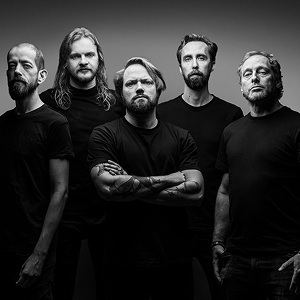
Ahead of our upcoming review of their debut full-length “Axis,” Jacopo at Progressive Rock Journal sat down with Amsterdam Heavy Psych/Stoner Doom outfit Cervus to discuss a decade of sonic evolution, the personal weight behind their new record, and the craft of shaping a 55-minute wall of sound.
Formed in Amsterdam in 2016, Cervus has spent nearly a decade in the Dutch Heavy scene. How would you describe the band’s core vision when you started, and how has your internal dynamic evolved since then?
We started out as a jam band with some colleagues, basically just fooling around, having fun and drinking beer every Tuesday night. Trying different music styles and influences but always with a heavy orientation. We were called Skytorpedo at the time and had various lineups in the band before our drummer Rogier Henkelman joined in 2018. From that point onward we started to take the band more seriously, and decided we should start recording some demos, finishing some songs and get out of our rehearsal cave. We started to be more dedicated and focussed to find our specific sound. Cervus was ‘born’ in that moment in a way, though we only decided to change our name a year or two later just before releasing our first EP Ignis. – Tom Mourik (Bass)
Looking back at your early releases, from “Ignis” (2021) to “Shifting Sands“ (2023), how do you view that progression today, and what did those sessions teach you leading up to your debut LP?
Without Ignis and Shifting Sands we could have never made Axis. Our album was formed and ‘crystalised’ out of maybe 40 songs that we had written during our ‘jam days’. We killed a lot of darlings, made clear decisions which songs matched the best together on a record and the current ten songs that made it to the album stood out for all of us. Where Ignis has a more a straight forward stoner, 70’s hard rock kind of approach, Shifting Sands and our single Cycles lend more from psychedelic and doom influences. Axis is a sort of culmination of our previous work and we would like to think that it transcends different genres to make our own specific sound. We made extra effort to use more dynamics within the songs, to have more breaks in between all the heaviness, so the heaviness feels even heavier. We feel our music and writing has become a lot more mature and grounded since our previous releases. – Jan Woudenberg (Guitar)
With dual guitars, keyboards, and harmonica in the mix, how do six musicians build such a massive “wall of sound” without crowding the arrangements?
Oh, we crowd the arrangements! But yeah, that’s been a challenge since the beginning. Especially starting as a jam band where everyone could do whatever they wanted, all the time – if that’s the attraction it’s a tough sell trying to get people to play less. But everyone really matured this time around. I think with this record in particular we did a pretty good job at making sure everyone’s parts support the others. Either you reinforce what someone else is playing, or you come up with something that dances and flows around it, but whatever it is, it’s all about playing with intent. – Rogier Henkelman (Drums)
How has your local ecosystem and playing live stages like Le Guess Who? U shaped Cervus as a live act over the years?
Due to the fact that our first EP Ignis was picked up quite well, we started to play more live. The fact we had some good reviews and response helped us to be able to play a wider variety of venues. In the last few years we have developed ourselves as a real dynamic live band and have been able to make significant progress playing for different audiences. We always try to bring an infectious enthusiasm to the stage and are known to be able to fire up a place. We also made good friends with other Dutch bands in the scene. And because of our ‘crossover’ kind of sound, where we combine different aspects of different genres, we are able to match with different kinds of bills. – Jan Woudenberg (Guitar)
Even though we started out as a “fun” project on the side. We take it seriously enough to go places and make the best of every opportunity we get, because we are pretty niche in what we do. Every stage big or small should be handled with the same grandeur, giving the people more of their money’s worth. And that show mentality we like to get better at. At a concert “stage performance” is half the battle. – Dennis de Bruin (Guitar)
The local heavy rock scene here is small, so playing places like that feels equally like a big opportunity as a good hang with likeminded people. In Amsterdam the scene is basically held together by one woman, Els Bruinewoud (Love For Loud, The Wormhole Cult). She organizes a lot of amazing concerts around the city out of sheer love for music, featuring local bands as well as bands from all around the world. A bunch of volunteers and local musicians help Els to put together these really special evenings. There’s an immediacy and a DIY attitude there that can’t help but shape you. – Rogier Henkelman (Drums)
“Axis“ deals with profound grief after several band members lost a parent during its creation. How did this shared experience shape the writing process, and was music your primary cathartic outlet?
During the years of writing and recording the album, we did lose different family members. It was something we had to deal with and something we carried with us on this journey. After some time, we began to see patterns in the songs that reflected a kind of mourning process. It starts with the pure fury and powerlessness of loss and ends with a sort of harmonic understanding of grief, allowing us to give that loss a certain place within our being. Everything in between is the storm of emotions and the various healing processes involved in coming to terms with the fact that someone is simply no longer there. The lyrics were also shaped around these themes, and if you read them, you’ll be able to discover the overall story told throughout the record. So, rather than being primarily a cathartic outlet, the album became more of a foothold, a driving force and a means of healing. – Jan Woudenberg (Guitar)
Because so many things happened in this pocket of time we as artists/musicians can only answer our grievances by writing and playing about them, not always in the literal sense, but you do take a bit of emotion with it in the work. It sure fuels the process. – Dennis de Bruin (Guitar)
Spanning 10 tracks and 55 minutes, at what point did you realize these compositions formed a single, cohesive album rather than another EP?
After the release of two EP’s and a single we always knew the next release should be a full album. We had so many songs, ideas and rough sketches and through the production of the album we tried to make sense of them and tried to really give them a special Cervus touch. The ten songs on the album are really the summary of that process. There are songs on the album that are many years old but also songs that just came into being, songs that were merged together and songs that were acquired from live jams. We hope the album feels like a journey that takes you to places and different soundscapes, and forms a cohesive experience that you can listen to time and time again. We really feel that Axis becomes better the more you listen to it, and that is something we are very proud of. – Jan Woudenberg (Guitar)
“Black Masquerade” opens the record with a disorienting soundscape before breaking into heavy riffs. What made this track the right opening statement for ”Axis”?
We had pretty much the whole album lined up but we felt that we missed the right opening. There was an album in there, and all the songs are great but none of them made sense as an opener. Since it ranges from hard-as-nails riffs to psych jams, it needed something grounded to pull the whole record together. After writing some songs at home, Dennis and I got together and just passed a guitar back and forth. We each tried riffs until we hit something that felt like it hit that spot. It was the last song we came up with for the record, and it’s the most goal-oriented writing we’ve ever done, but I think it paid off. The disorientating soundscape symbolises the start of the journey, to get the world back on its axis, and kind of launch you into the album. – Rogier Henkelman (Drums)
We decided on little soundscapes here and there early on. To us it fits the vibe: The shift from equilibrium into chaos of the individual’s inner self as a reaction to the external events that are about to happen. – Dennis de Bruin (Guitar)
Lyrically, “Black Masquerade” explores sorrow and disillusionment. What is the central emotional core behind this piece?
Black Masquerade was one of the last songs I wrote lyrics for and looking back on it I think it really sets the tone of the album. It paints a bleak vision of a world in decay after a pivotal person passes, one who upheld a balance of some sorts. The protagonist of the song fully depended on this person, but now he or she needs a new way forward. I believe that parents, especially during your formative years, shape your view of the world. When they pass, that responsibility falls to you and you need to seek your own truth. So on one hand it’s quite bleak, but also hopeful. – Tom van der Linden (Vocals)
The album closes with “Golden Arms,” an intimate Psychedelic Folk piece dedicated to Tom’s late mother. How did that track come together, and why was it important to end the record on that note?
Golden Arms was one of those magical little jams that just came into being during a writing weekend on Texel, back in September, 2022. Rogier, our drummer, who happens to be a great guitar player as well, was strumming away on a guitar while we were hanging out and having some late night beers. We hit the recording button as fast as we could and I chimed in immediately with some vocal lines. Later, at home, Rogier added a nice lead guitar and some other finishing touches to the demo. A few years later, I wrote the lyrics after my mother’s passing and thus Golden Arms was born. It’s the ultimate ode to my mother’s warmth and wisdom. I personally thought it would really suit the album’s main core theme of loss and grief to end on a smaller, intimate note. The pain of losing a loved one comes in waves, huge and small, and after the bombast of Remember My Name, it provides the perfect contrast and a sweet goodbye to an album full of highs and lows. I also think it’s just ballsy to end a stoner rock album with a folk song. I can’t think of many examples of bands in our genre that have done something similar. – Tom van der Linden (Vocals)
The first half transitions from Heavy riffs into the Darker, Folk-tinged atmosphere of “Fading From View.” How do you approach pacing and contrast when sequencing an album?
We tried a couple of variations on album structure by just listening a lot to it in different orders and discussing it with each other. It didn’t take long to land on the sequence that we have now, because it just felt like the most natural order for the album. We made sure that there would be enough variation in tempo, length and intensity throughout the album, with enough contrast between songs. After a couple of heavy ones, you want a bit of a break, and vice versa. If it’s just heavy riffing all the time, it kind of loses its heaviness and impact. We kept the longer epics for the end, and the more easily accessible straight forward heavy rock songs for the beginning, to reel people in basically. – Tom Mourik (Bass)
Track five, “Roamer,” serves as a panoramic instrumental midpoint. Was it written intentionally as a breathing space, or did it assume that role naturally?
It assumed this role naturally. Our previous EP Shifting Sands also had an instrumental song called Tempest, and we all really liked the experiment of doing an instrumental piece every now and then. With that in mind, and the fact that we really liked Roamer, we knew we wanted to have it on the album for sure. And it seemed to fit perfectly in the place that it ended up on on the album. It serves as a well deserved calm moment after 4 heavy songs; a breath of fresh air before diving back into the fuzzy depths again so to speak. – Tom Mourik (Bass)
Immediately after “Roamer,” the record erupts into “Harbinger of Rain,”two minutes of desert punk intensity. What inspired such a swift burst of speed at that turning point?
Mostly, pacing. After two mid-tempo, introspective songs like Fading From View and Roamer, we felt the album needed a shot of adrenaline, a rough wake up call of sorts. It keeps the album from falling into a slump, and it amps you up for the three epics afterward. I think that a lot of stoner rock albums tend to generally hover around mid-tempo, which often in my view can kill the pacing. – Tom van der Linden (Vocals)
I guess it serves as a reminder that, yes we do make more calm and psychedelic stuff, but you’re still listening to Cervus! We just love that you’re in this beautiful psychedelic landscape, and then you get a loud wake-up call with Cervus kicking in the door again. And apart from that it’s also a bit of a joke because the contrast is so extreme, it honestly cracks us up every time we listen to it. Maybe it’s also because we’re all animators, and we just love cartoony comic timing? – Tom Mourik (Bass)
‘A swift burst of speed at that turning point’ is where you hit the hammer on the nail. Harbinger of Rain is a certain turning point on the album, maybe even the Axis the album title refers to! After Harbinger of Rain we start to explore different atmospheres of the record and introduce more heavy psych epics, more drawn out, spacier and experimental songs rather than the short bursted heavy riff orientated songs from the start of the album. – Jan Woudenberg (Guitar)
Tracks seven and eight, “Faces Of Evil” and “Beneath The Waves,” form a 16-minute diptych of Heavy Psych epics. What was your compositional approach to these long-form pieces?
Beneath the Waves is real Jan jam. It almost arrived wholesale, plucked from the ether. I listened to the recording of the first jam on that song, and though it’s messy most of the ideas were already in there. We revisited it a couple of times leading up to the recording session, but a lot of the riffs and flow of the song were there already, even some vocal lines. It really came together in the studio though: the drums, bass and rhythm guitar were a solid base, but Dennis really got a chance to freak out over it. He’s the reason it moves from groovy to frantic so effortlessly. – Rogier Henkelman (Drums)
Faces of Evil was an old jam that Dennis came up with, which eventually had 100 different versions and was actually ‘stuck in the mud’ for a while. We nearly decided to give up on it, until Tom van der Linden and I came up with a new verse, and then all the pieces fell naturally in their place. We went for maximum contrast by stripping the verse of pretty much everything, and then blasting at full force the rest of the song. – Tom Mourik (Bass)
Non-traditional elements like harmonica and subtle soundscapes are woven throughout the record. How do you integrate these textures into a heavy stoner doom framework?
It wasn’t really a matter of integrating anything: all those elements are there because in some moments we felt we were missing something. The harmonica was Tom’s idea, to add a little moment before the verse starts. It was played by Sergej Joksimović , who built our rehearsal studio with his team. It only felt right to feature him on this record in some way. The soundscapes were Dennis’s idea, to help ease some song transitions, and to glue the songs together. – Rogier Henkelman (Drums)
It comes down to a gutfeel, when you are really invested and pretty much breathing the whole record, new flavors emerge from the id that were not there before. We knew some parts needed something for sure but it did not always work with ‘conventional ways’. The new sounds we tried fit surprisingly well. – Dennis de Bruin (Guitar)
“Axis“ was recorded in-house at WOODROX Studios and mixed by your drummer, Rogier Henkelman. What are the main benefits and challenges of self-producing an album like this?
The biggest benefit is freedom, the ability to do exactly what you want, how you want it. And of course it allows you to take as much time as you need. A lot of producer-mixer-types have their sound, and think they help a band by imposing their vision. Which is fair, it’s often why they get asked. Cervus has a particular kind of groove and texture though. There’s a thing that happens when we’re in a room together. It can be heavy but it’s got to feel organic (the ‘Cervus swing’ as Tom calls it), and I’m really protective of that. The main challenge is not losing perspective. With so many moving parts and as chaotic as all our lives got these last few years, I think each of us lost perspective or patience at some point. This album took a long time to make, and the longer it takes, the more you get used to the idea that it takes a long time to make. Why start rushing now? – Rogier Henkelman (Drums)
In comparison with our previous releases ‘Axis’ is an immense leap forward. We always have self-produced our releases with the means we had at hand. Previously we had to work with ‘everyday household grade’ equipment, also for financial reasons. That changed with WOODROX. We built the studio ourselves and were able to invest in some proper preamps and microphones. Also, through the years, Rogier developed himself further as an engineer/ producer and we think the results are clearly present in the sound of the album. There is always the danger that you become the director of your own movie but fortunately Rogier has four other ‘picky’ band members with opinions that have been trying hard to get the best possible mix we could conjure up! The main benefit of course being the fact we can get as close to the general Cervus sound we all feel does justice to the songs and the overall feel of the album. – Jan Woudenberg (Guitar)
For mastering, you worked with Karl Daniel Lidén. What distinct qualities did he bring to the final sound of “Axis”?
Above all, Karl’s a pro! Very pragmatic, very quick and very easy to work with. The record is kind of all over the place, in terms of sound and dynamics. By his own admission that was a challenge. But he did a great job protecting the subtleties in the quieter, more spacious parts, while letting the heavy parts breathe. It’s loud but never choked. The result is a surprisingly easy listen. – Rogier Henkelman (Drums)
As an independent listener he also could think ‘out of the box’ and gave us an updated and matured version of the sound we had in mind and wanted for this album. – Jan Woudenberg (Guitar)
The album’s photography and visual layout were handled internally by the band. How does the artwork reflect the themes of loss and mortality found in the music?
The album cover is inspired by a classic vanitas still life and is foremost an altar and ode to our lost ones; The deer skull represents our band. In latin ‘Cervus’ translates to ‘deer’, and it’s more or less the protagonist of the cover. In the backdrop we placed a globe that has been tilted from its axis. The idea behind it is that your whole world shifts on its axis when you lose someone that is close to your heart. The other objects are all personal items of our lost ones. To set it apart from a classical vanitas we decided to do something more interesting with colours and lighting and thus make it less of a Death Metal album cover. – Tom Mourik (Bass)
As an independent band navigating Bandcamp and the global doom community, what is your perspective on the health of today’s underground scene?
The scene is alive and well! But underground means you gotta search a bit harder, but if you keep helping each other by posting and sharing bands and playing with one another you’ll find new music, friends and venues. – Dennis de Bruin (Guitar)
We think there is an amazing scene out there with really good bands that all try to raise the bar for heavy underground music. We are immensely inspired by bands such as Lowrider, Elephant tree, Rezn, Elder, Dozer, Messa, the list goes on and there are so many awesome bands active today. It’s actually a very exciting time to be able to be part of this movement. Also working with Karl Daniel Lidén was an absolute honour for he did so many iconic records that keep inspiring us to this day. – Jan Woudenberg (Guitar)
With “Axis” releasing on November 13, 2026, what are your upcoming live plans to bring these new songs to the stage?
We got a couple of gigs lined up in November in Utrecht and Amsterdam. Our plan is to do a lot more shows next year to promote the album. We are also hoping to have an official release party sometime in the first half of next year if possible. And going for a mini-tour in neighboring countries like Belgium or Germany is a dream that we are dreaming currently, but there’s no concrete plans for that yet. Keep an eye on our socials or our website for more info about upcoming shows, or follow us on Bands in Town or Songkick, we regularly update those – Tom Mourik (Bass)
Our thanks to Cervus for taking the time to speak with us. “Axis” releases officially on Friday, November 13, 2026, via Bandcamp and all major streaming platforms. Stay tuned to Progressive Rock Journal for our upcoming full review of the album.
Purchase “Axis” on Bandcamp: https://cervustheband.bandcamp.com/album/axis