

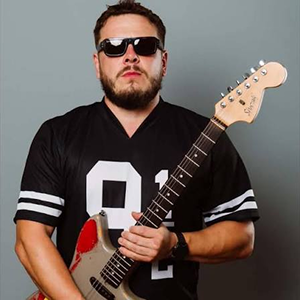
Across more than two decades of artistic evolution, Slovakian guitarist, composer, and producer David Kollar has carved a singular path at the crossroads of Art Rock, Jazz Prog, Avant-Garde, and Cinematic Soundscapes. Known for high-profile collaborative ventures, co-founding the powerhouse trio KOMARA with King Crimson’s Pat Mastelotto and Trey Gunn, contributing guitar work to Steven Wilson‘s projects (“To the Bone,” “No-Man’s Love You to Bits,” “The Harmony Codex”), and recording alongside atmospheric trumpet masters like Arve Henriksen and Nils Petter Molvær, David treats the electric guitar not merely as a solo instrument, but as a gateway between raw architectural ideas and sound design.
His latest solo release, “Music From The Bag,” released July 30, 2026, unearths a decade of accumulated sketches, transforming them into nine dense, rhythmically intricate instrumental tracks. Following our detailed review on Progressive Rock Journal, we caught up with David to discuss the mechanics of sound design, his philosophy on technological tools, his collaborative history, and the evolution of modern Experimental Rock.
Welcome to Progressive Rock Journal, David. As this is our first formal interview with you, let’s look at the arc of your career. You’ve navigated Jazz-Rock, Heavy, Art Rock, Ambient Electronics, and Film Scoring. How do you view your stylistic evolution from your early guitar work to your present sound design philosophy?
I see it all as one big mosaic. Every period of my musical life, every genre I’ve explored since I started playing, has been and still is an important piece of that mosaic. Thankfully, there are so many possibilities today in terms of what you can do with music and audio that sometimes I don’t even know what to explore first. I feel that I’ve been influenced by all the styles you mentioned, and I actually see that as a big advantage.
Your collaborative resume features formidable names in Progressive and Experimental music, co-founding KOMARA with Pat Mastelotto, working with Trey Gunn on KOMARA II, and contributing guitar tracks to Steven Wilson’s solo and side projects. What key compositional or sonic lessons did you take away from working alongside such distinct musicians?
I think the biggest thing I’ve learned from all of them is freedom. Not being afraid to go somewhere I’ve never been before and create something interesting. All of the musicians you mentioned would send me musical material and basically say, “Record whatever you want, however you want. I’ve also played live with Pat and Trey, but never with Steven. What I find almost contagious about all of them is their work ethic, their discipline, and the way they give themselves 100 percent to whatever they’re working on.
You have also developed a deep musical shorthand with trumpet visionaries like Arve Henriksen, Erik Truffaz, and Nils Petter Molvær. What draws you as a guitarist to the breathy, vocal-like phrasing of open and processed trumpets?
Both, actually. And the trumpet can play melodies in a way that the guitar simply can’t. I love having that sonic element in my music. To me, it sounds almost like a human voice, and when you have a really good trumpet player, magical things can happen. Sometimes, when I play live with Arve, I get goosebumps right there on stage just listening to him play.
Beyond record releases, your work extends into Film Scoring, including sessions with acclaimed Hollywood composer Thomas Newman and your recent in-depth discussion with Rick Beato in Atlanta. How does improvising for visual media alter your approach to guitar technique and harmonic pacing compared to writing solo albums?
Working on films always makes me create music that I probably wouldn’t create otherwise. I often explore genres or emotions that I wouldn’t necessarily put on one of my own albums. It’s a nice kind of compromise for me. I’ve listened to a lot of music and played in so many different styles over the years that I can react to what’s happening on screen quite quickly. On the other hand, when I’m making my own music, I never know in advance what it’s going to be. An idea or a concept simply comes to mind, and I start exploring it. And somehow, I end up releasing two albums a year.
“Music From The Bag ” gathers material spanning roughly ten years of ideas, riffs, and unreleased sketches. What made you decide in the winter of 2025 that it was finally time to open this “bag” and bring these specific pieces to completion?
It was bothering me to have all these unfinished pieces sitting on my hard drives. Some of them were ideas I hadn’t used for KOMARA, others hadn’t fit into any of the films I’d worked on, and many of them reflected my earlier fusion period. At some point, I just said to myself, “Enough. I’m going to finish these things.
In our recent album review on Progressive Rock Journal, we highlighted how the record feels like a deliberate distillation of compositional control rather than a random collection of leftovers. How did you select these nine final tracks out of a decade’s worth of archived ideas?
I think one of the reasons the album sounds so cohesive is that I re-recorded all the instruments from scratch. I wanted everything to have a consistent sound and feel as though it came from the same period. I think I originally had about six tracks, and I finished three more so that the album would be a decent length. (laughs)
You mentioned that many of these sketches leaned toward Rock and Fusion but remained unfinished for years primarily because they lacked a committed rhythmic framework. Why was a conventional drum recording session not the right answer for these specific compositions?
Drums are always the biggest challenge for me. I know that if I ask Gergo Borlai, Marco Minnemann or Pat Mastelotto to record drums for me, they’ll do it, but I usually have to wait a while. I also really enjoyed experimenting with the technology available to me. I didn’t want the drums to sound entirely conventional. I wanted you to hear that the sounds had been manipulated, although that’s not the case on every track. There were basically three reasons: I didn’t want to wait, I wanted to avoid having a completely different drum sound on each track, and, most importantly, I really enjoyed doing it this way this time around.
The percussive foundation of “Music From The Bag“ is fascinating. You conducted nearly 600 experiments transforming recordings of Arve Henriksen‘s trumpet and your own frame drum hits into drum pattern layers. Could you walk us through the technical workflow of turning brass and acoustic hand drums into synthetic drum kits?
When I was working on the music for the film MIKI, Arve sent me several samples of himself beatboxing through his trumpet. I edited the rhythmic patterns and then gave AI a prompt to turn those trumpet sounds into drums. Of course, it wasn’t that simple, because AI tends to produce those nice, sexy, listener-friendly tracks — the kind of commercially appealing music you hear in the background while shopping at a mall. And that was exactly what I didn’t want. That’s why I ended up with more than 600 exports. I then edited and manipulated the material further in Logic Pro X and recorded additional instruments on top of it.
Artificial intelligence was used during these percussive experiments. You have been very clear that AI must remain a tool in the author’s hands rather than a composer. Where do you draw the line between technological exploration and human creative decision-making?
For me, the dividing line is quite clear. On one side, you have an artist who uses technology but still has the final say and shapes the material according to their own artistic vision. On the other side, you have someone who asks AI to generate entire compositions and then presents them as their own work. I see a big difference between using technology to express your own ideas and asking technology to come up with those ideas for you.
On tracks like “Freezing Again,” you superimposed two distinct rhythmic layers to build a polyrhythmic foundation. How did you manage frequency separation and timing precision so the dual rhythms enhanced the groove without cluttering the mix?
I have to admit, it was all very intuitive. I’ve always loved those moments in King Crimson’s or Nils Petter Molvær’s music when two drummers were playing at the same time. I didn’t really approach it from a technical perspective. I just listened and went with what felt right. I do a lot of things in music this way — actually, almost everything.
You handled virtually everything on this record, guitars, bass guitars, synthesizers, piano, and programming. Did taking total control over the entire instrument chain change how you approached the guitar soloing versus the textural backdrops?
Yes, to some extent. I see guitar solos as just another colour that I can add here and there. My guitar has many different sounds and sonic possibilities, and I think I used almost all of them on this album. These days, I don’t really think so much about guitar licks or which scale I should be playing. I think more about what kind of colour I want to add to the composition through the solo.
The opening track, “Rusted Sample,” sets a clear tone by placing heavy, saturated fusion guitar phrasing over an electronic drum grid. How did you structure the dialogue between the rigid pulse of the synth-drums and the expressive freedom of your lead lines?
As I mentioned earlier, it all happens quite spontaneously. I follow my ears. I really don’t have a particular system or method for doing these things. All my albums come together this way, regardless of the musical style. I’m a big fan of Andrei Tarkovsky, who was a very intuitive filmmaker, and I can relate to that approach. I guess all the music I’ve listened to throughout my life has created this mixture of different musical worlds inside me, and somehow, it finds its own way out.
“Twenty-Four Hours” is a tight, two-and-a-half-minute structural contraction with spoken vocal inserts. What inspired the micro-timing and vocal modulation choices on this piece?
It’s my personal statement against the war in Ukraine and a reaction to the way Donald Trump approached it. He said that if he won the election, he would end the war within 24 hours. When Russia invaded Ukraine, it was quite frightening for us here in Slovakia, even though we’re a NATO member. At the time, we feared that Russia would take over Ukraine in three days and end up right at our border. So, in a way, this piece is my inner scream.
“Forgotten Tape” serves as a reflective breathing space featuring piano writing alongside subtle electronic textures. Was this track an actual vintage tape recording from your archives, or was it composed specifically to provide emotional contrast on the album?
It’s just a title, really. It was originally a stray demo I’d put together using some old samples I had in Ableton Live. I built the piece around those samples and then recorded some guitars over it. I see it more as a kind of interlude on the album.
The centrepiece, “Freezing Again,” runs over six minutes and uses metric modulations and cumulative dynamics. How did you structure its long-form soundscape to ensure the tension built organically over time?
It’s actually a different version of a piece called “Freeze the Last Smiles” from my album Behind the Frozen Window, where my daughter reads poems by Valerij Kupka. It’s a variation on that original piece. If you listen to Behind the Frozen Window, you’ll probably understand what I mean when I say that every album I make is different. (laughs)
“Tension Field” is arguably the most confrontational piece on the record, pushing low-end frequencies and refusing to resolve melodically. What was the goal behind creating a track entirely centered on frequency tension?
I really don’t think about music in those terms, but I’m glad you have such a good ear and notice these things in my music and put them into words. It actually makes me go back, listen to the piece again and think about it from a different perspective. This is also a kind of interlude for me, an emotional transition between two pieces. I see it as a short, open-ended poem.
The album closes with “When The Bag Is Empty,” bringing together fusion lines, electronic pulsation, and wide ambient passages. Did you compose this track knowing it would summarize the record’s entire stylistic scope?
No, not really. When I had most of the material finished, I started putting the tracks in order. This piece felt quite comprehensive to me, so it made sense to put it at the end of the album. It also features two short solos — one in the spirit of Jeff Beck and the other using a harmonizer, more in the style of Jon Hassell.
Given the intricate, dual-layer drum programming and processed textures on “Music From The Bag,” how do you envision performing this material live? Will it be a solo multimedia set, or do you plan to translate these patterns to a live band?
I have to admit, I have no plans to perform this album live, which is actually the case with most of my albums. For me, live performances are always a continuation of my creative process. Maybe if I got back together with my trio, with Gergo Borlai on drums and Lorenzo Feliciati on bass, we could learn these pieces and adapt them to sound like a real live trio, with plenty of room for improvisation. I never play my compositions exactly the way they sound on the albums.
As an artist operating at the intersection of Art Rock, Jazz Prog, and Avant-Garde, how do you view today’s progressive music scene? Do you feel audience appreciation for instrumental, sound-design-focused albums is growing?
I have to admit, I don’t really follow the progressive music scene at all. I do follow Steven Wilson’s work, though, and what I enjoy about him is that he keeps moving forward. I don’t necessarily mean getting better, but you can hear that he’s a curious musician who wants to explore new things. That’s what I like about him. He also always seems to have a concept behind each album. But I’m honestly part of the progressive rock scene almost by accident. I don’t really follow what’s happening in it or who’s doing what. I love listening to classical music. I recently bought Górecki’s Third Symphony on vinyl, I read books, and from time to time I listen to Jon Hassell.
“Music From The Bag“ is available now on Bandcamp and streaming platforms. You can read our review of the album on Progressive Rock Journal. To explore David Kollar‘s extensive discography, video interviews, and upcoming project updates, visit his official Bandcamp page.
“Music From The Bag” is available on Bandcamp and streaming platforms. David Kollar has also recently released his new solo album, “Guitar Stories,” through 7D Media on November 06, 2026.
To explore his extensive discography, books, video interviews, upcoming concerts and projects, visit his official website at https://www.davidkollar.com.
For more personal insights into his creative process, thoughts on music, art and life, as well as articles and podcasts, follow his blog on Substack at https://davidkollar.substack.com.
Read our Review of “Music From The Bag” here: [Review] David Kollar – Music From The Bag