

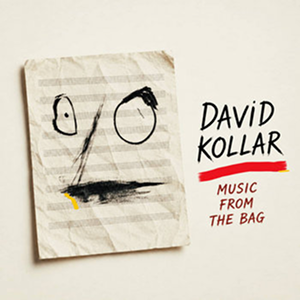
There is a particular strain of guitar writing that lives in the gap between composed architecture and spontaneous discovery, where a chord change is neither a cliché nor a free association, but a calculated risk dressed in the grammar of Jazz Fusion or the texture of Ambient Electronics. David Kollar has spent the better part of two decades operating precisely in that territory. His credits speak to a career built at the intersection of Art Rock, Jazz Prog, and the broader Avant-Garde: co-founding the trio KOMARA with Pat Mastelotto (the rhythm engine behind King Crimson), extending that project into “KOMARA II” with Trey Gunn‘s Warr-guitar vocabulary, contributing guitar work to Steven Wilson‘s projects, “To the Bone,” No-Man‘s “Love You to Bits,” “The Harmony Codex,” crossing into the free-improvisatory world of the Norwegian and French trumpet scenes with Arve Henriksen, Erik Truffaz, and Nils Petter Molvær, and stepping into the cinematic improvisation sessions of composer Thomas Newman. “Music From The Bag,” released on July 30, 2026, is a solo statement drawn from roughly a decade of accumulated ideas, riffs, sketches, half-finished structures that, for years, could not find a final shape because they lacked a committed rhythmic framework. Kollar has now supplied that framework himself, and the result is a nine-track album that reads less as a collection of “leftovers” than as a deliberate distillation: a distillation of compositional maturity, formal discipline, and a willingness to let electronics and ambient texture occupy equal footing with the guitar rather than merely underline it. What distinguishes the record is that none of its elaborations, polyrhythmic layering, synthetic drum design, long-form soundscapes, ever retreat into hermeticism. The textures are dense, the time signatures shift, the harmonic language borrows from Jazz and the Avant-Garde alike, yet the writing consistently finds a human, singing line at its centre. It is experiment with the safety pin still in it. The album opens with, “Rusted Sample,” a track that immediately establishes its dual identity: a layered rhythmic substrate built from processed sampling and synthetic drum design, against which Kollar‘s guitar, treated in a Rock/Fusion register, carries the melodic weight. The balance is the point. The synthetic pulse never smothers the phrasing, and the phrasing never drifts into unaccompanied improvisation. Heavy, saturated guitar tones lock into the electronic grid with a confidence that suggests the part was written for the rhythm, not fitted over it. It is a compact, effective statement of intent: this is a guitar album that has chosen its instruments carefully. A structural contraction in the strictest sense, “Twenty-Four Hours,” two minutes and twenty-six seconds in which micro-timing precision and the interplay between bass and synthetic tones do most of the narrative work. Spoken-vocal inserts repeat the title, threading through a web of guitar technique, effect modulation, and electronic layering that keeps the tension taut from downbeat to final bar. This is the album’s most explicitly Experimental and electronic track: a piece in which the “instrument” is as much the processing chain as the fretboard. In “Red Dust” the rhythmic section shifts to a percussion-led profile, and the timbral palette opens into Ambient and Avant-Garde registers. Guitar lines intertwine with what reads as ethno-influenced percussive textures, generating a sustained, low-level tension that the track’s brevity only sharpens. In under two and a half minutes, Kollar sketches an atmosphere rather than a melody, a rare economy of means. A key passage in the album’s arc, “Before We Devide.” The arrangement favours fluidity: synthesizer pads and melodic guitar lines enter into a continuous dialogue, neither subordinating itself to the other. The rhythmic section picks up Electronic inflections and additional percussion, opening spaces for Fusion-tinged solo phrases that nestle naturally within an overall Ambient/Avant-Garde architecture. Crucially, the intensity stays high without ever tipping into display. This is writing that trusts structure to generate excitement. “Overdrive” is the most unambiguously Rock statement on the record. Drum layering is deployed for its sheer kinetic impact, and the guitar’s overdrive treatment is allowed to sit at the front of the mix, a deliberate callback to Kollar‘s heavier, more straightforward past work. Yet even here the rhythmic foundation is electronic, intricate, and subject to continuous time-change, over which Kollar places refined, economical guitar lines. The effect is of a Rock song that has been passed through a prism: the energy is intact, but the refraction is electronic. A nostalgic fragment in which Kollar‘s piano writing emerges alongside delicate electronic textures, “Forgotten Tape,” is a reminder of the artist’s polychromatic instrumental range. The track’s architecture is the same as elsewher, modern tonal palette, solo guitar interventions, but the presence of the piano and the overall gentler dynamic give it a reflective, almost archival quality. It is the album’s breathing space: brief, warm, and pointedly human. The longest track and, structurally, the album’s centrepiece, “Freezing Again.” Two superimposed rhythmic layers generate a polyrhythmic foundation, implicit metric modulations and a carefully managed dynamic architecture give the piece a slow, cumulative architecture. Kollar develops the central theme through Ambient and atmospheric passages, long soundscapes, layered textures, against which his solo lines function as counterpoint rather than climax. The length earns its keep: this is where the album’s interweaving of modern electronic vocabulary and more classical, through-composed sensibility is most fully realized. “Tension Field” is a concentrated exercise in low-end and mid-range frequency design. Bass and synthesizer tones are pushed into angular, unyielding registers, and the structure refuses to breathe, no rests, no melodic resolution. It is the album’s most confrontational two-and-a-half minutes: brief, complex, and entirely committed to the idea that tension itself can be a compositional material. The closer “When The Bag Is Empty” carries explicit conceptual weight, the title enacting the album’s premise in miniature. Every stylistic register encountered across the preceding tracks, Fusion phrasing, electronic pulsation, rhythmic stratification, Atmospheric opening, converges here in an organic, cumulative statement. Layered guitar work evolves the main theme over a rhythm section in constant flux, wide, dilated atmospheric passages provide release before the thematic material returns, propelled by guitar phrasing that carries the listener cleanly to the final bar. It is a satisfying dissolution: not a fade, but a resolution. The “bag” that gave this album its name, ten years of riffs, sketches, and half-formed structures, has been fully emptied, and what remains is a cohesive, filler-free record in which every track earns its place. Kollar is explicit about the philosophy that underpins the project: technology, including AI-assisted tools, has a legitimate role only when it remains instrumental, a means in the hands of a human decision-maker. The creative choices on “Music From The Bag” are, in every audible sense, his. The result is a work of considerable compositional maturity, formal precision, and technical command that reinforces, rather than merely restates, his position as one of the more distinctive voices working at the crossroads of Art Rock, Avant-Garde, and Electronic Music. It is not a loud record. It does not need to be. It simply does not waste a single bar.
Tracklist
01. Rusted Sample (04:09)
02. Twenty-Four Hours (02:26)
03. Red Dust (02:13)
04. Before We Devide (03:38)
05. Overdrive (04:26)
06. Forgotten Tape (02:41)
07. Freezing Again (06:06)
08. Tension Field (02:56)
09. When The Bag Is Empty (05:14)
Lineup
David Kollar / Everything