

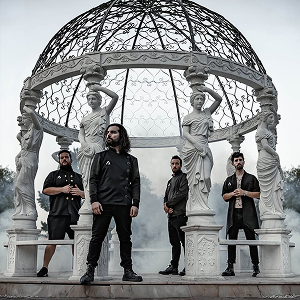
Portuguese Progressive Metal outfit Apotheus are set to release their fourth studio album, “The Complex Permutation,” on November 20, 2026. Known for blending intricate rhythms, Technical Heavy riffs, and expansive narrative Sci-Fi worlds, the band returns with an ambitious cosmic saga detailing a conflict between the collective entity GODS and the primordial VOID. Ahead of our upcoming album review, we caught up with the band to discuss the philosophical depth behind the new record, their sound evolution, and their journey through the European Prog scene.
“The Complex Permutation“ marks your fourth full-length album. Looking back at your evolution from earlier works like “When Hope And Despair Collide“ through “The Far Star and Ergo Atlas,” how do you feel your musical and thematic identity has matured over the years?
Miguel: “I think the biggest change has been finding our own identity. When we started in 2008, we were essentially a group of friends who loved heavy music and wanted to create something together. “When Hope and Despair Collide” belongs to that earlier period, when we were still discovering what kind of band we wanted to be. “The Far Star” was a turning point. We began telling an original science-fiction story, explored cleaner vocals and more structured compositions, and suddenly had a common universe that could guide the music. “Ergo Atlas” allowed us to take that approach much further, both musically and philosophically. With “The Complex Permutation,” I feel we’ve become better at knowing what a song needs, and perhaps more importantly, what it doesn’t need. We’re still experimenting, but with more confidence and purpose. It also feels special to finish a story we started telling seven years ago. We’re older, perhaps a little wiser, but fortunately we still get excited about writing a ridiculous riff! 🙂“
Progressive Metal from Portugal has developed an increasingly prominent voice in the European scene. When you first formed Apotheus, what was your initial vision, and how challenging was it to build a space for Heavy, narrative-driven Progressive music coming from your region?
Miguel: “Our original vision was much simpler than the project we have today: four friends making music we genuinely enjoyed, without worrying too much about where it would fit. The ambition grew with us. We’re from a relatively small part of Portugal, and the country’s metal scene has always had remarkable quality, especially considering the resources available. What it doesn’t always have is the scale or professional infrastructure you might find in larger European markets. That can make everything harder, from promoting a release to organizing concerts abroad. For us, the answer has been to keep raising our standards and building an identity that people can recognize. The narrative universe became a very important part of that, but it wasn’t some clever marketing plan we had in 2008! We discovered it along the way. There’s still a lot of work to do internationally, and a lot of people who have never heard of us. In a way, that’s frustrating, but it’s also quite exciting.“
Science fiction isn’t just a background motif for Apotheus, it’s an interconnected universe spanning albums, written stories, and audiobooks. What originally drew you to Sci-Fi as the ideal canvas for your songwriting?
Miguel: “We’ve always been science-fiction fans, all of us, although naturally with different tastes. I was probably the one who first pushed the idea of creating our own universe while we were writing “The Far Star.” Isaac Asimov was a particularly important influence for me. In fact, the title “The Far Star” is a tribute to a spaceship in his work. What I love about science fiction is that you can take a very human question about freedom, mortality, identity, or the consequences of progress, and explore it in circumstances that could never exist in our everyday lives. It gives you an extraordinary amount of freedom as a storyteller. To be clear, our story isn’t an adaptation of Asimov or anyone else’s work; it’s an original universe we created together. The influence was more about that way of thinking. I also think science fiction fits progressive metal rather naturally. Both encourage exploration, unexpected turns, and ideas that don’t necessarily fit into a neat three-minute format.“
How do you balance the narrative world-building with the pure musical composition? Does the lore dictating the overarching storyline come first, or do guitar riffs and atmospheric synth soundscapes inspire the plot direction?
Miguel: “The main events of the story usually come first, but I wouldn’t say that the music simply obeys the plot. We need to know what is happening to the characters, and what they might be feeling, before we can give a song its direction. Then the interesting part begins: the music starts suggesting things of its own. A riff, a piano melody, or a particular atmosphere can change how we imagine a scene and sometimes even how we tell it. It’s very much a two-way conversation between the narrative and the composition. Our writing retreats are important here. We isolate ourselves for several days, sometimes longer, and work together with as few distractions as possible. We discuss the story, build the songs, discard ideas, argue a little, and eventually something clicks. 🙂 We don’t want the narrative to become a prison for the music. Ultimately, a song still needs to work as a song, even for someone who has never read a single page of our story.“
Musically speaking, where does “The Complex Permutation“ take your sound compared to “Ergo Atlas“? In what areas did you push yourselves further in terms of technical precision, dynamics, and vocal arrangements?
Miguel: “We certainly wanted to raise the bar again, but not necessarily by making everything faster, heavier, or more technically complicated. I think “The Complex Permutation” is more confident in its contrasts. There are moments of considerable aggression, but also passages where a simple melody or a little silence carries much more weight than another layer of guitars would. We’ve become more selective with arrangements and orchestration, and more conscious of how each song contributes to the emotional journey of the album. Vocally, I feel we’ve explored a wider range of intensity and vulnerability. “Boundaries,” with Björn Strid, is one example of how contrasting voices can give a song another dimension, while “Key Keeper” approaches emotion in a very different way. The production also helped us express those details more clearly. So yes, there’s plenty of technical work in there, but what makes us proudest is that it serves the songs rather than becoming an end in itself.“
The narrative core of the new record centers on a grand conflict between the unified entity GODS and the ancient force VOID. What do these two entities symbolize on a human level regarding individuality, free will, and existential suffering?
Miguel: “What’s fascinating to me is that GODS and VOID are, in some ways, born from similar ideas. Both involve the unification of consciousness, and both are powerful enough to make decisions on a cosmic scale. But they reach radically different conclusions. GODS emerges from the union of humanity and the Alphae and fights to preserve existence. VOID comes from an ancient civilization that gradually abandoned individuality because it associated personal attachment, loss, and freedom with suffering. Eventually, VOID concludes that the only way to eliminate suffering completely is to eliminate existence itself. That isn’t the motivation of a conventional villain, which makes it much more interesting to us. On a human level, the conflict asks how far we should go to prevent pain, and what we might lose in the process. Is a world without suffering desirable if achieving it means giving up individuality or free will? I don’t think there is a simple answer, and I wouldn’t want the album to pretend there is one.“
The lead single “Key Keeper” carries a profound emotional weight through Miguel Andrade‘s vocals and Heavy riff walls. What can you tell us about the creation of this track and the personal theme of loss at its heart?
Miguel: “There isn’t a personal tragedy behind “Key Keeper,” at least not in an autobiographical sense. What happens is that we immerse ourselves so deeply in the fictional story that the characters’ pain and joy can almost feel like our own. In this chapter there’s an incredibly difficult goodbye, the weight of sacrifice, and the possibility of losing everything that makes someone human. I remember sitting down at the piano with the words “See you on the other side” already running through my head. That was the seed of the song. From there, we developed it together, building around that emotional idea and allowing the heavier passages to coexist with something much more fragile. I think that contrast is what gives the song its power. The feelings are fictional in origin, but the emotion we put into performing them is absolutely real. By the time we’ve lived with these characters for so many years, it’s almost difficult to think of them as entirely imaginary.“
“Key Keeper” features the compelling philosophy: “Sometimes holding the key doesn’t mean you should open the door.” How does this dilemma tie into the larger narrative arc of the album?
Miguel: “Within the story, the Key Keeper is a human who retains the ability to reverse the unification that created GODS. Turning the key could restore the individuality he desperately misses and, with it, the possibility of returning to the life and people he loved. But doing so at that moment would also destroy the universe’s best chance of surviving VOID. That’s the dilemma behind the phrase. Having the power to change something doesn’t necessarily mean that using it is the right decision. I find it an especially human moment in a story populated by entities of almost unimaginable power. For all the cosmic scale, what matters here is one person’s capacity to live with loss and choose something larger than his immediate desire. It also connects directly with the questions raised in “Ergo Atlas”: how much of ourselves are we willing to surrender for the sake of others? I like that the answer isn’t presented as painless or heroic in any simplistic way. It hurts, and that’s precisely why the choice matters.“
The tracklist transitions through pieces like “Boundaries,” “V.O.I.D.” “Ascension,” and “A New Beginning II.” Is the album conceived strictly as a continuous, linear listening experience from start to finish?
Miguel: “Yes, there’s a clear chronology, and the order is very deliberate. Each track corresponds to a chapter or a moment in the story, and the album moves from the first encounter with VOID towards the consequences of that confrontation and, ultimately, a possible new beginning. In that sense, hearing it from start to finish reveals a lot of connections that might otherwise go unnoticed. At the same time, we don’t want to demand homework from our listeners! 🙂 “Boundaries” or “Key Keeper” should still be enjoyable as individual songs, even if you don’t know who GODS is or why somebody is holding a key. That’s always been the balance we’re aiming for with these concept albums. The music needs to stand on its own, while the story offers another layer for anyone who wants to go deeper. And because this record concludes the journey begun with “The Far Star,” listening to the full trilogy gives those final moments even more weight.“
You recorded and mixed the record with Jorge Lopes at Redboxstudio, while mastering was handled by Acle Kahney of TesseracT. What specific sonic attributes did Acle’s mastering bring to the final soundscapes?
Miguel: “Working with Acle was a really interesting experience. The most immediate improvement, to my ears, was the control of the low end. We have some very dense arrangements, and it can be difficult to maintain that weight without losing definition. We also loved how the guitars came forward: they really popped out, while still feeling part of the same sonic picture. But it wasn’t simply a case of sending the mixes away and accepting the first result. There was quite a bit of back and forth, including detailed adjustments to specific parts of the record. Acle listened to what we were trying to achieve and understood our vision, which I think is the most important quality in any collaboration like this. Of course, Jorge Lopes’ work recording, producing, and mixing the album remains fundamental. The mastering helped us take that sound across the finish line without compromising its character.“
In addition to the album, you are releasing companion text and audiobook versions of the story. Why was it important for you to make this Sci-Fi universe accessible across different media formats?
Miguel: “When we began “The Far Star,” we realized fairly quickly that the universe we were imagining had become too detailed to fit entirely into lyrics. We could write about a particular moment, emotion, or character, but explaining all the events through songs alone would either leave too much out or make the lyrics terribly awkward. So we decided to write the story as well. With “The Far Star”, “Ergo Atlas”, and now “The Complex Permutation,” that approach became an essential part of our creative process rather than an extra feature we added afterwards. The text allows us to explore the details and motivations; the songs provide a more immediate emotional experience; and the audiobook, which I narrate myself, adds another dimension through voice, atmosphere, and sound. We don’t expect every listener to consume all three formats. Quite the opposite: we want people to enter through whichever door appeals to them. But those who choose to explore everything will discover how closely the pieces connect.“
In recent years, you’ve performed at key European festivals like ProgPower Europe, Comendatio Music Fest, and Laurus Nobilis. How do you approach translating such dense studio atmospheres and Cinematic concepts into a high-energy live performance?
Miguel: “I genuinely think the live experience is where Apotheus shines. We put an enormous amount of effort into making sure a concert is more than four people standing on stage and reproducing the album. We think about the flow of the set, the transitions, the moments of tension and release, and the interaction with the audience. Technically, there’s a lot happening behind the scenes. We carefully synchronize lighting, fog, and video with the music, with plenty of work going into the cues, and we’re fortunate to have a fantastic front-of-house engineer who understands exactly what we’re trying to achieve. Those things aren’t there to distract from the songs; they’re there to make their contrasts feel even stronger. Of course, a concert also needs spontaneity and a genuine connection with the room. You can plan a hundred details, but the best moment is often when you feel the audience reacting and the whole performance suddenly comes alive. That’s an experience a studio recording simply can’t reproduce.“
You’ve shared stages with established names like Katatonia, Caligula’s Horse, Pain of Salvation, and Gaerea, alongside running your own 2025 European headliner tour. What were some of the most memorable experiences or key insights gained from these tours?
Miguel: “There have been so many memorable moments, but our 2025 European headline tour stands out because it was a very different kind of adventure. Playing festivals alongside artists we admire is an enormous privilege, and we’ve learned a lot from seeing how different bands approach the stage. But going out on our own, travelling between cities, and meeting people who had made the effort to come specifically to see us was something else. We played in some extraordinary places, including a tunnel in a medieval castle in Hungary. That’s not something you experience every day! The less glamorous side was the endless driving, the logistics, and the rather brutal summer heat. To make things more interesting, the air conditioning in our van broke down. 🙂 Our travelling companions, Hélio Ribeiro and Sérgio Rocha, were absolutely invaluable in keeping everything moving. More than anything, the tour taught us how much invisible work goes into a good concert, as well as how rewarding it is when you finally connect with people so far from home.“
Playing alongside both classic progressive bands and modern, aggressive acts like Gaerea highlights your versatile sound. Do you view Apotheus as a bridge between Melodic Prog Metal and heavier, darker modern soundscapes?
Miguel: “I think that’s a fair description, although we don’t consciously try to position ourselves between two scenes. Our tastes are simply too varied for that. We love bands such as Pain of Salvation, Katatonia, Opeth, Tool, and Leprous, but we’re also influenced by artists like Peter Gabriel, Portishead, Massive Attack, or Sade. Not all of those influences are immediately obvious in our music, and that’s fine. They affect how we think about atmosphere, melody, rhythm, and emotion. As a result, an Apotheus song might move from something very delicate to a genuinely aggressive passage without either feeling out of place to us. We’ve sometimes struggled to find a genre label broad enough to describe what we do, which is probably why “progressive metal” suits us: it leaves room to explore. If that allows us to connect with people who usually listen to quite different kinds of heavy music, all the better. I would rather have a recognizable identity than fit perfectly into a category.“
Looking at the ten new tracks on the tracklist, which song are you most eager, or perhaps most challenged, to perform live on stage during upcoming dates?
Miguel: “‘Boundaries,’ without a doubt! We’ve actually played it twice already, at two shows in 2026, and the audience reaction was fantastic. It feels particularly good on stage because it captures something that I think is very characteristic of Apotheus: there’s a crushing breakdown, but also these soothing, melodic passages that create a completely different kind of energy. The contrast makes the heavier sections feel even heavier, and the melodies more meaningful. That’s where Apotheus lives, really. And when you see people reacting to both sides of the song, it’s incredibly rewarding. We still have plenty of work ahead of us in adapting the new material to the full live show, but hearing how “Boundaries” connected with an audience has made us even more excited to bring “The Complex Permutation” to the stage.“
From customized apparel to digipaks, vinyl, and dedicated audiobooks, Apotheus maintains a very meticulous visual identity. How vital is visual art and merch design in completing the universe you create for your audience?
Miguel: “For us, the visual identity isn’t an afterthought. We spend years building a universe, so it makes sense to care about how that universe looks and feels when someone encounters the artwork, opens a digipak, or holds a vinyl record. We worked again with Nihil, the artist behind the “Ergo Atlas” cover. When we saw this particular artwork, we immediately fell in love with it. It felt remarkably close to the atmosphere of “The Complex Permutation,” and there’s a figure in it that instantly reminded us of the Key Keeper. That kind of connection is very satisfying, because the image begins to carry meaning for someone who knows the story. The same thinking extends to merchandise: we want the designs to feel connected to the music, not like a logo printed on random objects. Of course, a T-shirt doesn’t need a twenty-page explanation to look good! But for anyone who wants to explore the concept, there’s something more there.“
From your perspective within the modern European Progressive community, how do you see the scene evolving today? Is there still strong demand for deep, long-form concept albums in today’s fast-paced digital environment?
Miguel: “I think the progressive scene is in a curious position. On one hand, the way people discover music today encourages speed: short clips, singles, playlists, and an almost endless supply of new releases. That can make it difficult to persuade someone to spend forty or fifty minutes with an unfamiliar album, never mind read a story that accompanies it. On the other hand, I don’t believe the appetite for deeper experiences has disappeared at all. There are listeners who actively want to understand an artist’s ideas, immerse themselves in a concept, and return to a record because they keep discovering new details. Perhaps that audience will never be the largest, but it can be exceptionally dedicated. We try not to see these two worlds as mutually exclusive. A single or a music video can be somebody’s introduction to Apotheus; the full album, the written story, and the audiobook are there if they want to continue the journey. The challenge is reaching those people in the first place.“
For readers of Progressive Rock Journal who are discovering Apotheus for the first time through this interview, what central emotion or message do you hope they take away when pressing play on your music?
Miguel: “Above all, I’d like them to feel something. Before the science fiction, the technical passages, or the philosophical questions, this is music, and its first job is to make an emotional connection. Sometimes that means the impact of a heavy riff, sometimes it’s a melody that stays with you, and sometimes it’s the atmosphere of a whole record. If people then become curious about the story, even better. Across these three albums we’ve explored survival, individuality, sacrifice, suffering, and free will, but we’re not trying to hand listeners a set of correct answers. Personally, I find it much more interesting when a work of art makes me question something I thought I understood. So my invitation is simple: listen with an open mind, allow yourself to enjoy the contrasts, and if the universe we’ve built intrigues you, come and explore it. We’d be delighted to have you along for the journey.“
With “The Complex Permutation“ releasing on November 20th, what are the next steps for Apotheus in terms of touring plans, visual releases, or further lore expansions?
Miguel: “First, we want to give this album the live presentation it deserves. We already have our release-day show in Guimarães on November 20, and we’re working on further concerts in Portugal as well as Spain, France, Germany, Belgium, and the Netherlands. There are plans taking shape, but we’ll only announce specific dates when they’re properly confirmed. Visually, there’s also a video for “Ascension” accompanying the album release, continuing the work we’ve put into connecting the music with the story. And of course, the written story and audiobook are part of this chapter as well. As for the future of the fictional universe, “The Complex Permutation” brings the trilogy to a conclusion, but I wouldn’t say we’re closing that door forever. There are many possible ways to revisit a world like this, perhaps even from a completely different perspective. We don’t want to announce something before we genuinely know what we want to create. For now, we’re excited to finally share the ending and then play these songs for as many people as possible!“
We want to extend our gratitude to Apotheus for taking the time to share their insights with us. “The Complex Permutation” arrives on November 20, 2026. Stay tuned to Progressive Rock Journal for our upcoming review of the album.
Purchase “The Complex Permutation” HERE