

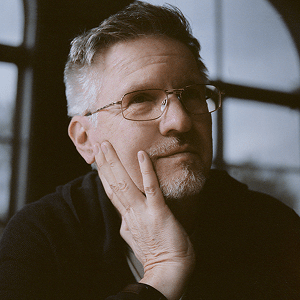
From the sonic cathedrals of Tangerine Dream in the mid-80s to the intricate, pulse-pounding textures of Hollywood film scores, Paul Haslinger has spent his career at the intersection of formal academic rigor and cutting-edge technological experimentation. After two decades of defining the sound of modern cinema and television—from Underworld to Halt and Catch Fire — Haslinger is returning to his roots of total creative autonomy. Alongside long-time collaborator Christian Wittman (of Lightwave), he has launched noion Music, a label dedicated to “Atmospheric Minimalism” and deep listening. The label’s inaugural releases, “Mallarmé” and “Borges,” serve as “curated sonic geographies” where mathematical precision meets the expansive, metaphysical depths of literature. We sat down with Paul to discuss the philosophy of the new label, his shared history with Wittman, and how a lifetime of “memory palaces” has led to this new chapter of sound art.
Paul, you’ve described noion as a platform for “Atmospheric Minimalism.” After such a vast career, what was the specific catalyst that made you feel now was the time to launch your own independent label?
When I think of record labels, the ones that truly inspired me always come to mind: ECM, New Albion, Made to Measure, Modern Love, Nonesuch. What made these labels stand out for me wasn’t just the excellent music, but the whole package: the control over artwork, the presentation as a whole, the conveyance of music. So after admiring all these labels for a long time, one quite naturally develops the wish to start something in the same vein on your own terms. A new field of possibilities, curated from the ground up and held to my impossibly high standards.
You and Christian Wittman have a creative history stretching back to Lightwave’s “Tycho Brahé.” How has your collaborative dynamic evolved from those early days to this new, paritarian partnership?
Friendships and musical collaborations often foster our “second family”: a group of people you encounter, interact with, and keep in touch with. In the case of Christian (and Christoph, a member of Lightwave), we first met in 1986, so we’ve known each other for 40 years. And we count quite a few chapters in that history. We’ve also collaborated with an array of outstanding musicians. It was a 2004 project with Lightwave (Bleue Comme Une Orange) that introduced me to the late Jon Hassell, one of my key influences and musical father figures (together with Richard Horowitz). I think the key to any long-lasting relationship, musical or otherwise, is the amount of electricity between people: how much you are able to inspire and propel each other toward something you would not have discovered on your own. This has certainly been the case in my friendship with Christian. No day and no conversation has ever been quite the same. We continue a process of discovery that started many years ago.
You’ve called the noion catalogue a “curated sonic geography.” How do you and Christian decide which “territories“—between Ambient, Drone, and Contemporary Classical—are worth exploring?
I think for both of us, a lifetime of listening to and absorbing music has resulted in a set of musical and creative preferences. They provide the foundations for most of our discussions and projects. For the last 10–15 years, technological advances in music software have brought us to the point where we can create music in the style of Ligeti with just a laptop. And this approach—to create from memory and aesthetic selection—is very much aligned with the original concept of musique concrète. This is a reactive approach, similar to photography. Haruki Murakami famously stated that he never knows where a book or story will end when he begins to write it. This is also our approach: we know the frame of a project, but we leave open all the possibilities within it.
The label manifesto cites Boulez, Cage, and Eno. Which of these thinkers most closely mirrors your current belief that music is an “ethical category” rather than just an aesthetic one?
In my mind, Cage is the one closest to our approach, in his appreciation of chance within defined frames.
Common to all three is an interest in discovery, and the drivers of those moments of new insight are not always musical. They often involve philosophical and ethical components, as well as synergies between Western and Eastern thought. All three also shared a deep appreciation of architecture, because the experience of space is so central to both their definition—and our definition—of musical discovery.
The inaugural tracks were recorded between Nina Studio in Paris and your Large Array in Los Angeles. What kind of technical and poetic dialogue exists between these two very different geographic poles?
In 2026, geographical distance has become quite relative. Thanks to file-sharing and video-conferencing, we have meetings every week, and our conversations go from technical discussions all the way to creative-aesthetic exchanges. We’ve both been obsessed with music for a long time, and beyond that, with books, philosophy, history – and the most fun conversations are always those that can go from the most minute details, to the most universal aspects of creation. It’s our definition of having fun. Lately we’ve been hearing about attempts to revive supersonic civilian flight, so I haven’t entirely given up hope that one day I might once again meet Christian for a coffee in Paris!
In “Mallarmé,” you were inspired by a radical 1897 poem known for its fragmented typography. How did you translate those visual “silences” and the “abolition of chance” into a fluid sonic environment?
Mallarmé saw this poem as the opening of a new space, and in so many ways he demonstrated principles that became central to avant-garde music in the 20th century: non-hierarchical structures, free association, and the breaking of barriers. It is all contained within this text. You could also relate this to the founding principles of musique concrète. This “field of experience” that Mallarmé was after is also very much reflected in our compositional approach. We typically start with a few musical elements that create a specific atmosphere in line with the poem. This becomes the basis from which we develop a catalogue of ideas in the form of small musical lines, themes, and gestures. Eventually, we begin reducing and shaping those accumulated ideas into a sequence and balance that achieves the greatest clarity and impact. This is a critical step in the creative arc of these pieces: by reducing elements, we try to get to and unveil the essence of the piece.
Moving to “Borges,” the music unfolds like a labyrinth. How does the sound reflect Jorge Luis Borges’ specific fascinations with infinity, memory, and the unstable nature of reality?
Borges often takes scientific principles to extremes, and then, by distorting them, drives them into the absurd. Labyrinths are patterns that at one point become unpredictable, confusing. In music, we thought that patterns and sequences represent the starting point of order. And their deconstruction, fragmentation and modulation necessarily lead to an aleatoric structure. This, of course, brings us back to the open space of exploration. There is an obsessive quality in Borges, which we also tried to mirror in certain looping aspects of the music. There are always winks and a nice dose of humor in his descriptions of the absurd. Likewise, the music keeps a lighter tone, allowing for some of the comic qualities to shine through.
You’ve mentioned that your intellectual life is a “memory palace” full of books. Besides “Mallarmé” and “Borges,” what other authors inhabit the “rooms” of your current musical thinking?
It would certainly surpass the framework of this interview to take you on a full tour. And if I worked in advertising, I would say you need to check out the next few projects to find out. But in expanding on my original statement, I would say that this personal memory palace is not only filled with books, but also with a vast catalogue of things my mind has bookmarked for one reason or another. I believe that memories often drive creation, especially when, as in my collaboration with Christian, someone else’s catalogue of thoughts comes into play. The original ceremonial function of music was often to support the recitation of poetry or religious texts. So the connction between story and sound has been with us for a very long time. The knowledge of a vast catalogue of ideas creates the potential for new readings. No story is the same, and every story is the same. I think Borges would agree.
You handled the mixing and mastering for both releases. What was the greatest challenge in balancing the unhurried pace of these works with the meticulous precision required for such deep listening?
I think of this process as the ultimate treat for any composer: you are conducting the orchestra, you can fine-tune any detail down to a microscopic level, and you can alter the space and the relationships within that space at will. As such, engineering and mastering this type of project requires the same degree of concentration that a conducting performance would. In my mastering approach, I try to alternate between deep technical adjustments and general listening sessions away from the studio. It is a curious fact that in order to evaluate the flow of music, you have to alter your field of experience. Many engineers do this by listening at extremely low volume, but I feel it is mainly a question of mindset. The absence of analysis while you listen. What you feel often defies analysis.
You were classically trained in Vienna before joining Tangerine Dream at age 23. How much of that academic discipline still survives in the way you “sculpt” Electronic sound today?
While I certainly studied and always appreciated classical music, my real love was always in the studio and with the bands I was playing in. I also studied musicology, so in many ways I am simply a music geek, endlessly obsessing over this or that thing I have just discovered. The question brings us back to something I mentioned earlier: it is now possible to create and realize a piece similar to Varèse on a laptop with a collection of software tools. So even if you don’t have the resources or the training, many of the things you heard and admired are suddenly within reach. I do think of music as an act of sculpting. And the aesthetic frame you use for that process ultimately consists of all the music you have heard before—and the quality of that music. When I listen to strings, the fact that I grew up in Austria within a certain symphonic tradition will always influence how I evaluate string sound. A great deal of this simply becomes part of your system. It becomes part of your musical personality.
In Edgar Froese’s autobiography “Force Majeure,” he shares several stories about your time together. Looking back at the 1986-1990 era, what do you feel was your most significant contribution to the band’s evolution during those years?
I have not yet had a chance to read Force Majeure, but I think any story involving two people will inevitably be told differently from each side. I will always be extraordinarily grateful to Edgar and Chris for asking me to be part of the band and, ultimately, making possible the career I have had. It is difficult for me to assess the significance of my own contributions in Tangerine Dream. If you asked me which album I feel has stood the test of time, I would single out Underwater Sunlight. If the question were directed toward soundtracks, I would mention Miracle Mile. The most significant event during those five years, viewed from my current perspective, was the split between Edgar and Chris in late 1987. It fundamentally changed the fabric of the band, and from that point onward an important aspect of balance was missing.
You remain in occasional contact with Chris Franke in Los Angeles. Is a future collaboration between the two of you something that remains a possibility, or is that chapter purely part of the “memory palace” now?
Haha… my impression is that Chris has his hands full with all kinds of technical projects, and he is pretty happy and content where he is. When I worked with Peter on Neuland, we had some contact with Chris, but he was then as he is now keeping very busy with his various projects. Chris, like Edgar and Peter, has a very unique musical talent, and his guidance and production support were crucial in making Underwater Sunlight what it is. I remember driving with him one grey Berlin morning to Hansa Studios to record the piano parts for the album. And knowing that Chris was out there, making sure it would sound good, directly enabled that performance.
You recently collaborated with Peter Baumann for “Neuland.” What did that project teach you about your own musical roots that you’ve brought into the foundation of noion?
I originally met Peter when Tangerine Dream signed to his label, Private Music, in 1988. He was also instrumental in helping me begin a new phase of my career in Los Angeles during the 1990s. So we’ve known each other for quite some time. And like with Edgar and Chris, we always had a lot of fun, whether we were simply spending time together or working on creative projects. If you will, Neuland was a significant step in the direction of NOION. It was a first attempt to play by our own rules and build a label ecosystem around the work. Unfortunately, not everything worked out as planned, and we were unable to realize the project in a live setting as originally envisioned. In retrospect, I think we should have focused more on the label aspect and built everything a bit more slowly. But as is often the case in life, those learning experiences eventually led to NOION and to a different approach in launching and managing both the label and the projects it supports.
After decades of scoring for film and games, how liberating is it to produce music that functions as a “field of experience” rather than a support for a visual narrative?
This is, of course, an important aspect. The freedom to create, shape, and explore is quite different from supporting picture. The difference is not technical. I still enormously enjoy scoring films and television projects. It is more the openness of the playing field that is different. The fact that there is no script; rather, the script is written alongside the project. There is no film, but we may create a film in connection with the project. Those conditions create a fundamentally different framework for exploration. And once again, the old West Coast notion that “everything is possible” shines through.
Through “10 Phantom Rooms,” you develop virtual instruments. Do you see technology as a boundary to be pushed, or a tactile extension of the composer’s hand?
I think it is quite natural for musicians to continually tinker with their instruments. Mozart’s friend Anton Stadler developed a clarinet with an extended range, and it inspired Mozart to write new music that took advantage of those possibilities. New possibilities lead to new ideas. As such, I am simply trying to find ways to expand our virtual instrument palette, with the hope that these instruments, too, will become tools that enable new forms of creation.
It took eight years to find your solo voice for Exit Ghost. What advice would you give to the new generation of composers who feel pressured by the “speed and abundance” of today’s music industry?
If I am being honest, there is very little advice I can give. I am fully aware that my path has benefited from many moments of unplanned good fortune. And while you can give luck a chance—by studying, working, and playing with other musicians—it is never a guaranteed outcome. I also believe that our strongest influences are often the people we look up to. As mentioned before, the examples set by Richard Horowitz and Jon Hassell continue to inspire me to this day. There is also the fluidity of music itself. You can be absolutely certain about something today, and two years later it may look completely different. In my view, it is extremely important to allow that process to happen. Allow yourself to be wrong, to rediscover. Stay open to change. Never carve your rules in stone.
Are there plans to bring the noion projects into a live setting—perhaps as acousmatic performances—or do you view these works as experiences destined strictly for the studio and home listening?
Some of our future projects could certainly have a live component (whether it’s a concert, sound installation, or part of a cross-disciplinary performance). For the moment, we have our hands full with the label, and we hope to start releasing physical editions, box sets, immersive formats, and eventually media expansions (books, films).
Paul Haslinger’s journey through noion is a testament to the enduring power of intellectual curiosity and the necessity of silence in an increasingly noisy world. By bridging the gap between scientific precision and evocative sound art, he and Christian Wittman have created a new compass for the contemporary experimental scene. As the label evolves into a platform for like-minded musicians, it promises to remain at the forefront of redefining artistic expression. “Mallarmé” and “Borges” will both be released on July 10, inviting listeners to embark on their own meditative journey through these meticulously crafted sonic labyrinths
Purchase “Mallarmé” on Bandcamp: https://noionmusic.bandcamp.com/album/mallarme
Purchase “Borges” on Bandcamp: http://noionmusic.bandcamp.com/album/borges