

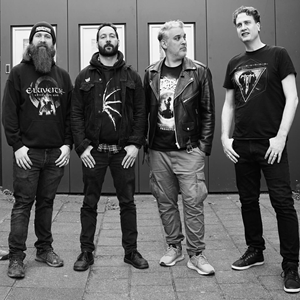
Following the release of their sophomore album “Spiritual Chains” on September 12, 2025, international Heavy Rock collective Thorndale has solidified their position within the contemporary Doom and Stoner Rock landscape. The transatlantic collaboration between members based in Austin, Haarlem, Den Haag, and Scarborough resulted in a powerful statement that balances raw intensity with compositional sophistication. Recorded across multiple studios in North America and Europe, and mixed at Sweetspot Studios in Sweden, the album demonstrates the band’s commitment to sonic excellence while exploring the darker territories of Heavy Rock and Doom Metal. We spoke with the band to discuss the creative process behind “Spiritual Chains,” their international collaboration dynamics, and their vision for modern Heavy Music.
Thorndale operates as a truly international collective with members spread across the Netherlands, the United States, and Canada. How did this transatlantic lineup come together, and what were the initial circumstances that led to the formation of the band?
Gus: “The band started as an idea in Singapore, with this shared love for doom, stoner, and classic heavy metal. It took a minute to get rolling, but once Zigor and Peter began writing together, it clicked fast. Peter’s constantly generating riffs and bouncing ideas off Zigor, and the songs started stacking up. These days Zigor and I live in different places, but we’re still writing together and keeping the momentum going“
Zigor: “That was the regal version of the story. The bare bones version of it is we were in a bar on the island listening to stoner/doom/heavy metal and Gus goes “I’ve always wanted to make music like that”. To which I respond “yeah, man. Me too. Let’s do it”… and here we are. We knew it wasn’t just enough to be able to play that sort of music… a lot of folks can… in Gus’ words “you’ve got to have that in your veins”. This is where Peter came in. I found him through his band Primal Charge and the rest is history.“
Recording an album across studios in Austin, Scarborough, Haarlem, and Den Haag presents unique logistical challenges. How did you approach the recording process, and what strategies did you employ to maintain sonic cohesion across these geographically dispersed sessions?
Peter: “Our preproduction process of sending demos back and forth is what keeps us organized in the end because we work out any mess during that process. A song will start with a riff idea, it might be a wav file or a phone video. Then I demo it with a rough arrangement and programmed drums and send it to the guys. This is where we go back and forth, adding layers, changing parts around, etc. We do our best to communicate when a song has reached its final form, then everyone records their own parts. All of those parts get sent to the mixing engineer to be put together as a whole. I think the cohesion comes from everyone using a consistent tone. For example, drums are done in one session and not over 6 separate sessions, vocals are all recorded together, I will use the same rhythm sound on all songs, etc. This way there is a consistent sound from song to song.“
Zigor: To be honest, many of the big names you know have also taken a similar approach to writing and recording that is not very different from ours. Nothing beats being in the same room but you can’t always have that. I know for instance Paradise Lost very often works like this and even Tony Iommi the Riff Lord has been known to work asynchronously in the initial stages of an album.“
The decision to have the album mixed and mastered at Sweetspot Studios in Sweden by Rickard Bengtsson and Stafan Karlsson—known for their work with Arch Enemy and Spiritual Beggars—was clearly deliberate. What attracted you to this particular studio and production team, and how did their approach influence the final sound of “Spiritual Chains”?
Zigor: “Rickard and Staffan are true Gods of their craft. One could say a number of us in Thorndale grew up on their mixes and productions, in my case Spiritual Beggars and some of the early Arch Enemy.“
Your sound navigates between Heavy Rock, Doom Metal, and Sludge influences without adhering strictly to any single template. How do you define Thorndale’s sonic identity, and which artists or bands have been most influential in shaping your approach to heavy music?
Maarten: “I’m influenced by all kinds of metal and listen to virtually every sub‑genre out there—from Metallica to Cannibal Corpse. I have a particular fondness for melodic bands such as In Flames, Soilwork, and Children of Bodom. I try to bring those melodic elements into Thorndale, whether in the rhythm sections or the lead lines I add to the songs.“
Zigor: “I don’t tend to define it. Listeners and critics tend to do that job for us. It’s heavy metal. It’s what comes out of our combined influences. It doesn’t sound like our other bands so I call it “the space in the middle” (where we all meet) to quote one of the greats.“
Peter: “When we first got together we set the goal of writing “stoner metal” together. However, I don’t really keep that top of mind when I’m writing, other than the fact that we’re leaning towards low, slower or mid tempo, and heavy. Labels like “doom” and “sludge” are important when describing the music to someone else or advertising, but I don’t want to give the impression that I put much thought into that. I think we’re just trying to write kick-ass, heavy songs. I will also say, I like that we’ve kept an emphasis on vocal melody as part of our identity, I think that has been an important part of our sound. As far as inspiration goes, Sabbath and Black Label Society come to mind quickly, especially for our style, but I take inspiration from so many places. Jinjer, Eleine, Devin Townsend, Paradise Lost, Megadeth, Arch Enemy, Spiritbox, Dream Theater, Children of Bodom, and many more.
Gus: “Honestly, it’s not something we plan out. Peter writes those BLS-type riffs, Zigor’s got the more obscure doom and heavy metal side, Maarten is into melodic death metal and I’ve always had groove metal and a little grunge in me. So when we combine it, it ends up sounding really familiar, in the best way. We hear it back and we’re like, yeah, that’s us.”
“Spiritual Chains” demonstrates a notable stylistic diversity across its six tracks, from the accelerated sections of “Veins of the Phoenix” to the monolithic Doom of “Gods of Pain.” Was this tonal variation a conscious compositional strategy, or did it emerge organically during the writing process?
Peter: “I don’t ever want to release an album that sounds like the same song repeated over and over. So I guess it was a conscious strategy. I will listen through the demos once we have a few and think, ‘okay we’ve got some slow/doomy sounding stuff, we should add something upbeat to contrast.‘”
Maarten: “For this album I sent in a few riff ideas, which we later developed into two songs. I didn’t spend a lot of time thinking about what the album needed overall. With the other tracks I added my parts and tried to insert something the guys wouldn’t expect. It’s always fun to wait for their feedback and see whether I went too far—haha.“
Zigor: “While we do spend quite a bit of time working on the songs, we don’t tend to go “and I want this number to sound like this or that”. It’s a bit of a journey, the more we write and perform together, the tighter we get from a writing perspective as well. I think you can hear the evolution of that Thorndale sound getting clearer and clearer.“
“Veins of the Phoenix” served as the album’s first single with an accompanying video. What made this particular track the ideal introduction to “Spiritual Chains,” and how do you feel it represents the album’s broader thematic and sonic scope?
Zigor: “I think this is a track we all got behind from the get-go. It represents a lot of those elements we’ve given birth to since our debut album “Lightning Spawn”: it’s got the hook, the melody and the heaviness… all woven together. We thought this was one of the finest (if not the finest) representation of the album.“
The lyrics across the album explore themes of struggle, spiritual confinement, and existential pain. Could you discuss the conceptual framework behind “Spiritual Chains” and how the lyrical content developed in relation to the music?
Gus: “Lyrics are mostly Zigor’s lane. He sends me these poem-like drafts, and I kind of dig into them to understand what he means and what the emotional core is. Then I build a vocal melody or pattern and see how his words land on it. Sometimes it fits perfectly and I change nothing, and sometimes I tweak the wording a lot so it flows with the vocals. Zigor naturally writes about the darker themes, struggle, pain, that real human stuff.“
Tracks like “Battles Fought in Vain” and “Twenty Thousand Souls” incorporate frequent tempo modulations and Progressive structural elements within relatively concise durations. How do you balance technical complexity with maintaining direct, visceral impact in your compositions?
Maarten: “I try to listen what the song needs. This can be simple lines or small additions. This music is not about showing technical skills it is about creating a song which have an own identity. I approach each songs completly openmind without think what i did in a previous song.“
Peter: “It’s all about telling a story. Tempo modulation, transitioning to familiar or unfamiliar parts, and complex vs simple riffs or melodies are all tools to develop a story. We put a lot of effort in defining where the song seems to want to go naturally, then using those tools to enhance it. If a song feels like it flat-lines, or never makes its point, then we start discussing what to change.“
Zigor: “I like to call this “the right amount” which is also supposed to be the best way to approach just about anything in Life. In music though it takes quite the skill. I am not saying we’re skilled, I am saying it’s not always easy to have that balance in tunes or in an album. It’s quite the art and I guess we enjoy that challenge… and the longer we spend writing and performing together, the better it gets as a band.“
“Gods of Pain” represents one of the album’s heaviest moments, incorporating pronounced Sludge influences and alternating vocal approaches. What inspired this particular sonic direction, and how does this track fit within the album’s overall narrative arc?
Gus: “With Thorndale, the plan was always clean vocals. I get to do harsh stuff in my other projects, death metal, hardcore, metalcore, so this was my space to just sing. But when I played the songs for producer Jeff Henson, he suggested we experiment with some harsh vocals here and there. We tested it, and it worked way better than I expected. It gave the songs more punch, so we rolled with it.“
The title-track “Spiritual Chains” features some of the album’s most dynamic contrasts, shifting between aggressive propulsion and more atmospheric passages. Can you walk us through the composition and arrangement process for this particular piece?
Maarten: “For this song, I decided to challenge the band by introducing additional melodic lines, solos, and a layered riff. My goal was to give the guitar parts extra depth and texture.”
Peter: “Referring to my earlier answer about using tools to enhance a song, I think this song flat-lined in the original demo. It was all atmospheric with no aggression. So we added the upbeat section, liked where it was going, then added stuff like the shots before the section starts to make it really dramatic. Then Maarten added some harmonies to the riffs which really brought it to life.“
Zigor: “Yeah, for sure this song sounded a lot different in the first few takes. That middle Iron Maiden like part really changed things and transformed the song as well as the later additions.“
Jeff Henson of Duel contributed a guest guitar solo on “Exiles and Masters.” How did this collaboration come about, and what did his involvement bring to the closing track of the album?
Gus: “Jeff was super easy to work with. He recorded and produced my vocals, and we hit this part of the song where what I was singing was okay, but it wasn’t really landing. Jeff goes, what if we put a solo there. I told him the guys were already done recording and probably weren’t going to jump back in. And Jeff just went, all right, I’ll do it. He picked up a guitar, noodled around for ten or fifteen minutes, and then tracked the solo right there. It was one of those moments where it just worked.“
Gustavo, your vocal approach shifts considerably across the album, from cleaner melodic lines to more aggressive, Sludge-influenced delivery. How do you determine which vocal style best serves each composition, and what influences inform your performance choices?
Gus: “Honestly, it was pretty natural. I didn’t go in with a big plan beyond having the songs finished. Jeff helped me tighten up some melodies, and then he was like, let’s try some harsh vocals here. We did it right then and there, and it immediately made sense.“
The rhythm section demonstrates both technical proficiency and compositional awareness throughout the album, particularly on tracks like “Twenty Thousand Souls.” How do you approach the construction of bass lines and drum patterns to serve the broader sonic architecture of each track?
Zigor: “So I’ve been working with (guest drummer) Rob Stone for close to a decade now. Apart from Thorndale we’ve played together on quite a few other albums so I’ve really got to learn his style elsewhere. When it comes to Thorndale it really is a natural flow between the 2 where I may write basslines ‘knowing’ what he’s likely to do over them and I know he does the exact same thing, with me in mind. That’s for bass. In terms of drums, Rob knows the band REALLY well by now and what we’re going for. He’s a great example of ‘the right amount’ and never overplaying over the compositions so as to maximise his impact as a drummer.“
Costin Chioreanu created the cover art for “Spiritual Chains.” How does the visual concept align with the album’s thematic content, and what role does visual presentation play in Thorndale‘s overall artistic vision?
Zigor: “The art represents the content very well, I’d say. Lyrically, the whole idea behind the album was to talk about those social conventions most people don’t even question or realise and how folks do “stuff” just ‘cause it’s what everybody else does. If you look at that cover you’ll see a lot of those social conventions, be it religion, government, etc. The whole approach Costin takes when he does our covers conveys a lot of what the music is all about, not all I’d say, but a big chunk of what we feel when we write and perform our music.“
Are there plans to bring “Spiritual Chains” to live audiences? What challenges and opportunities does your international lineup present when considering touring or live performances?
Zigor: “We’re playing the Laurus Nobilis festival in Portugal in July and there are some other dates being confirmed this year and next year. It seems to be picking up so we’re excited to bring the show on the road while we continue to work on our 3rd album!“
Maarten: “One benefit is that we can all work and practice from home, which saves a lot of time compared with meeting in a rehearsal space. Of course, that convenience also has its downsides. For me, this new approach to working online feels fresh, and it’s amazing that we can create music with collaborators across the globe—people we’d never have met otherwise. I hope we’ll eventually be able to perform together in North America for a few live shows.”
Gus: “For sure, doing it online is great in some ways, but it comes with challenges. The main one is shows, since we’re spread out geographically. But we’ve managed and we’ve already played live. I’m hoping to be there for more of them, and if I can’t make it, we’ve got some killer vocalist friends who can cover so the band doesn’t have to slow down.“
The contemporary Heavy Rock, Doom, and Stoner scenes have experienced significant evolution over recent years, with increasing diversification and cross-pollination between subgenres. How do you perceive the current state of Heavy underground music, and where do you see Thorndale positioned within this landscape?
Gus: “Honestly, the scene is stacked right now. I love stoner rock and metal, and I’m constantly digging into doom bands too. It’s almost impossible to keep up though, there are so many releases and not enough hours in the day.“
Maarten: “Through our cross‑genre collaborations, I’ve discovered the stoner and doom scenes, which I hadn’t explored much before. Now those styles are part of my playlists, and I’ve uncovered several great bands and musicians that I’m excited to keep discovering.“
Peter: “I love the cross-pollination and want to see it continue. I feel very optimistic about heavy underground music, there are so many great artists writing incredible music. Sometimes it’s just a challenge to keep up with all the artists I admire!“
Zigor: “I love where the subgenre is going. If we can do our little part to keep it alive and well and for folks to find something in our music they can relate to, something that can move them in some way, I am happy.“
What’s next for Thorndale following the release of “Spiritual Chains”? Are there new compositional directions you’re exploring, or can we expect further development of the sonic territories established on this album?
Zigor: “We’re very deep into doing the finishing touches on what will become our 3rd album and very close to start tracking in the studio. Stay tuned! In terms of development, I will let the others chime in but from where I sit I feel and hear the ever more defined “Thorndale” sound as well as us walking into maybe what I’d say are natural progressions and paths for us to continue our journey… there’s a tad of prog (you already hear this in some of our older tunes if you pay attention) and I’d say getting even heavier and heavier…“
Gus: “The guys just sent me nine new songs and I’m really into them. You can hear the DNA of the first two releases, but there are definitely some new ideas in there too. On my end, I’m trying to level up as a singer and push myself to write better vocal melodies. It’s hard sometimes, but I love working through it.“
Peter: “To add to what Zigor said, I think there are also some really haunting melodies that have developed with the new stuff. The heavy foundation is there, but the vocal and instrumental melodies are well defined and feel very memorable to me.“
Maarten: “For the next album I’ve contributed a number of new ideas—both whole songs and additional parts to the material the others have written. The music keeps evolving as the band refines its own sound while incorporating fresh influences. I’m really looking forward to the final tracking sessions and hearing the finished result.“
We thank Thorndale for taking the time to discuss the creative process behind “Spiritual Chains” and for offering insight into their international collaboration and artistic vision. The album stands as a compelling statement within the contemporary Heavy Rock and Doom Metal landscape, demonstrating both technical competence and compositional depth. Those interested in exploring “Spiritual Chains” can find the album through the band’s Bandcamp page and official channels.
Purchase “Spiritual Chains” on Bandcamp: https://thorndale.bandcamp.com/album/spiritual-chains
Read our review of “Spiritual Chains” here: [Review] Thorndale – Spiritual Chains