

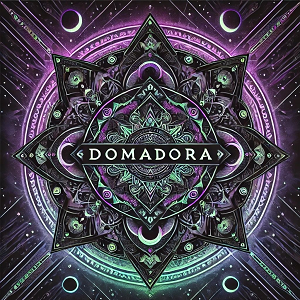
Dear readers, we’re delighted to bring you an exclusive interview with French Heavy Psychedelic Rock and Stoner band, Domadora. Their highly anticipated new album ”Indian,“ released on May 1, 2025, fuses hypnotic grooves with raw, immersive soundscapes.
How did the project come to life, and what is the meaning behind your choice of the name Domadora?
“‘Domadora’ is a Spanish word meaning the tamer — or the riff-taming machine. It’s as if wild riffs float through the air, and we capture and tame them through improvisation. La Domadora is a machine that tames wild riffs. “Indian” is our 6th album, born from a desire to return to heavy psychedelic rock riffing and improvisation on stage. Our two previous albums — The U Book (2021) and Renaissance (2022) — were different kinds of experiments, diverging from our earlier work. With Indian, we wanted to go back to something raw, spontaneous, and fully live.“
You deliver Heavy Psychedelic Rock with Stoner influences—how did your passion for these sounds begin, and which artists or styles inspire you most?
“It’s music we love to play — maybe even more than we love to listen to it. It’s the journey that excites us. Setting off down a road without really knowing where it leads, but going anyway. It’s about surprising each other, bouncing off one another, discovering musicalphases and learning to tame them. That means our influences are incredibly broad — from Jimi Hendrix to The Beatles, passing through Deep Purple, but also classical music for its capacity to transport us, and even the jazz of Billie Holiday or Nina Simone for their raw emotional honesty.“
What was the initial spark or inspiration behind “Indian”?
“A new line-up arrived in 2024: Alex Assaleix on drums and Franck Clunet on bass. We are a power trio — guitar, bass, and drums. After months of improvising and jamming, we naturally felt the need to capture time by recording these spontaneous creations. That became Indian. We named it Indian because we were deeply inspired by the trance music of Native American and Amazonian peoples — with loops and percussions repeating endlessly until they trigger a trance. That’s what led to the title track of the album.”
How did you develop the sonic palette and instrumentation choices on this record?
“We’ve stayed true to our dirty and wild sound — ultra-psychedelic journeys alternating with dense waves of pure sonic violence. That’s the sound of the album. Fuzz, drive, finely layered echoes intertwining. Many moments feel more like
psychedelic sound paintings than traditional music.“
Can you walk us through your songwriting process—did pieces evolve organically in rehearsal, or were they composed in advance?
“We spend most of our time improvising. We often start with guitar riffs, which we jam on for 20, 30, sometimes 60 minutes or more. Naturally, the music takes unexpected turns. Our toolbox expands, and when we revisit those riffs, the tracks evolve and shift. So, the tracks on this album are unique moments frozen in time. We will never play them the same way again.“
What story or emotion do you hope listeners take away from the title-track?
“We hope listeners will travel through our music. You have to let go, lie down in the dark, and experience the tracks as a long sonic journey. Anyone who’s able to surrender to the sound, we promise a powerful, unforgettable
internal adventure that lasts 52 minutes.
You open your eyes at the end and say: ‘Wow! Where was I just now?‘”
Were there any particular challenges you faced during the recording or production phases?
“We never overdub or edit. Everything is recorded live. We play the tracks multiple times, open all the doors of our soul, and improvise. What we play depends entirely on our emotional state. If we’re angry, the music is full of rage.
If we’re at peace, it becomes deep and soaring. We must always play in sync with who we are in the moment.
Then we listen back and choose the most inspired takes.“
How did the album artwork concept come together, and how does it relate to the music?
“We needed an image that expressed both power and weight, as well as the mastery and subtlety of the Indigenous spirit.
That close-up of the buffalo face captured it all.“
In what ways do you feel this release represents growth or change compared to your earlier work?
“As I mentioned earlier, we’ve returned to a more raw and immediate sound, something that gives us the push to dive into wild improvisations on stage.“
Do you have a favorite moment or passage on the album that you’re especially proud of?
“I think the waves of intensity in Fast Brother Jam are particularly interesting — and the final section is beautiful. It feels like that haunting, delicate calm that comes right after a storm or a bloody battle. I also love the beauty of the riff in Seventh Resurgence, the evolving intensity in Isangoma, and the twists and turns in Sons of Fire — all of them are a real joy to play.“
Many of your fans—and our readers—are wondering if there will be an opportunity to perform “Indian” live. Do you have any plans to bring this album to the stage in the near future?
“Right now, we’re performing all the tracks from the album on stage. We’ll be playing across France (Amiens, Nantes, Paris, etc.) until the end of the year, and some European dates are in the works for the first quarter of 2026 — possibly in
Italy, Croatia, and Slovenia.“
Looking back on your live shows, is there a memorable anecdote or unexpected moment you’d like to share from your performances?
“One show stands out — the concert we played in Berlin in April 2025 at Supamolly. The energy of that venue and the warmth of the crowd were so overwhelming that we played in a completely automatic state. We truly left our bodies.
It was insane. Pure black magic. Psychedelia at its peak. A fantastic memory.“
The underground heavy music scene thrives on events and festivals. How important is it to keep these gatherings alive, and what challenges do you see organizers and artists facing today?
“I think everything depends on the listeners. There are older bands that were of course amazing, but it’s time they made space for today’s artists. Right now, there are so many great bands out there. Yet many festivals still revolve around 80-year-old headliners. With all due respect to them and what they brought to the music world — organizers and audiences need to turn toward the present and future instead of relying endlessly on the past. The father must be slain.“
What advice would you give to young musicians who want to explore a genre like yours?
“I don’t have any lessons to teach, but here’s my perspective: You have to play while staying in tune with your inner state.
Music is magic. You shouldn’t try to control anything. You have to let go, and throw yourself into the unknown without fear. Something interesting will always come out of that. I believe there are beings of light around us — invisible — guiding us. They are the ones who decide, who inspire the melodies, the ideas, the atmospheres. So just understand that — and let yourself be guided.“
Outside of music, do you have any other creative pursuits or passions you’d like to tell us about?
“Painting works exactly the same way as music for us. Let yourself be guided. Let go. Trust your unconscious and the spiritual dimension. Our music is sonic painting.“
I thank the band for this interview—wishing them the best in promoting the new album and in all their future artistic endeavors. Thank you so much for this exchange.
Purchase their new album “Indian” on Bandcamp: https://domadora.bandcamp.com/album/indian