

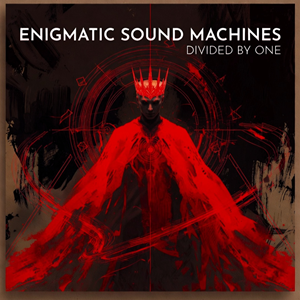
When two long-time collaborators decide to stop experimenting and start building, the resulting architecture tends to carry a weight that studio exercises rarely achieve. That threshold has now been crossed by Enigmatic Sound Machines. The Montreal-based project, anchored by Jeremie Arrobas (lead vocals, synth-guitars, keyboards, sound machines) and Thomas Szirmay (enigmatic voice, sound machines), arrives at its fourth full-length record with a trajectory that reads, in retrospect, like a deliberate calibration. “Telepathic Waves” (2023) was an almost exclusively synthetic statement-glowing, contained, a blueprint rather than a building. “The Hierarchies Of Angels” (2024) pushed the structures toward the broader grammar of Progressive Rock. “Imperfect Silence” (2025) traded momentum for contemplative stillness, letting atmosphere do the structural work. “Divided By One,” released on June 5, 2026, marks the formal consolidation of that arc. The decisive shift is personnel-driven: bassist Hansford Rowe and guitarist Alain Bellaiche are no longer session allies but permanent members of a true quartet, joined on backing vocals by the same core and by Anna Arrobas on select tracks. The effect is not the explosive reorientation one might expect from adding two players, but something subtler and, in this context, more valuable, a deepening of melodic commitment, a tightening of rhythmic vocabulary, and an instrumentally impeccable execution that never quite tips into display. What distinguishes this record from the broader field of Electronic-Progressive output is its refusal to oscillate between poles. There is no filler passage, no obligatory dynamic reset that exists solely to manufacture contrast. Instead, “Divided By One” sustains a near-uniform register of intensity, threading retro-futuristic electronic textures through complex polyrhythmic frameworks while keeping the guitar and bass voices articulate and purposeful. The result is an album that rewards repeated, focused listening rather than casual background rotation, a distinction that matters in a genre where so many releases blur into interchangeable “soundscapes.” The title-track establishes the album’s coordinates in under two minutes. Arrobas constructs a driving rhythmic scaffold by layering at least three programmed drum kits, each occupying a distinct temporal lane, and onto that grid Rowe lays bass lines of pronounced melodic intent while Bellaiche‘s guitar cuts through with economy rather than density. Guest guitarist Steve Bonino, listed in the credits, adds a further textural layer. The title’s paradox, division by one, implying a conceptual or even theological fracture rather than a neutral mathematical operation, is mirrored in the track’s sonic duality: synthetic darkness held in check by an almost classical structural clarity. It is a confident opening, one that makes no apologies for its ambition. The longest and most conceptually articulated composition on the album “Chaos Dreaming” unfolds organically from an original instrumental matrix into which vocal lines were layered in a subsequent production pass, a sequencing choice that is immediately audible in the way the vocal sits inside the arrangement rather than atop it. The track breathes in long exhalations and sharp inhalations, alternating compressed dynamic passages with stretches of open, almost Chamber-Music spaciousness. The section that will likely draw the most critical attention is the mid-track Reggae inflection: a rhythmically intricate passage that could easily have become a gimmick is instead resolved with a fluency that owes much to Bellaiche‘s guitar work, which threads the transition so naturally that the genre shift reads as an organic modulation rather than a cut-and-paste insert. At over nine minutes, it functions as the album’s conceptual spine. Positioned at the album’s midpoint alongside its successor, “Sirensong” pivots to a more conventional verse–chorus architecture, and the concision is the point. It serves as the emotional axis around which the surrounding epic stretches orbit: the vocal delivery is warm, forward-mixed, and expressive, while the percussion sits behind a wash of Atmospheric, extended keyboard textures that blur the boundary between electronic and Progressive registers. Anna Arrobas‘ backing vocals add a harmonic warmth that keeps the piece from drifting into coldness. The detail in the keyboard-and-melody interweaving remains high throughout, and the overall tension of the album is not relaxed so much as refocused, a useful recalibration before the second half. “Pool of Mirrors” continues the lyrical thread of its predecessor, sharing the siren-mythology reference, and moves at a well-defined mid-tempo that lets the quartet’s formal equilibrium come to the fore. The synthesizers generate a marine, almost sub-aquatic atmospheric bed; Rowe’s bass navigates the harmonic progression with an ease that suggests long familiarity rather than first-session polish. The vocal lines and refrains are designed to linger, the draft notes compare the effect to a siren’s song rebounding off a still water surface, and the comparison, while perhaps slightly overwrought in its own right, captures the track’s function: it is a mirror held up to “Sirensong,” reflecting the same Melodic material back through a different textural filter, “Heaven’s Rain” where Anna Arrobas‘ backing vocals complete the effect. A composition that works primarily through the contrast between near-silence and full instrumental crescendo. The electronic rhythmic foundation underpins a dense, slowly evolving keyboard tapestry while the lyrical content moves through themes of loss and resilience without becoming didactic. The execution here is what sets the track apart: volume management is precise, the crescendo builds over the full seven minutes without ever feeling rushed or over-inflated, and the interplay between Symphonic sweep and subtle Folk-Rock inflections, both filtered through the band’s own vocabulary, gives the piece a distinctly personal signature. It is the album’s emotional apex, and it earns the position through restraint as much as through its climactic peaks. The most rhythmically urgent and energetically charged moment on the record, “Screaming Sound Machines,” and the one where the “guitar” in Progressive Rock is least negotiable. Three guitar voices operate simultaneously, Bellaiche, Arrobas on synth-guitar, and guest Steve Bonino, and the arrangement is tight enough that none of them are buried. Their hooks interlock with a complex synthetic loop and the serpentine, almost contrapuntal bass lines of Rowe, producing a blend that recalls Classic Rock’s directness while the harmonic language and textural detail keep it firmly in New Wave territory. At under five minutes, it functions as a pressure-release valve before the album’s final stretch, and it is, by any measure, one of the most satisfying three-minute-plus stretches of playing on the record. The “bulkiest” composition in the set, “Heavy Water,” and the one that most clearly demonstrates why the move to a permanent quartet mattered. The arrangement is a layered superposition: multiple synthesizer voices, two electric guitars plus Arrobas‘ synth-guitar, a doubled bass part managed by Rowe in the choruses, and four programmed drum kits executing distinct patterns in parallel. The dynamic climax is achieved through accumulation rather than volume, and the finale, a dense vocal layering that incorporates remote contributions from Laura Piazzai and Roland Buhlmann, delivered in post-production, gives the track a spatial and timbral width that the core quartet alone could not have achieved. Guest guitarist Roland Buhlmann and backing vocalist Anna Arrobas are both credited. It is the album’s most physically imposing piece, and it works because the density is organized, never random. Originally conceived as the album’s natural closer, “Inviolate Fields” is a suite of nearly ten minutes that leans heavily on timbral exploration. Arrobas’s synthesizers are given wide open lanes for divergence, Rowe and Bellaiche work in a more restrained, almost sculptural register that provides structural counterpoint without competing. The track’s intensity remains high throughout, and the integration of vocal elements, Laura Piazzai‘s lead vocal and Quinn Bachand‘s violin adding orchestral color—alongside the electronic and guitar textures creates a layered, dreamlike atmosphere that sustains the listener’s attention well past the nine-minute mark. The mid-section’s experimental passages, which detour from the central theme before returning to it, are among the most interesting moments on the record, offering a glimpse of the band’s exploratory instincts beneath the album’s otherwise disciplined surface. In my assessment, it is one of the high points of “Divided By One.” A reworking of Gary Numan / Tubeway Army‘s “69964 – Are ‘Friends’ Electric?,” included at the request of the label’s Mark Monforti. In deliberate counterpoint to the density of the preceding tracks, the cover is essentially a two-person performance, Arrobas on the full instrumentation and Rowe on bass, with Szirmay delivering the lyric in a spoken-word declamation rather than a sung melody. The stripped-back approach is coherent with the group’s electronic roots and gives the album a closing gesture that is dry, dark, and deliberately unsentimental. It is not the most ambitious track here, but it is the most pointed, and it lands with the quiet authority of a statement made in a low voice. “Divided By One” is, above all, a cohesive record. The consolidation of Enigmatic Sound Machines into a stable quartet has paid off in ways that are audible on every track: Melodic lines arrive with a consistency the earlier, more experimental entries could only gesture toward; the sonic architecture is free of the seams and sudden shifts that often betray a project still searching for its shape. There is no false revolution here, no need to prove that adding two musicians necessitates a stylistic rupture. The album’s authority rests on a different set of merits, the intelligent layering of rhythmic voices, the careful calibration between electric guitar and analog/digital synthesis, the production’s attention to micro-detail (the four-kid percussion in “Heavy Water,” the remote vocal and guitar contributions, the verse-level interplay in “Sirensong” and “Pool of Mirrors“). These are the marks of a band that has stopped composing for the studio and started composing for the instrument. For listeners who appreciate Electronic Progressive Rock at its most structurally rigorous and emotionally self-aware, “Divided By One” is not merely a strong fourth entry in a promising catalogue. It is the album that tells you the experiment is over, and the music has only just begun.
Tracklist
01. Divided by One (06:16)
02. Chaos Dreaming (09:32)
03. Sirensong (05:07)
04. Pool of Mirrors (05.54)
05. Heaven’s Rain (07:18)
06. Screaming Sound Machines (04.57)
07. Heavy Water (07:33)
08. Inviolate Fields (09:50)
09. Are Friends Electric ? (05:16)
Lineup
Jeremie Arrobas / Lead Vocals, Synth Guitars, Keyboards, Sound Machines
Thomas Szirmay / Enigmatic Voice and Sound Machines
Alain Bellaiche / Guitars, Backing Vocals
Hansford Rowe / Bass and Backing Vocals
Guest artists:
Steve Bonino / Guitars (Tarcks 1,6)
Roland Buhlmann / Guitars (Track 7)
Anna Arrobas / Backing Vocals (Tracks 1,3,4,7)
Laura Piazzai / Lead Vocals (Track 8)
Quinn Bachand / Violin (Track 8)
Read our Exclusive Interview with the band here: [Exclusive Interview] Enigmatic Sound Machines – Inside the Sculpted Darkness of “Divided By One”