

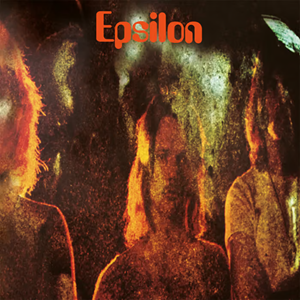
In the effervescent landscape of early 1970s Germany, where Krautrock was systematically dismantling and rebuilding the rules of contemporary sound, Epsilon stood as a singular and deliberate anomaly. Founded in Marburg in 1970 from the ashes of notable local outfits Orange Peel and Nosferatu, the band led by guitarist and vocalist Michael Winzkowski carved a path that consciously diverged from the prevailing cosmicism of the era. Rather than pursuing abstract sonic architecture, Epsilon anchored themselves in the British Progressive Rock tradition, aligning their sensibilities closer to London than to Berlin or Düsseldorf. Their self-titled debut, originally released in 1971 on the then-nascent Bacillus Records under the direction of Peter Hauke, now made available digitally on March 13, 2026 via Bacillus Records/Bellaphon, is an organ-dominated statement that remains one of the most compelling and underexamined entries in the German Progressive Blues Rock catalogue of that fertile decade. Recorded in January 1971 at the prestigious Dieter Dierks studio in Cologne — the same facility that would go on to host some of the most definitive German Rock recordings of the ’70s — the album carries the hallmarks of both technical rigor and expressive urgency. The production, clean and well-defined for its time, allows each instrument to breathe within arrangements that are consistently more disciplined than their British contemporaries. “Two-2-II” opens the album and, at over eight minutes, sets the coordinates of the entire work with authority. The piece begins with guitar phrases weighted with pathos, underpinned by a pulsating bass and a measured, precise drum performance, before Walter Ortel‘s organ asserts its dominance. The rhythmic character is one of the track’s most distinctive qualities: propulsive and almost buoyant, yet continuously interrupted by slashing organ riffs and harmonically dense bridge sections. Ortel‘s debt to Ken Hensley of Uriah Heep is unmistakable throughout, while Winzkowski delivers incisive guitar licks that sharpen the dynamic tension. An unexpected quotation of the Rock’n’Roll standard “Keep A-Knockin‘” surfaces mid-track — a candid glimpse at the band’s irreverent streak and their willingness to blur the boundaries between the Progressive and the populist. “2-Four-4” opens with a martial theme shared between clavinet and organ, constructing an atmosphere with almost symphonic weight. The structure then undergoes a decisive shift, pivoting into a full-blooded Blues-Rock terrain reminiscent of early-Zeppelin, where Winzkowski‘s raw, gravelled vocal delivery finds its most natural habitat. The centrepiece of the track is a lucid, Jazzy piano solo — refined in execution and unexpected in context — before the composition cycles back to its opening theme. The ability to navigate multiple time signatures and contrasting emotional registers within a single piece speaks to a compositional maturity that goes well beyond what one might reasonably expect from a debut recording. “Every Day’s Pain” abandons structural complexity in favour of sheer forward momentum. Built on a foundation of massive Hammond chords, the track is a hard-driving Blues-Rock excursion where Ortel unleashes a blistering B-3 solo with an authority that draws clear lines to Keith Emerson‘s work with The Nice — a lineage made explicit by the band’s early repertoire of Nice covers. The rhythm section of Michael Ertl and Hartmut Pfannmüller operates with disciplined power, providing the kind of locked-in, unadorned drive that lets the organ take full command. Compact, direct, and uncompromising, it stands as the album’s most viscerally satisfying moment. “Before” is where the album earns its most unexpected dimension. Distortion and density dissolve entirely, replaced by bossa nova rhythms carrying organ, acoustic guitar, and piano in a manner that recalls the more contemplative side of Santana — though the decision to centre the melodic weight on keys rather than guitar keeps the identity firmly Epsilon‘s own. Wordless vocal melodies drift through the closing section, lending the piece an almost pastoral quality. It is the record’s most formally independent statement, and one of its most quietly convincing. “Between Midnight” occupies the role of the album’s emotional centre of gravity. A ballad built on delicate piano and understated acoustic guitar, it provides breathing space between the more architecturally complex compositions that surround it. The harmonic atmosphere carries faint echoes of Procol Harum, while Winzkowski‘s vocal performance here reveals a warmth and soul sensibility that has led more than one observer to draw comparisons with Otis Redding. Whether one accepts that parallel or not, there is an undeniable sincerity to the delivery that gives the track an intimacy the heavier material does not attempt. “Paint It Black Or White” is the album’s most audacious gesture. Taking the Rolling Stones‘ classic as its point of departure, Epsilon transforms the original almost beyond recognition — expanding it into a Psychedelic and Baroque construction that shares the spirit of the Deep Purple or Vanilla Fudge approach to covering pop material from the late 1960s. The organ riff that drives the main body of the track is imposing and Cinematic, and the interpolation of Bach’s Prelude No. 1 in C Major in the central section adds a contrapuntal dimension that is either brilliantly conceived or provocatively presumptuous, depending on one’s tolerance for that kind of re-compositional ambition. Either way, it represents a fully committed artistic statement on the band’s own terms. The album closes with “Hurry Up,” a Boogie-Woogie piano-driven number that steps deliberately outside the Progressive framework of everything preceding it. Vocally rough-edged and rhythmically loose, it functions much as certain album-closing numbers did for Emerson, Lake & Palmer or Argent — a declaration that the roots run deep, and that the sophistication elsewhere on the record was always a choice rather than a limitation. Some purists may find it an anticlimactic ending; others will read it as the band winking at their own seriousness. Epsilon‘s debut occupies a specific and underappreciated position in the German Rock of its era. It neither conforms to the Experimental abstraction of Krautrock nor fully replicates the grandeur of its British Progressive inspirations, choosing instead to work within a Progressive Blues Rock framework with a directness and individuality that gives the record a personality entirely its own. Some contemporary and retrospective critics have pointed to a certain stylistic diffuseness, and it is true that the album’s breadth — from Hard Blues to Bossa Nova to Baroque re-composition — occasionally works against internal cohesion. Yet it is precisely this tension between discipline and eclecticism that makes the record compelling to return to. A debut that announces a band still calibrating its own identity, and doing so with a technical confidence that most of their contemporaries never matched. Subsequent albums — “Move On” (1972) and “Epsilon Off” (1974) — would see the band gravitate toward a more guitar-centric, less ambitious sound. This debut, recorded with a clarity that Dierks‘ studio consistently delivered, remains their most fully realised and historically relevant document. Its digital availability through Bacillus Records/Bellaphon in 2026 ensures that a record which circulated for decades only among dedicated collectors and specialists in German Progressive Rock now has a wider audience within its reach. For those drawn to keyboard-driven Progressive Rock, to the intersection of British and German sensibilities in the early 1970s, or simply to records that reward patience and repeated listening — “Epsilon” belongs in the conversation.
Tracklist
01. Two-2-II (08:11)
02. 2-Four-4 (07:30)
03. Everyday’s Pain (02:56)
04. Before (03:19)
05. Between Midnight (02:45)
06. Paint It Black Or White (06:22)
07. Hurry Up (02:48)
Lineup
Michael Ertl / Bass
Hartmut Pfannmüller / Drums, Bongos and Percussion
Walter Ortel / Organ, Piano, Nail-Piano, Vocals and Percussion
Michael Winzkowski / Vocals, Guitar, Acoustic Guitar, 12-String Guitar and Percussion
[…] Epsilon – Epsilon (1971 – 2026 Digital Reissue | Bacillus Records/Bellaphon): The debut of Marburg’s Epsilon, originally released on the nascent Bacillus Records in 1971 and recorded at Dieter Dierks‘ studio in Cologne, is now available digitally for the first time. An organ-dominated statement that aligns more closely with the British Progressive tradition than with anything in its immediate German surroundings, the record moves freely between Hard Blues, Bossa Nova, Baroque re-composition, and a jaw-dropping deconstruction of “Paint It Black.” One of the most compelling and underexamined entries in the German Progressive Blues Rock catalogue — now within reach. [Read here] […]