

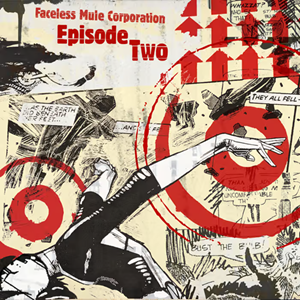
James Closs builds strange worlds in private. Already known for Muleskinner Jones, the British multi-instrumentalist returns under his most enigmatic guise — Faceless Mule Corporation — with “Episode Two,” out June 17, 2026. Rooted in England’s “Weird West,” this double album delivers 120 minutes of uncompromising immersion. Closs describes it as his most “oblique” material — furthest from anything resembling conventional structure. The architecture is built on extended transmissions, most hovering near the ten-minute mark, born from modular synth experiments that were then cut apart, deconstructed, and rebuilt with layers of saturated guitars, processed vocals, and tape loops. The architecture is built on extended transmissions, most hovering near the ten-minute mark, born from modular synth experiments that were then cut apart, deconstructed, and rebuilt with layers of saturated guitars, processed vocals, and tape loops. “Inwards” opens without ceremony — two minutes of instrumental atmosphere functioning purely as a portal. No statement, no preamble. An airlock before the pressure changes. “Born, 1970” wastes no time. Nuclear threat imagery, teachers chain-smoking in classrooms, casual racism as family entertainment, systemic celebrity abuse — the lyrical terrain is bleak, clinical, and deliberately unyielding. Against it, Closs deploys a locked motorik pulse, filtered electronics, and processed vocals that don’t comment on the degradation so much as embody it. The modular work and sound-sculpting are immediately identifiable as signatures of the project — passages of experimental prog and electronic Krautrock that expand outward, pulling the listener into a narrative that lands with uncomfortable contemporary resonance. “Hungover in East Berlin” extends the trajectory. Alienation and urban squalor in post-reunification East Berlin: shared dormitories, bottom-shelf alcohol, carbon monoxide fumes, geriatric Czech Punks, the sensation of being finished and wasted. The lyrics are reportage from the margins. The music, however, breathes differently — arioso, layered, with repeated synth melodies that modulate and evolve over a motorik backbone filtered through Closs‘ particular aesthetic. Tradition and sonic innovation held in productive tension. The track doesn’t conclude so much as pivot — a passage toward the Brandenburg Gate that feels, just barely, like a clean slate.” “Void State Inhibitor” is where the Krautrock-Electronic matrix intersects post-punk venom. Microchips implanted in the young, synthetic opioids in the water supply, AI drones overhead, GCHQ/CIA/MI6 casting long shadows — the dystopian critique is modern, precise, and merciless. The improvised modular synth work and fractured noise draw explicitly from Pere Ubu‘s playbook, while vintage keyboard inserts act as a bridge between mid-70s German School experimentalism and early electronic suites. A sharp-toned guitar cuts through during solo passages; the vocal delivery channels the nascent Post- and New Wave scene without pastiche. Analogue drumming counterbalances the electronic sprawl. One of the album’s central statements. “All Hail the Insect-God” pulls the album toward darker, more occult terrain — not as exaltation, but as invocation. References to Carcosa, Lovecraftian and Chambers-derived cosmicism, an omniscient compound eye, a goddess who will dine on souls. The modular synths and vintage keyboards construct dense electronic beds that support the sense of ritual submission embedded in the title. In the second half, the organ takes the foreground while the motorik pulse holds structure — a foundation that allows the keyboards to expand the piece’s ceremonial weight without ever losing the thread. “Age of the Worm Thing (Phase 3)” arrives with a Post-punk vocal — raw, effected, unsettling. Pale smoke-shrouded cities, “snail-face” refugees, a protagonist scraping out his own brain to serve on a silver tray to the worm that owns everything. The rhythm section is markedly electronic, giving room for hypnotic modular synth lines to layer and evolve, interwoven with analogue instruments in a display of genuine compositional command. The lyric “compared to this, “Phase 2 was a walk in the park” reads not as escalation but as warning — hope, already a mirage, is here all but extinguished. “The Rising” pushes that logic to its terminus. Entities beating beneath the permafrost, in the Mariana Trench, in Voronya Cave — subterranean and submarine horror at its apex. The music reflects the imminence of that primordial ascent: an expansive first half that gradually tightens, the rhythm accelerating until the track becomes intricate and suffocating, stripping away any remaining ground. Technical drumming, penetrating and unsettling vocals, jagged guitar lines interlocked with electronics — no resolution, only the closing in. “Blood Moon Over Lisbon” — the longest transmission. It opens with hypnotic synth melodies that develop slowly, accumulating weight. The build culminates in a kick drum that hits like a sledgehammer on bare stone. A “forbidden melody,” a red moon over Lisbon, rifles loaded with carnation buds — the Carnation Revolution refracted through electronic Krautrock. Tension increases incrementally as melodies and effects layer over locked, repetitive grooves, indebted to The Fall and primordial Krautrock but routed through a distinctly modern sensibility. The extended runtime earns its keep; every minute serves the architecture. “Outwards ” closes symmetrically — a mirror to the opening, returning the listener out of the transmissions and back to surface air. “Episode Two” is a massive, necessary work for anyone willing to push into the most oblique margins of contemporary sound. At 120 minutes, with transmissions that consistently approach the ten-minute threshold, this double album makes no concessions to modern attention spans. It demands immersive, near-ritual listening. Closs operates well outside the radar of conventional music industry logic, retreating into his studio to construct strange, dystopian worlds — an approach that aligns him with underground figures like Michael Yonkers, who built alien sonic universes in a Minneapolis basement, or Martin Newell, dispatching his visions into the cosmic void via self-produced cassettes. What emerges from “Episode Two” is a radical artistic philosophy: for Closs, the work is its own justification. The act of creation validates the object; the audience is incidental. This is not an invitation. It’s a demand to tune your antenna to a disturbed frequency — insect-gods, urban decay, and cosmic horror included. Abrasive, saturated, and deeply compelling. Art that does not ask permission to exist.
Tracklist
01. Inwards (02:08)
02. Born, 1970 (08:01)
03. Hungover in East Berlin (10:33)
04. Void State Inhibitor (12:56)
05. All Hail the Insect-God (08:05)
06. Age of the Worm Thing (Phase 3) (09:41)
07. The Rising (10:30)
08. Blood Moon Over Lisbon (13:47)
09. Outwards (03:46)
Lineup
James Closs / Everything