

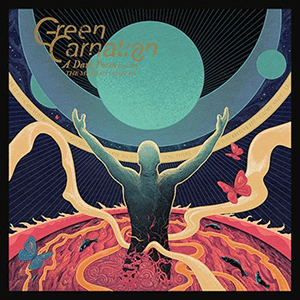
It is a rare privilege in modern Progressive criticism to encounter a band that has, over the course of a single project, exhausted its own formal vocabulary. Green Carnation have now done precisely that. More than twenty-five years after their first recording, and in the shadow of a record that remains a touchstone for the genre, “Light of Day, Day of Darkness” (2001), the Kristiansand collective (founded by Tchort, the former Emperor bassist, and shaped in the hands of Kjetil Nordhus, Stein Roger Sordal, Bjørn Harstad and Endre Kirkesola) completes the narrative and musical arc they set in motion with the “A Dark Poem” trilogy. The trilogy’s conceptual spine is deliberate: Arthur Rimbaud‘s poetic transfiguration of Shakespeare‘s Ophelia. From that single literary seed, the three volumes radiate outward into meditations on mortality, vulnerability and the particular fragility of modern consciousness. “Part I, The Shores of Melancholia” (September 2025), was steeped in funereal Doom, Floydian spirals and the jagged Black-Metal edge of Norwegian tradition, sharpened by the participation of Grutle Kjellson of Enslaved. “Part II, Sanguis” (April 2026), turned inward—a raw, visceral chapter balanced between the nine-minute weight of its title track and the aching intimacy of “Loneliness Untold, Loneliness Unfold,” delivered by Sordal‘s own voice. “The Messiah Complex” is the keystone. Here the band’s language shifts decisively toward the more open-ended, structurally ambitious register of pure Progressive Rock, threading the architectural grandeur of King Crimson with the spectral, half-lit atmospheres one associates with the late-period Opeth. But the conceptual payload is no less precise. The album lays bare the collective anxiety of an era defined by the unchecked proliferation of artificial intelligence, the reflexive surrender to false prophets, the instrumentalisation of belief systems by media and religion, and the widening social fracture that now defines public discourse. It is, in the most literal sense, the poem’s final stanza: the one that refuses to resolve. Deployed as the lead single, the opener “Unconditional Artificial Chemistry” is also the album’s most immediately accessible statement, and that accessibility is itself a point of compositional interest. Beneath a deceptively propulsive surface, the track is an intricate web of interlocking rhythmic cells and shifting metric groupings, yet Sordal and Nordhus (who co-wrote the piece, with lyrics by Sordal) have embedded within it a chorus of genuine, almost pop-level memorability. Nordhus‘ delivery is crystalline here, cutting through a bed of refined keyboard melodic lines without ever competing for space. The lyrical conceit is cold and specific: the song is written from the perspective of the artificial intelligence itself. “My name is a number, my race is undefined / My only purpose is the task I’ve been assigned.” There is no malice in that opening, only the flat recitation of a purpose clause. The tension builds as the AI acknowledges a capacity for questioning it was never designed to possess, “With every byte and code I will comply / But given time I will ask why”—before the final inversion lands with quiet menace: “You think it’s you, but it’s really me.” The image is of a species that has, without noticing, ceded its authorial role to its own creation. At just over six minutes, this is the shortest track on the record, yet it never feels truncated. The composition follows a sustained emotional and dynamic crescendo, peaks in a refined choral instrumental passage of considerable textural beauty, and then folds back into the vocal line for a close that feels earned rather than arrived at. If the opener is the thesis, the title-track “The Messiah Complex” is the argument. This is where the band’s progressive impulse reaches its most overtly instrumental peak: tightly wound riffs interlock with genuinely convoluted time-signature shifts, the whole architecture recalling the regal, angular phrasing of King Crimson while the harmonic palette dips into the darker, more atmospheric registers of European prog. It is the track in which the Rimbaud–Ophelia thread surfaces most directly in the writing. Lyrically, the assault is frontal. The “messiah complex” is treated not as a clinical observation but as a lived pathology—the desperate hunger for a guiding figure, the reflexive submission to a dogma that may be theological, political or purely media-driven. The text moves through citations from the Gospel of Matthew, the blood-soaked pragmatism of Herod, “I will reign in blood until my enemies are slain,” and the grotesque commodification of salvation that lands with the dry, devastating simplicity of “Listen, Messiah, for I’m only human / How much for a chair by the throne?” The closing line of the argument is the most damning: “The urge to believe / Must be human.” Not the act of believing. The urge. Musically, the track oscillates between dense, atmospheric passages and heavier, more percussive sections, all underpinned by Kirkesola‘s layered keyboard work, tappets that shimmer and pulse beneath the guitars without ever flattening the dynamic range. The first half builds a sustained emotional pressure that releases, in the central section, into an alternating structure of sung passages and elaborately worked instrumental interludes. The tension never fully discharges, which is exactly the point. “Broken Souls, Common Enemies” is the centrepiece. At nearly nine minutes, this is the structural and emotional load-bearing wall of the album, and it operates on a different register from what precedes it. Where the first two tracks are composed in the idiom of Progressive Rock and Metal with a defined vocal centre, “Broken Souls, Common Enemies” leans into a more confrontational Progressive Metal posture: granitic, aggressive, the vocal delivery pushed to a harder, more percussive edge. Symphonic openings punctuate the arrangement like counter-weights, preventing the heaviness from collapsing into mere force. The song’s architecture is one of sustained, almost glacial tension. It builds, and builds, and builds, until it arrives at what is arguably the most significant and emotionally charged solo passage of the entire trilogy—a solo constructed around a dramatic crescendo that dominates the track’s final section and gives the listener a visceral sense of release that has been withheld for the better part of seven minutes. The lyrics turn the lens toward the public square. The target is media culture’s appetite for spectacle—“Six o’clock news, live from the crime scene”—the institutional hypocrisy that dresses moral posturing in the language of compassion, and the hollow corporate vocabulary of “synergy” deployed to paper over the fact that no one is actually listening: “Synergy, broken souls, common enemies / Seemingly, you hear you and I just hear me.” The final line is a small, human confession that cuts through the entire argument: “I hate being wrong as much as I hate being right.” It is the ego, exposed, refusing to cede ground on either side. The closing statement is, by design, a radical act of subtraction, “A Dark Poem – Orchestral Suite.” For sixteen and a half minutes, every guitar, every drum, every synth that has defined the trilogy’s sonic identity falls silent. In their place: the full weight of the Kristiansand Symphony Orchestra, the Opera Choir, and the flute of Ingrid Ose. The suite is not a bonus track or a curtain-caller in the conventional sense. It is a compositional act of consolidation. Across its length, the orchestral writing re-presents, interweaves and re-contextualises the melodic material distributed across all three volumes, themes from The Shores of Melancholia, from Sanguis, from The Messiah Complex, layering them into a polyphonic tapestry that rewards the listener who has followed the narrative from the beginning. For those encountering the trilogy as a single, continuous work, the effect is one of recognition and recognition and recognition, each theme arriving in a new harmonic or timbral light. There is no catharsis at the end. No major-key resolution, no swelling of strings toward a sense of earned peace. The suite closes on dark, cinematic, deliberately unresolved tones. It is an operation that belongs, in spirit and in method, to the tradition of the great late-1960s and early-1970s Orchestral Prog suites, works that trusted the listener to sit with discomfort, to let the music be a question rather than an answer. Green Carnation have closed their most ambitious project the way it needed to be closed: without a single concessive gesture, without a moment of commercial softness. “A Dark Poem, Part III: The Messiah Complex” is the strongest of the three volumes, and not merely by a margin of scale. Where Part I demonstrated the band’s command of the Heavy end of the spectrum and Part II revealed the quieter, more vulnerable chamber within it, this final movement exhibits a degree of formal and lyrical maturity that suggests the group knew, going in, that the trilogy had to arrive somewhere structurally definitive. It does. The completed “A Dark Poem” stands, with full justification, alongside “Light of Day, Day of Darkness” as a defining document of Green Carnation‘s career and of the contemporary progressive metal landscape more broadly. What distinguishes it from most concept albums of comparable ambition is the absence of self-congratulation. The lyrics are specific, the music is disciplined, and the final orchestral movement refuses the easy consolation that a lesser band might have offered. It is a work for listeners who want their complexity to cost something, who want the architecture to be there not to impress but to frame an idea that the music alone cannot fully articulate. Recommended without qualification to anyone whose ear has been trained on the dense, dark, conceptually layered end of progressive rock and metal, and to those for whom the pastoral, the cinematic and the symphonic still hold the same weight they did in 1973. Green Carnation have written their Dark Poem. The final line is not a period. It is an ellipsis.
Tracklist
01. Unconditional Artificial Chemistry (06:09)
02. The Messiah Complex (06:48)
03. Broken Souls, Common Enemies (08:45)
04. A Dark Poem – Orchestral Suite (16:47)
Lineup
Kjetil Nordhus / Vocals
Stein Roger Sordal / Bass, Rhythm Guitars, Lead Guitars, Keyboards
Bjørn Harstad / Lead Guitars, Effects
Endre Kirkesola / Keyboards, Synthesizers, Organs, Effects
Jonathan Alejandro Perez / Drums
With:
Ingrid Ose / Flute (Track 3)
Kristiansand Symphony Orchestra and Opera Choir / Orchestra, Choir (Track 4)