
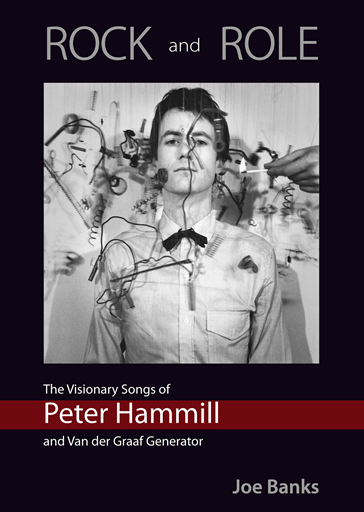
A Monumental Critical Portrait of an Essential Artist
Writing about Peter Hammill has never been an easy task. His work resists simplification, refuses comfortable narratives, and constantly escapes the usual frameworks applied to Rock musicians. With “Rock and Role,” Joe Banks does not attempt to tame this complexity. Instead, he embraces it fully, delivering a book that stands not merely as an extensive biography, but as a serious critical study of one of the most uncompromising artists in modern music.
This is not a conventional life story, nor an exercise in nostalgia. Banks approaches Hammill as a figure defined by tension: between exposure and control, urgency and reflection, authenticity and performance. The title itself encapsulates the core of the project. “Rock” is not treated as a genre, but as an expressive force—raw, unstable, risky. “Role” is not a façade to be dismissed, but a necessary function, a mask through which truth can be articulated without being destroyed by it. Throughout the book, Banks explores this unresolved duality as the central engine of Hammill’s artistic life.
One of the book’s major strengths lies in its treatment of Van der Graaf Generator. Rather than reinforcing the familiar Progressive Rock narrative, Banks deliberately reframes the band as an anomaly within that context. Van der Graaf Generator are presented not as architects of virtuosity or elegance, but as a collision point between music, drama and existential urgency. The organ does not decorate, the rhythm section does not soothe, and Hammill’s voice does not merely sing—it confronts, fractures, and exposes. In this reading, the band becomes a dramatic apparatus designed to amplify inner conflict rather than resolve it.
Banks is particularly effective in dismantling superficial interpretations of Hammill’s lyrics. Myth, symbolism and theatrical language are never treated as escapism, but as tools to intensify human struggle. Themes of identity, responsibility, isolation and communication recur not as abstract concepts, but as lived tensions. Van der Graaf Generator’s music is shown to be deliberately uncomfortable, demanding attention rather than offering reassurance—an approach that explains both their cult status and their enduring relevance.
If Van der Graaf Generator represent the raw eruption of artistic urgency, Hammill’s solo career is portrayed as the space in which responsibility and control come sharply into focus. Banks convincingly argues that Hammill’s decision to work alone was not a retreat, but a logical extension of his need for autonomy. Home recording is framed as a political and artistic stance: a refusal of mediation, a rejection of compromise, and an acceptance of full accountability for every creative decision.
The apparent stylistic fragmentation of Hammill’s solo output is reinterpreted not as inconsistency, but as necessity. Each album responds to a specific emotional and intellectual moment, adopting whatever form is required to express it. There is no attempt to build a linear career narrative; instead, Hammill’s work unfolds as a sequence of confrontations, each one honest in its instability.
Banks’ analysis of Hammill’s voice is one of the book’s most compelling sections. The voice is treated not as a technical instrument, but as a moral space. Whispering, breaking, retreating into silence—all are presented as deliberate expressive choices. In the solo context, the voice becomes the primary site where confession, doubt and self-scrutiny take place. It is not a vehicle for performance, but the substance of the message itself.
The thematic chapters represent the intellectual core of “Rock and Role.” Banks identifies recurring motifs—identity and persona, the failure of communication, time and guilt, love as a destabilising force—and traces them across decades of music. This approach allows the book to transcend fandom and speak to broader questions about creativity, responsibility and artistic integrity. Hammill emerges not as a heroic figure, but as a profoundly human one: driven, conflicted and unwilling to simplify his own contradictions.
Crucially, Banks maintains a balanced critical perspective throughout. Admiration never becomes indulgence, and complexity is never smoothed out for convenience. Hammill is not portrayed as a misunderstood victim of the music industry, but as an artist whose deliberate choices inevitably place him outside commercial logic. This refusal to romanticise failure or difficulty gives the book a rare credibility.
Stylistically, “Rock and Role” achieves an impressive balance. Despite its scope and depth, the book remains clear and engaging, avoiding academic rigidity without sacrificing seriousness. Biographical details are used to illuminate rather than explain away the work, and interpretation is always grounded in careful listening and thoughtful analysis.
The scale of the book is not an excess, but a direct consequence of its ambition. Banks does not compress, simplify or domesticate a body of work that fundamentally resists reduction. The result is a reading experience that rewards curiosity and sustained attention, offering insight without ever lapsing into repetition or filler.
Ultimately, “Rock and Role: The Visionary Songs of Peter Hammill and Van der Graaf Generator” stands as one of the most substantial and intelligent books ever written about the artist. Not because it claims to be definitive, but because it approaches its subject with clarity, depth and intellectual honesty. In an era dominated by simplified narratives and easy mythologies, Joe Banks has produced a work that treats both its subject and its readers with respect. It is a book that invites engagement, encourages reflection, and confirms Peter Hammill’s place as one of the most essential and challenging voices in contemporary music.
Purchase “Rock and Role” here: https://burningshed.com/store/kingmaker/joe-banks_rock-and-role_book
Rock and Role Official Website: https://www.rockandrole.net/
Read our Exclusive interview with Joe Banks here: [Interview] Exclusive interview with journalist Joe Banks