

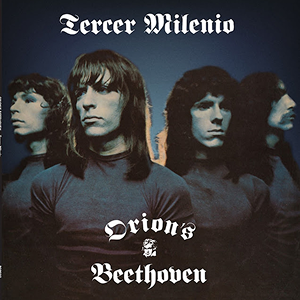
While Argentina in 1977 was sinking into the claustrophobic silence of the military dictatorship — a year in which experimentation was an act of involuntary resistance or forced adaptation — Orion’s Beethoven were undergoing their most radical metamorphosis. If in 1968 the name chosen by brothers Adrián and Ronán Bar was a declaration of intent — the collision between the vastness of the Orion constellation and the structural rigour of Beethoven — it is in “Tercer Milenio” that this vision abandons the clouds of symphonism to crash against the concrete of urban reality. This is no longer the time for poetic pop or the reinterpreted ‘Unfinished Symphony’ of “Superángel.” Here, the band embraces a heavier, more visceral and ‘grounded’ sound, transforming Symphonic Prog into a sinister and epic proto-Metal. This reissue by PQR-Disques plusqueréel is not merely a archival recovery; it is the extraction of a fossil of rare power from one of the darkest and most creative periods in Argentine history. With the opener, the band immediately lays down its declaration of intent, and “Amistades Desparejas” instantly reveals the shift in direction towards a proto-Metal sound, steeped in Heavy Psych and screaming guitars. The rhythm section is powerful, enriched by killer basslines that give body to the track, and by continuous tempo changes, maintaining continuity with their more Progressive background. It is an interweaving of burning riffs and acid-drenched solos, where melodic intermezzos succumb to heavy basslines and ferocious vocals. It is the meeting point between High Tide and Black Widow — a jam session that defies the gravity of the genre. With “Ella y los Colores,” the band returns to more Progressive and Symphonic territory. The most anticipated track among collectors. It is an electric ballad with mournful atmospheres, hosting Charly García on Mellotron. The track, which also features a cello (Carlos Rozzi), fuses the languid quality typical of Sui Generis with the Hard Rock intensity of the band. “Niño del Tercer Milenio” is the conceptual fulcrum of the album; here Adrián Bar described in the lyrics a post-nuclear war future (the then-imminent year 2000), populated by “mutants” in a mechanised and cruel society, devoid of romanticism. The visual inspiration came from the tragic images of the war in Biafra. Musically, it is a proto-Doom procession with Black Sabbath-style riffs. “Canción del Lobo” is a measured ballad that once again features Valeria Lynch on backing vocals. It is one of the moments in which the band explores more contained dynamics before the finale. An interweaving of Rock Nacional and Heavy Blues traits, with choral crescendos and refined electric guitar insertions. A suite of over 8 minutes, “Viaje (De Siglos)” sees the Symphonic elements of the early days re-emerge, but supported by a granite Hard Rock substrate and Hammond organ layers. Symphonic and psychedelic elements grafted onto a hard substrate. This balance is guaranteed by the work of Adrián Bar, who alternates heavy riffs with acoustic passages, and by the Hammond, Mellotron and organ layers curated by Ronán Bar, which add an almost ancestral atmospheric depth. The dreamy openings with arpeggios are the result of the entry into the band of Petty Guelache, whose acoustic guitar and voice reshaped the frontline of the group, allowing these excursions into more epic and acoustic territories before the distorted explosions. Guelache‘s voice is here at the service of lyrics that, as we have seen, confront the disenchantment of a mechanised and cruel society. The contrast between the symphonic beauty of the music and the harshness of the message — the mantra “matar sin motivo” — creates that sense of urgency and unease so typical of Argentina in 1977. Despite the proto-metal ferocity, the track never loses the compass of the Progressive, maintaining long and complex structures that never feel self-indulgent, but functional to the narrative of this journey through the centuries. The sixth and closing track, “Hermano Silencio,” is the track that seals the album with a decisive Heavy Prog imprint, bringing the band into territory close to proto-Metal. The track is dominated by a persistent organ that strongly recalls the style of Uriah Heep, intertwining with a guitar riff defined as a “sticky riff” — hammering and inescapable. The aggressive vocal is the hallmark of new singer Petty Guelache, with a very pronounced vocal edge; his powerful voice, capable of shifting the group’s style towards a harder and more visceral Rock compared to their Psych-Prog past. The definition “resounding closure” strikes me as very precise for a track that screams for more, and which demonstrates how the band, while maintaining an elaborate structure, had by then embraced an uncompromising executive ferocity. Compared to the debut “Superángel,” this record is considered a more mature and cohesive work, one that managed to steer the band towards proto-Metal and Heavy Prog without losing its own identity. For decades, Orion’s Beethoven remained “preserved primarily by collectors, historians and listeners drawn to the less-travelled roads of Argentine Rock.” The official reissue by PQR-Disques plusqueréel is not merely a commercial operation, but an act of justice towards a band driven by a genuine curiosity and vision rather than trends. The passing of Adrián in January 2026, at the age of 73, transforms this release into a sonic testament — a pioneer capable of making the rigour of Beethoven dialogue with the universal energy of Rock, leaving an indelible mark on Argentine culture. An essential album, which serves as a bridge between Symphonic Progressive culture and the nascent Heavy Metal, also succeeding in embedding elements intrinsic to the culture and the harsh historical period the country was living through.
Tracklist
Side 1:
Amistades Desparejas
Ella y los Colores
Niño del Tercer Milenio [1, 2, 3]
Side 2:
Canción del Lobo
Viaje de Siglos
Hermano Silencio
Lineup
Petty Guelache / Lead Vocals and Acoustic Guitar
Adrián Bar / Electric Guitar
Ronán Bar / Bass, Vocals, Mellotron and Organ
José Luis González / Drums and Percussion (Tracks 1, 2, 3)
Special Guests:
The album also boasts top-tier collaborations from the Argentine Rock scene:
Charly García / Mellotron (on the track “Ella y los Colores“)
Carlos Nozzi (Rozzi) / Cello (on the track “Ella y los Colores“)
Valeria Lynch, Luz Kerz, Mara Lua, Graciela García Caffi / Backing vocals (on the tracks “Amistades Desparejas” and “Canción del Lobo“)