
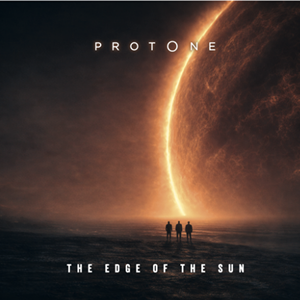
Emerging from the Haarlem region in the Netherlands, “The Edge Of The Sun” marks the official debut of ProTone, scheduled for release on November 27, 2026, in digital and CD formats (not available on Bandcamp). Behind the moniker lies a trio of multi-instrumentalists who have chosen to be identified primarily by their first names: Otto-Chris (bass, keyboards, vocals), Maarten Heeringa (guitar, ukulele, backing vocals), and Bertil Visser (drums, keyboards, backing vocals). The three have known each other for a decade, having crossed paths in various Dutch formations before converging on Kingfisher. Originally a solo project by Bertil Visser, Kingfisher evolved into the 2016 album “The Emptiness Inside Of Me,” featuring Otto-Chris and Maarten. What began as a casual collaboration has solidified into a stable partnership, grounded in a democratic approach where creative weight is shared. Their goal was to combine existing material with new compositions for a full-length debut. Production-wise, the trio does not work in isolation. Jeroen Goossens contributes to production and plays flute, alongside Joost van den Broek, a name well-known for his work behind Ayreon’s live shows and his direction in the studio. The resulting sound is compact and defined. The band views this debut not as a destination, but as the start of a journey, with ideas already in motion for the future. We are bypassing promotional fluff here. We are focusing on the notes: direct, unfiltered, and letting the architecture of the six tracks (totaling 46 minutes and 12 seconds), the arrangement choices, and the actual sound dictate the judgment. Two minutes and thirty-three seconds of instrumental opening, “Solar Ouverture,” built on electronic keyboards and enveloping sounds, supported by a minimal, electronically derived rhythmic section. It is a quiet threshold, almost ambient, functioning as an introduction that prepares the entry into the body of the album without burning its cards too early. The first expansive track, “Still,” nearly eight minutes long and the first single, is accompanied by an official music video. Here, the band dives straight into the heart of the matter, crossing classic Progressive Rock and Neo Prog with a dynamic and direct cut. Otto-Chris’ voice, light and relaxed, moves through a vocal territory reminiscent of Steven Wilson and a young Dave Gahan, supported by well-calibrated three-part harmonies in the choruses and moving verses. The strongest point of interest lies in the extended instrumental sections after the second verse: the Hammond organ pulls the sound back toward classic coordinates, while Maarten’s guitar brings gritty riffs, a heavier vein, and solos that alternate with the keyboards. This all happens within an elaborate rhythmic framework featuring time changes, the intervention of Jeroen Goossens’ flute, and an opening toward more modern and electronic timbres in the second part before returning to the chorus. The writing and execution hold the group’s artistic direction well, clarifying the project’s identity. Over seven minutes of instrumental music “Capriccio,” where the band presses the accelerator from the start. It begins with a striking synth figure, an initial electronic loop, and launched drumming that brushes against 1990s Power-Prog Metal. The track changes pace and register without standing still: accelerations with intertwined guitar and keyboards and continuous time changes are joined by classically inspired passages (with keyboards that at times recall Keith Emerson), heavy guitar inserts alternating with almost reggae-like hints, a more restrained synth passage, and Otto-Chris’ bass work, where funky slapping and Jazzy cuts give character to the rhythmic movement. The closing turns toward a theatrical and melodic imprint with piano and sustained notes. It is one of the most moving and idea-rich tracks on the album, where the intersection of classical writing, Prog/Metal drive, and rhythmic flashes works because it does not limit itself to citation, although the quantity of directions taken demands attention. Excluding the opening episode, “Stress Level” is the shortest piece in the lot and the one set in a more compact manner, closer to the verse-chorus song form. Here, the axis shifts toward a drier, more driving Heavy/Hard Rock with AOR veins, while maintaining time changes and good executive stability. The vocal attack has a sharper, more direct cut, with curated vocal harmonies, and the guitar closes with a well-centered solo. It is not my favorite episode of the disc, but it remains a solid parenthesis functional to the overall balance. With its five minutes and twenty-five seconds of instrumental music, “Strum Intel” is the last track under ten minutes before the finale. It returns to a blend of heavier Neo Prog and classic Progressive Rock, putting instrumental development back at the center with an alternation of solos between guitar and keyboards in the first section, supported by a compact rhythmic work driven by time changes. The flute returns, a detail that immediately jumps to the ear, even when not listed in the basic credits, adding symphonic color to the fabric of the track. After a more collected central phase, the intensity rises again until a tight closing with lead guitar and final choruses. Over nineteen minutes for the title-track that closes the work, “The Edge of the Sun.” It starts with winds and keyboards of a dreamy and cinematic cut, then sharply steers toward a compact Modern Prog, where keyboards, synth, and lead guitar enter immediately, and Jeroen Goossens’s flute brings folk nuances. The track crosses multiple seasons of progressive language, from Symphonic Prog to Progressive Metal, passing through time changes and alternation between driven phases and more relaxed moments, with an effective alternation between singing and instrumentation. After the second verse, the piece almost completely stops, then restarts with a new cut and a Gilmorean-style lead guitar that raises the tension. Not everything runs smoothly one hundred percent: around the thirteenth minute, the dip leads to a prolonged keyboard solo that, on a first listen, ends up tiring and weighing down that section, before the return of the theme/chorus after the fifteenth minute sets the finale in motion again. It is closed by a final piano passage that picks up the final theme and accompanies the exit. “The Edge Of The Sun” is a consistent debut that moves between classic Progressive Rock, Neo Prog, Heavy passages, and openings toward Progressive Metal, relying on the trio’s versatility and a curated production. On a first listen, the density of the arrangements and the continuous compositional drive can distract from the overall structural stability, but with repeated listens, the design gains greater cohesion. The most successful moments play out primarily in the longer and more articulated developments, with “Capriccio” and “Still” showing character, and the lengthy “The Edge of the Sun” pulling the threads of the entire setup together, despite some passages that could be trimmed. This confirms ProTone as a Dutch project to follow in its journey.
Tracklist
01. Solar Ouverture (2:33)
02. Still (7:59)
03. Capriccio (7:47)
04. Stress Level (3:18)
05. Strum Intel (5:25)
06. The Edge of the Sun (19:12)
Lineup
Otto-Chris / Bass, Keyboards, Vocals
Maarten Heeringa / Guitar, Ukulele, Backing Vocals
Bertil Visser / Drums, Keyboards, Backing Vocals
Guest:
Jeroen Goossens / Flute, Alto Flute, Bansuri and Tin Whistle (Tracks 2 and 6)