

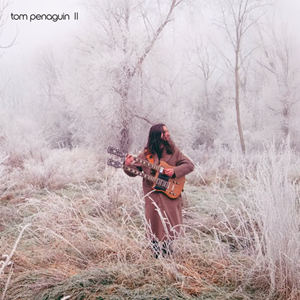
It is a genuine pleasure, after reviewing Tom Penaguin‘s self-titled debut [here], to immerse oneself in the second chapter of this artist’s discography. “Tom Penaguin II,” released May 29, 2026 via áMARXE, consolidates what the first record only hinted at: a complete, fully autonomous creative intelligence at work. Composed, performed, recorded, and produced entirely by Tom Penaguin, the album houses six tracks across a running time that builds steadily in architectural ambition, with four of them forming the centerpiece epic, “The Ornamental Hermit Suite.” What immediately distinguishes this record from the crowded Canterbury revival field is a principled refusal of the digital. No virtual instruments were employed at any stage. The sessions, tracked between July and November 2025, were mixed on an analogue TAC Scorpion console and subsequently transferred to half-inch tape via MCI JH110 — a deliberate production philosophy that shapes the sonic character of every bar. The Canterbury lineage here is more than aesthetic posturing: Penaguin received direct counsel from Dirk Mont Campbell, founding member of both Egg and Khan, whose fingerprints on the album’s architecture are, as we shall see, unmistakable. Artwork and design, curated by Maureen Piercy — who also contributes vocals — extend that sense of considered craft into the visual domain, accompanying the various physical editions, including a limited pressing on transparent blue vinyl. The album opens with its most expansive single statement, “Didier Dandelion in the Year of the Great Winds,” and the choice of placement is deliberate: thirteen minutes and twenty-four seconds that function as a full programmatic manifesto. From the first bars, the influences are clearly declared — early Caravan and Soft Machine provide the most immediate frame of reference — but Penaguin rapidly makes the territory his own. The keyboards dominate, as one would expect, but never decoratively: the Fender Rhodes Mk2, Hammond L122, Hohner Cembalet I, and Columbia Elepian are deployed with genuine compositional intent, weaving interlocking lines across a rhythmic section in perpetual evolution. Frequent metric shifts and Jazz-Rock inflections push the piece into genuinely complex formal territory, while the soloist interventions accumulate intensity rather than simply filling duration. It is a strong opening statement — patient, assured, and technically exacting. “Mandatory Intermission” it’s a brief interlude that earns its brevity. Built primarily around the Jacobacci LJ612 (double-neck) and Fender Rhodes, the piece functions as a tonal pivot between the album’s two halves — sustaining rhythmic momentum without releasing it. It does exactly what it sets out to do. “The Ornamental Hermit Suite, Movements 1-4” occupies the entire second side of the record and constitutes the gravitational centre of “Tom Penaguin II.” Its four movements expand progressively in duration and density, each one adding a further layer to an increasingly complex structure. The “1st Movement” is the sole vocal piece on the album, and the decision to feature Maureen Piercy here is well-judged. Her voice carries an ethereal quality that sits naturally within the Jazz-Rock and Avant-Prog weave Penaguin constructs beneath it — complex keyboard passages anchored by pastoral atmospheres and period harmonics, with the Canterbury idiom fully operative in both its rigour and its warmth. The “2nd Movement” opens with an organ-driven texture that recalls the Egg directly — which is less a coincidence than an acknowledgment: it is here that the guidance of Dirk Mont Campbell feels most tangible. The keyboard layering is particularly refined, deploying that distinctly Jazzy pastoral tone while threading ensemble-level groove against shifting time signatures. The movement alternates between intricate, technically demanding passages and broader crescendi that provide the necessary counterweight, maintaining tension without ever collapsing into ostentation. The “3rd Movement” marks a deliberate change of direction within the suite. A brooding, pastoral organ opens the proceedings, establishing a tonal ground over which a Free-Jazz-inflected rhythm section builds with increasing urgency. This is the most explicitly Avant-Prog moment on the record — not merely in its harmonic language but in how Penaguin manages the cumulative architecture. The rhythmic momentum builds measure by measure, culminating in a hypnotic bass-and-drum groove over which the keyboards layer increasingly dense and exploratory lines. The effect is of a piece that compels the listener’s full absorption before releasing them into the final section — the timing of this tonal rupture within the suite is precisely calibrated. The “4th Movement” closes both suite and album at the greatest length, and sustains that length with authority. It opens in a more airborne register than the third movement — Jazz-Rock textures with broader harmonic space and an evident fusion sensibility in its early passages — before cycling through the full range of Canterbury and progressive idioms that have defined the record. Crucially, the density never tips into gratuitous display. The analogue keyboard arsenal shapes each passage into something genuinely cohesive, and the overall arc of the movement affirms what the preceding fifty-plus minutes have steadily argued: that Penaguin commands every instrument on this record with rare and consistent mastery. The mastering by Peter Deimel at Black Box Studio is entirely commensurate with the production choices that preceded it — the tape transfer’s warmth and dynamic range are preserved with fidelity, and the results stand in pointed contrast to the compressed loudness that characterises so much Contemporary Progressive music. “Tom Penaguin II” is not an exercise in nostalgia. It is a demonstration, rigorously executed, that the Canterbury Sound remains a living formal language — one capable of extension and surprise in the hands of an artist willing to submit to its discipline. Required listening for admirers of Zopp, Alco Frisbass, and Ske, and essential for anyone seeking a credible bridge between the 1969–75 golden period and the future of the genre.
Tracklist
01. Didier Dandelion in the Year of the Great Winds (13:24)
02. Mandatory Intermission (03:37)
03. The Ornamental Hermit Suite, 1st Movement (05:21)
04. The Ornamental Hermit Suite, 2nd Movement (05:35)
05. The Ornamental Hermit Suite, 3rd Movement (06:18)
06. The Ornamental Hermit Suite, 4th Movement (11:50)
Lineup
Composed, played, recorded, mixed and produced by Tom Penaguin
With:
Maureen Piercy / Vocals (Track 3)