

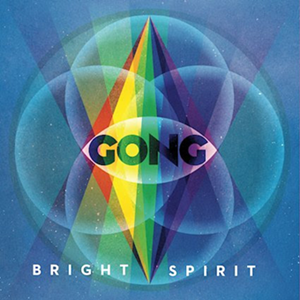
There are bands that carry a legacy, and then there are bands that carry a cosmology. Gong belongs to the latter category — a living, breathing, shape-shifting organism born from the visionary mind of Daevid Allen in the late 1960s, rooted in the fertile soil of the Canterbury Scene, and nurtured across decades of Psychedelic exploration, Jazz abstraction, and avant-garde experimentation. “Bright Spirit,” released on March 13, 2026 via Kscope, marks the third and final chapter of a trilogy that began with “The Universe Also Collapses” (2019) and continued through “Unending Ascending” (2023) — a sequence of records that, taken together, constitute one of the most ambitious and cohesive statements in the band’s post-Allen era. Recorded in South London with long-time collaborator Frank Byng, “Bright Spirit” finds Gong operating at a level of creative freedom and collective confidence that feels genuinely hard-won, earned through years of touring, loss, reinvention, and an unrelenting commitment to the frequencies that have always defined their singular artistic universe. The current lineup — Kavus Torabi on vocals, synth and guitar, Fabio Golfetti on guitar, Dave Sturt on bass, Ian East on saxophones, and Cheb Nettles on percussion — is not the Gong of “Radio Gnome Invisible” or “You,” and it would be reductive to expect it to be. What this ensemble has built, quietly and methodically, is its own gravitational field: one that orbits the same celestial bodies as Daevid Allen‘s original vision while charting genuinely new constellations. “Bright Spirit” is perhaps the clearest and most fully realised expression of that endeavour. Dreams, in both lyrical and structural terms, are the conceptual architecture of this record — not as escapism, but as a mode of perception, a way of navigating the porous boundary between the waking world and whatever resonates beyond it. The album opens with its most expansive and compositionally ambitious piece, “Dream Of Mine,” and immediately establishes the thematic and sonic coordinates of everything that follows. The track unfolds with a rhythmic foundation steeped in Eastern sensibility — ritualistic in its pulse, ceremonial in its weight — while Ian East‘s saxophone weaves modal lines that carry the unmistakable warmth of Jazz tradition filtered through Psychedelic abstraction. Kavus Torabi‘s vocal delivery is commanding yet intimately expressive, inhabiting the lyrical space with the kind of authenticity that transforms words into incantations. What distinguishes the composition, however, is its structural intelligence: rather than simply accumulating layers, it builds through genuinely articulated phases, each instrumental passage serving a narrative function within the larger arc of the piece. The mid-section blooms into interlocking vocal harmonies and an angular melodic theme of considerable memorability, before the track surrenders to an extended instrumental crescendo that weaves together Progressive complexity, Psychedelic depth, and moments of pure sensory immersion. Deep, resonant bass lines anchor the passage while guitar and saxophone effects dissolve and re-form the sonic surface above them. As an opening statement, it is fully convincing — a ten-minute meditation that feels both inevitable and revelatory, and which functions, as Torabi himself has described it, as a moment of crystalline clarity within the swirl. “Mantivule” shifts the compositional approach without sacrificing momentum. Guitar arpeggios, enriched with carefully deployed effects, establish an immediate hypnotic quality before the rhythm section asserts its presence with notable technical authority. Dave Sturt‘s bass playing here is particularly distinguished — melodically purposeful, rhythmically precise, and capable of sustaining both harmonic structure and forward momentum simultaneously. Cheb Nettles‘ drumming navigates a sequence of continuous time changes with an ease that speaks to deep ensemble cohesion, never imposing complexity for its own sake but rather using it as an expressive tool in service of the music’s evolving architecture. East‘s saxophone contributions throughout the extended instrumental passage are exemplary: technically fluent, tonally varied, and consistently oriented toward the collective sound rather than individual display. The piece builds through these elements toward a passage of notably heavier, more modern Progressive intensity before returning, with satisfying circularity, to the hypnotic thematic material of its opening. This is writing and performance of genuine craft — a track that rewards repeated listening precisely because its structural and textural richness reveals itself gradually rather than all at once. “The Wonderment” opens in a different register entirely. Electronic keyboard textures and layered effects create an introductory atmosphere of considerable depth, evoking both the cosmic and the introspective, Space Rock sensibility fused with something more experimental and contemporary. The vocal treatment here is notably processed, absorbed into the sonic fabric as an element of texture as much as melody, before Fabio Golfetti‘s electric guitar enters with a solo of real emotional intensity — Jazz-inflected, pathos-laden, and beautifully calibrated against the hypnotic keyboard backdrop. The piece represents one of the album’s most overtly experimental moments, a genuine excursion into territory that feels genuinely visionary rather than merely adventurous. It is, in the best sense, a Gong track for 2026: rooted in tradition, oriented toward futures the original band could only have intuited. “Stars In Heaven” occupies a contrasting emotional space. This is the album’s most direct and song-oriented moment — intimate, melodically rich, and suffused with that distinctively Canterbury quality of melancholy and warmth existing in careful equilibrium. The vocal performance is among Torabi’s finest on the record, carrying genuine passion within a restrained and finely judged framework. The instrumental arrangement supports rather than dominates, with guitar, bass, and keyboards generating a texture that is refined without being sparse, allowing the melodic content to communicate with clarity and emotional directness. There is something here that speaks to the deepest tradition of British Progressive songwriting — not as pastiche, but as genuine continuation, the same sensibility applied with full contemporary awareness. “Fragrance Of Paradise” — Torabi‘s first love song, by his own account — represents one of the album’s most tonally adventurous and emotionally layered compositions. Its opening passages carry Eastern and Folk inflections, an exotic rhythmic and melodic texture that gives way to warmly expressive vocals accompanied by guitar and keyboard arpeggios of considerable delicacy. What develops is a compelling synthesis of British Folk tradition, Progressive architecture, and something altogether more personal — the ’70s British sensibility of bands that moved fluidly between Folk, Rock, and Progressive idioms, updated and inflected by the specific personalities of these musicians in this moment. The track’s central instrumental section is particularly effective, building through a sustained and emotionally charged development that is met, eventually, by the return of Torabi‘s voice, creating a dynamic of call and response between singer and ensemble that feels genuinely organic. The track resolves by returning to its opening thematic material, closing a compositional circle with satisfying elegance. At three minutes and nine seconds, “Relish The Possibility” is the album’s most concise statement, and one of its most immediately affecting. A driving rhythm section — percussive, bass-forward, and rhythmically assertive — provides the foundation for a vocal melody of genuine warmth and accessibility. Folk-Rock inflections colour the arrangement with a dreamlike quality that sits in interesting tension with the track’s rhythmic energy, creating something that feels both grounded and weightless simultaneously. It is a moment of relative simplicity within an album of considerable complexity, and it works precisely because of that contrast. The closing “Eternal Hand” (6:48) brings “Bright Spirit” to its conclusion with a piece of considerable sophistication and emotional resonance. Opening with a delicate vocal passage set against a Jazz-Prog arrangement of notable refinement, the track establishes an atmosphere of quiet intensity that expands gradually through alternating vocal and instrumental sections, with East‘s saxophone contributing with particular eloquence to the ensemble’s collective voice. The overall sound here is among the album’s most polished and enveloping — warm, layered, and deeply considered — and the lyrical content, by Torabi‘s account, carries a weight and permanence that lingers well beyond the final note. As a closing statement for the trilogy, it is wholly appropriate: reflective without being elegiac, complete without feeling conclusive. “Bright Spirit” is the work of a band that has not merely inherited a legacy but has actively, rigorously, and with full artistic seriousness, continued to build it. The trilogy that now concludes with this record — “The Universe Also Collapses,” “Unending Ascending,” “Bright Spirit” — constitutes a genuinely significant body of work, one that demonstrates with clarity and consistency that the spirit Daevid Allen set in motion more than half a century ago remains vital, generative, and fully capable of producing music that demands to be taken seriously on its own terms. Kavus Torabi, Fabio Golfetti, Dave Sturt, Ian East, and Cheb Nettles have delivered, in the closing chapter of this trilogy, a record of genuine artistic integrity — adventurous in its musical thinking, emotionally resonant in its execution, and entirely worthy of the name it carries. A compelling and mature conclusion to an ambitious artistic project, and essential listening for anyone serious about the Progressive and Psychedelic traditions these musicians continue to honour and expand.
Pre-Order “Bright Spirit” here: https://www.gongband.com/
Tracklist
01. Dream Of Mine (10:32)
02. Mantivule (6:22)
03. The Wonderment (5:11)
04. Stars In Heaven (4:01)
05. Fragrance Of Paradise (7:39)
06. Relish The Possibility (3:09)
07. Eternal Hand (6:48)
Lineup
Fabio Golfetti / Guitar
Kavus Torabi / Vocals, Synth, Guitar
Dave Sturt / Bass
Ian East / Saxophones
Cheb Nettles / Percusion
[…] [REVIEW] […]