

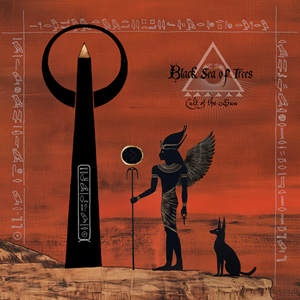
Melbourne’s Black Sea Of Trees return with their second full-length album, “Cult of the Sun,” released independently on May 8, 2026 — and the distance travelled since their 2023 debut “The Spiritual Beast” is immediately apparent. Where that record established the band’s core language — atmosphere, structural weight, and a sustained engagement with spiritual themes — “Cult of the Sun” pushes that foundation into considerably harsher and more uncompromising terrain. Built around the historical and mythological figure of Akhenaten, the heretic pharaoh who dismantled Egypt’s ancient polytheistic order in favour of solar monotheism, this is a concept album in the most rigorous sense: a narrative arc that moves from messianic covenant to cosmic annihilation, with no redemption offered along the way. The sun, here, does not illuminate. It consumes. The album opens not with aggression but with threshold — “Divinity” functions as a ceremonial invocation, a choral Atmospheric piece that wraps the listener in ancient desert resonances before a single riff has landed. It is a deliberate and well-calibrated choice: the band establishes the tonal world, the hieratic gravity of the narrative, before the protagonist even steps into it. The wordless choral textures establish an almost sacred hush that makes what follows all the more disruptive. “A Red Dawn” arrives as a tectonic shift. The track opens in a state of suspended tension that erupts into muscular, technically precise Progressive Metal, with Samuel Exton delivering harsh vocals of genuine intensity before the composition pivots into interlocking clean vocal harmonies that expand the sonic palette considerably. The band’s approach to dynamic architecture is immediately evident: dense walls of distortion give way to delicate arpeggiated passages, only to fold back into Progressive Death Metal fury with a tempo change that reframes everything that preceded it. Jan Schotting‘s drumming throughout is a constant point of structural authority — the rhythmic shifts never feel arbitrary, always narrative. The track closes in an atmosphere of violent resolution, the destruction of old temples echoed in the guitar lines that drag the riff to its conclusion. “Servant to the Sun” advances the story with focused momentum. The marching rhythmic drive that frames the protagonist’s euphoria after divine selection carries a sense of inevitability that is entirely intentional — this is music written to mirror psychological states, and the grandiose, expanding choral passages here convey the ecstatic release of unquestioned devotion with precision. A quieter central section sustains a trance-like quality before Chris Schwinghamer‘s lead guitar reasserts authority in the closing passages, the band resolving the track on an authoritative note that carries the messianic certainty embedded in the lyrical narrative. “Prophecy” occupies the structural centre of the album’s first half as a dark folk interlude — acoustic guitars, choral echoes, and spoken word delivered in an ancient language. It is a compositional pause of genuine intelligence: the prophecy itself outlines the full arc of the narrative, appearing also in Egyptian hieroglyphs on the album artwork, and the sense of foreboding it generates is irreversible. From this point, “Cult of the Sun” begins its descent. The sound of the spoken word propagates like an echo across stone corridors — resonant, sourceless, and deeply unsettling. The album’s most ambitious single statement arrives with “Visions of a Crimson Moon,” the longest track on the record and one that amply justifies its runtime. The opening section establishes a granite rhythmic foundation before Exton enters with extreme vocal stylings that gradually give way to deeply expressive clean passages — warm, almost devotional in tone, before the contrast reasserts itself. Francesco Adami‘s bass work is particularly prominent here, anchoring a composition that moves through psychedelic meditation, cyclical guitar motifs that bend and distort with a gravitational heaviness, and explosive dynamic climaxes that feel genuinely earned. Schwinghamer‘s solo passages trace trajectories between Atmospheric Prog and Metal with a fluency that speaks to the band’s refusal to treat either idiom as a secondary concern. The track depicts the protagonist’s dream-vision: a cosmic serpent, bone-built temples beneath a sky dominated by a black hole, warning without resolution. It is, musically, exactly that — beautiful, foreboding, and irreducible. The title-track, “Cult of the Sun,” marks the narrative’s internal reckoning. The composition opens with a clean, modern Progressive Rock sensibility — almost introspective — before riffs of near-Djent precision fracture the surface. Exton‘s clean vocal performance here is among the album’s finest, warm and controlled, carrying the lyrical weight of self-examination, false divinity, and the recognition of complicity in one’s own undoing. The rapid shifts in tempo and tonal register mirror the protagonist’s emotional disintegration; the recurring opening and closing riff, returned in an altered form, reinforces the cyclical symbolism that runs as a structural motif throughout the entire record. It is the compositional hinge on which the album turns. “Omen” arrives as the sun god’s revelation of its true nature. Middle Eastern scales and flamenco-inflected guitar work from Schwinghamer establish a desert character that is integrated with genuine subtlety — the tonalities move through the composition like sand dunes in constant, unhurried motion, alternating between heavier passages and broader, more dilated Atmospheric openings with a fluidity that never tips into genre pastiche. A clean vocal performance of considerable expressiveness opens the track before the dynamics tighten and the harmonic language darkens. In the final movement, Atmospheric guitar textures expand the sound outward — there is a tonal expansiveness here that recalls the approach of Devin Townsend at his most spacious — before extreme vocal fragments and layered choral echoes close the track in a Progressive Rock atmosphere of genuine depth. “Field of Reeds” operates as deliberate contrast — one of the album’s briefest pieces, built around sparse, sombre guitar arpeggios and penetrating harmonized vocals. The ancient Egyptian concept of paradise — the Field of Reeds as the afterlife’s reward — is invoked only to be denied. There is something distinctly sepulchral about the track’s atmosphere: the sensation of crossing a threshold into an enclosed ancient space, of breathing air that has been sealed for millennia, of being surrounded by a silence that carries enormous historical weight. The closing detuned string textures, representing the unravelling of matter as the black hole approaches, resolve the piece into something between elegy and warning. “Eclipse” closes the main album with a sustained meditative march — repeating riffs, droning guitar bends, and a pacing that mirrors the slow, inexorable consumption of existence. The final lyrical statements express acceptance of extinction without the consolation of divine purpose or afterlife, and the track’s dynamics build with a deliberateness that keeps the listener entirely suspended until the final moments — when NASA‘s recorded sound of a black hole emerges from the mix, followed by complete silence. The title works as both narrative closure and conceptual symmetry: an album dedicated to the “Cult of the Sun” ending in the eclipse of everything. It is an effective and earned conclusion. The bonus track, “The Dark Distance” (3:06), extends the emotional weight beyond the main arc. Predominantly acoustic, with orchestral background textures in the opening movement, a warm vocal performance from Exton, and a percussive rhythmic section that gives the piece unexpected forward momentum, it functions as an epilogue of acceptance — themes of futility and inevitability rendered in the most intimate sonic register the album offers. It does not diminish the finality of “Eclipse“; it reflects on it. Across its ten tracks and approximately fifty minutes of music, “Cult of the Sun” demonstrates that Black Sea Of Trees — Samuel Exton (vocals/guitar), Chris Schwinghamer (lead guitar), Francesco Adami (bass), and Jan Schotting (drums) — are operating at a level of compositional and narrative ambition that demands serious attention. The album balances long-form composition with more concise structures without sacrificing coherence, and the integration of desert tonality, Middle Eastern melodic elements, and ancient spiritual imagery into a Progressive Metal framework is handled with consistent intelligence and restraint. “Cult of the Sun” is not an easy record — it asks for attentive, committed listening — but it rewards that commitment with a depth of construction and emotional trajectory that grows with each return. A significant statement from a band still in the early stages of what promises to be a substantial body of work.
Tracklist
01. Divinity (01:46)
02. A Red Dawn (06:36)
03. Servant to the Sun (05:58)
04. Prophecy (02:03)
05. Visions of a Crimson Moon (08:13)
06. Cult of the Sun (06:53)
07. Omen (05:17)
08. Field of Reeds (03:18)
09. Eclipse (07:54)
10. The Dark Distance (03:06)
Lineup
Samuel Exton / Vocals and Guitar
Chris Schwinghamer / Lead Guitar
Francesco Adami / Bass
Jan Schotting / Drums