

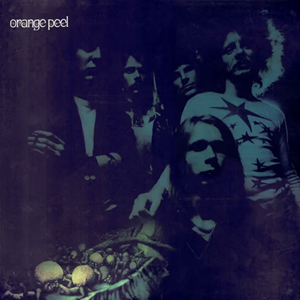
In the magmatic and primordial ecosystem of early Seventies German Rock, few sonic objects possess the raw impact and enigmatic allure of Orange Peel‘s sole, self-titled LP. Originally consigned to history in 1970 under the Bellaphon imprint, the record today finds its definitive and necessary digital consecration through the official release curated by Bacillus Records on Bandcamp, which took place on May 08, 2026. This act of recovery is not merely a philological gesture, but the reaffirmation of a primacy: that of a band capable of forging a brutal and visionary synthesis between the acidity of Havy Psychedelia and the expansive structures of what would come to be baptised Krautrock. Recorded at the legendary Dierks Studios in Stommeln under the supervision of Dieter Dierks, the work of Orange Peel — a quintet hailing from Hanau — represents a point of no return for the Teutonic underground. Here, within the “sacred walls” where the cornerstones of the genre took shape, the blazing debut of a then seventeen-year-old Curt Cress unfolded, a drummer destined to become one of the most influential figures on the European scene. The sound of Orange Peel is a living organism dominated by Ralph Wiltheiß‘s Hammond organ and Leslie Link‘s saturated guitars, a combination that drives Blues-Rock toward territories of pure abstraction and sonic violence. The beating heart of the work occupies the entire first side, “You Can’t Change Them All” — a monumental suite that defines the very concept of structural excess. The track opens with a subdued chordal construction, an atmospheric fuse that ignites an explosion driven by the frantic interplay between the Hammond organ and the rhythm section. This is no simple blues improvisation, but a manic duel in which Wiltheiß‘s so-called Schweineorgel (the “pig organ,” named for its dirty and growling timbre) intertwines with Link‘s Hendrix-influenced guitar work. Cress, despite his young age, imposes a muscular dynamism that sustains sudden accelerations and time doublings, while the plaintive and distinctly “Teutonic” vocals of H. Peter Bischof lend the piece an aura of existential urgency. Midway through, the track veers into a spatial and liquid Psychedelia, before collapsing into a cyclical finale of percussion and tonal debris. It is an eighteen-minute masterpiece that alone justifies the worldwide cult surrounding this band. Following the clamour of the opening suite, this second episode functions as a moment of compression and lyrical clarity. In “Faces That Used to Know,” the rhythm becomes controlled, almost restrained, built around an organ motif that defines the melodic backbone of the track. Although the form remains more conventional by the band’s standards, brief instrumental incursions introducing deformed tonal colorings are not absent, keeping the psychedelic tension elevated. It is a demonstration of how Orange Peel could handle the song form without surrendering the underlying darkness that permeates the entire record. “Tobacco Road” is he reinterpretation of John D. Loudermilk‘s classic and here is stripped of every Folk remnant and transfigured into a Heavy-Psych monster. The density of the fuzz guitars is suffocating, continuously interrupted by rhythmic breaks that fracture the flow of the main riff. Bischof‘s delivery transforms the lyrics into a cry of urban alienation, while Wiltheiß literally takes command in the central section, steering the organ phrasing toward unexpected and aggressive angles. It is a tribute to the band’s Blues roots, but executed with a ferocity that looks directly toward the darkest British proto-Prog, ideally invoking the raw force of groups such as Atomic Rooster. The album’s finale, “We Still Try to Change,” is entrusted to a composition that perfectly embodies the Experimental spirit of the most uncompromising Krautrock. The opening is dominated by a dark tension centered on Heini Mohn‘s bass lines, which swell gradually until erupting into a violent collective interplay. The second half of the track abandons every rhythmic or harmonic handhold to venture into absolute instrumental abstraction. The piece dissolves into a non-linear conclusion made of isolated clusters, suspended notes and silence, leaving the listener in a state of unsettling suspension. It is the final seal on a record that accepts no compromise, closing the circle of a totalising sonic experience. The Orange Peel‘s album is not simply a genre record; it is a historical document of an era in which the boundaries between Hard Rock, Blues and the Avant-Garde were still fluid and dangerous. The new digital release on Bacillus Records does justice to a formation that, despite dissolving shortly after these sessions, sowed the seeds for much of the German music that followed. Its members would go on to write history in projects such as Epsilon, Emergency, Atlantis and Passport, but the raw, primordial and undisciplined magic captured on this 1970 self-titled remains unrepeatable. We are in the presence of a work that shines with a black light, sustained by superb instrumental technique and an artistic vision unafraid to challenge the patience or expectations of the listener. For anyone wishing to understand the heaviest and most visceral roots of the German sound, the rediscovery of this masterpiece is an obligatory act. Orange Peel did not merely “try to change,” as the closing title declares; with this record they effectively shifted the axis of European Rock Music toward uncharted territories. An absolute masterpiece for historical importance, executive ferocity and artistic integrity.
Tracklist
01. You Can’t Change Them All (18:15)
02. Faces That Used to Know (03:12)
03. Tobacco Road (07:16)
04. We Still Try to Change (10:04)
Lineup
H. Peter Bischof / Vocal, Percussion
Curt Cress / Drums, Percussion
H. Leslie Link / Guitar, Effects
Heini Mohn / Bass
Ralph Wiltheiß / Organ