

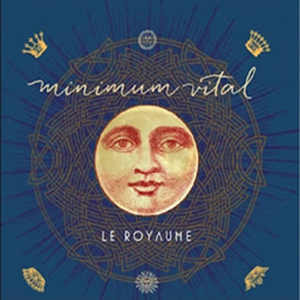
Few ensembles within the French Progressive tradition have cultivated an artistic identity as singular and enduring as Minimum Vital. Since their emergence in the mid-1980s, the twin brothers Jean-Luc and Thierry Payssan — alongside their long-standing collaborator Eric Rebeyrol — have forged a musical language entirely their own: rooted in the melodic sophistication of Classic Progressive Rock, nourished by the ancient tonalities of Occitan and Medieval Folk traditions, and continuously renewed through an instinctive openness to musical cultures far beyond the borders of France. “La Royaume,” released on December 15, 2025 via the venerable Musea Records, marks the latest chapter in a discography of remarkable consistency and artistic integrity — and it stands, without qualification, as one of the most accomplished records of their career. What defines Minimum Vital at their finest is precisely what defines “La Royaume” throughout its forty-nine minutes: the capacity to build complex, emotionally layered music without ever surrendering warmth or melodic clarity. The album gathers around it an expanded cast of contributors — among them violinist Mario Peperoni, flautist Stéphane Ducasse, and drummer Charly Berna — whose presences are not ornamental but structurally essential to the album’s timbral architecture. The result is a record of uncommon richness, one that reveals further dimensions with each attentive listen. “La Chapeloisse” opens the album with the quiet authority of a band that requires no overture or preamble. The initial interplay between guitar, keyboards, and violin establishes immediately the aesthetic coordinates of the record: melodic lines that interlace with organic logic, a rhythmic foundation that provides both momentum and space, and vocal harmonies that function less as ornamentation than as integral structural voices. Mario Peperoni’s violin is central from the outset — its tone warm and expressive, its phrasing fluid enough to converse naturally with the electric guitar without imposing on the music’s tonal equilibrium. The Progressive architecture of the piece develops with confidence, reaching moments of genuine dynamism before resolving with an economy that bespoke compositional maturity. A superb opening statement. “En Galise” introduces a more rhythmically assertive dimension. A marching-tempo drumming pattern and the combined weight of synthesizer and guitar establish a processional quality that carries overt medieval resonances, yet the arrangement evolves steadily toward Symphonic Prog territory, expanding in scope and harmonic density as the piece progresses. The bass line — characteristically substantial in Rebeyrol’s hands — anchors the ensemble while the melodic voices circulate above with increasing freedom. The construction is careful, the crescendo earned, and the final moments carry an epic quality grounded not in gesture but in structural accumulation. “Ordo Danielis” is among the album’s most immediately striking compositions. The opening passage — voices, guitar, and keyboards suspended in a space poised between sacred polyphony and Epic Progressive Rock — creates an atmosphere of genuine mystery. The band develops the theme with admirable discipline, allowing the instrumental passages to gather intensity through controlled layering rather than through sheer volume or speed. The Folk-Medieval and Symphonic-Prog elements co-exist here with unusual fluency, lending the piece a timeless quality that few contemporary Progressive ensembles can authentically claim. Technically precise and emotionally resonant in equal measure. “Cadenced” represents an elegant shift in register. Brief in duration — barely three minutes — and anchored by a delicate piano introduction, the piece develops around subtle Jazz inflections, with woodwind contributions that place it squarely within a Canterbury-influenced lineage. That Minimum Vital can navigate this register with the same authority they bring to their more expansive constructions speaks clearly to the band’s compositional range. The piece functions as a moment of refinement and contrast within the album’s broader arc, and its inclusion reflects a programming intelligence that rewards attention. “Las Estrellas” is the album’s most extended track and arguably its most fully realised. From the opening interplay between traditional instruments and electric guitar — mandolin and synthesizer engaged in a melodic dialogue of considerable grace — the composition unfolds with a structural confidence that recalls the finest moments of the band’s catalogue. The Occitan atmospheres that have always been central to Minimum Vital‘s identity are here particularly vivid: the melodic language is warm, modal, and deeply rooted, yet the Progressive architecture that carries the piece never allows it to rest on purely retrospective sentiment. The transition from the acoustic-tinged opening to the organ-led central section — the mandolin persisting throughout as a tonal anchor — is handled with an assurance that transforms what might have been a simple genre juxtaposition into something genuinely complex and coherent. One of the album’s defining moments. “Berry Roak” sustains the album’s momentum with a track built on irresistibly propulsive melodic lines. The integration of traditional timbres with electric guitar and keyboards is again managed with seamless craft, and the rhythmic section — restless, continuously evolving — provides a foundation of controlled tension over which the melodic voices operate with considerable freedom. The piece demonstrates the band’s particular gift for melodic writing that functions simultaneously as accessible and structurally sophisticated: catchiness and compositional rigour here are not in tension but in productive dialogue. “Yan Dele Son‘” at just over two minutes, moves into territory both more direct and more intimate. The first vocal appearances to deploy a more explicitly Folk-song character are integrated with percussion and traditional instruments before a brief but effective electric guitar intervention closes the piece. The juxtaposition is handled with a light touch, and the result — though brief — adds a human directness to the album’s landscape that is genuinely affecting. “Godzilla” marks the album’s most pronounced shift in tonal register. The cinematic intro gives way to a driving, organ-dominated Heavy Progressive sound — guitar riffs constructed with evident care, time-signature changes deployed not as technical display but as structural logic, and a treated, hypnotic vocal line that functions as a melodic instrument in itself. The Heavy Progressive character of the piece is earned through rhythmic intelligence rather than sheer weight, and the acceleration in the second half — the rhythmic section pushing into more urgent territory while the melodic architecture remains controlled — demonstrates a compositional discipline that elevates the piece beyond straightforward Progressive Rock into something more genuinely singular. “Farewell” offers one of the album’s most emotionally concentrated moments. Two minutes of acoustic guitar arpeggios and flute — unhurried, melancholic, carrying something of the character of early music — constitute a passage of rare expressive economy. The emotional weight here is considerable, achieved not through complexity but through the careful selection of tones and textures that allow the music’s innate pathos to surface without mediation. Stéphane Ducasse‘s flute contribution is particularly fine. “Danse Villageoise” returns the ensemble to Folk-Prog territory with evident pleasure and energy. The organ and synthesizer opening gives way to a rhythmic dialogue that carries the piece with considerable forward momentum, while the mandolin — deployed throughout with characteristic elegance — infuses the melodic lines with the Folk and medieval flavours that define so much of the album’s character. The interplay between guitar, keyboards, and mandolin across the composition’s development is detailed and satisfying, the time-signature shifts organic rather than imposed, and the overall construction demonstrates again the band’s ability to synthesise disparate elements into coherent and distinctive musical architecture. “Danse Cornue” opens with a moment of levity — a brief laugh that serves as an apt cue for one of the album’s most tonally eclectic compositions. The rhythmic foundation here is unmistakably funky — dense, groove-driven, and with a swagger quite distinct from anything preceding it — while the organ, guitar, and synthesizer lines navigate with agility through a Prog-Fusion framework that refuses easy categorisation. The continuous metric transformations are handled with the fluency of a band genuinely at ease in complex rhythmic terrain, and the fusion of Funk, Progressive Rock, and Jazz-adjacent textures is achieved with a playful assurance that renders what might have been a compositional risk into one of the album’s most enjoyable and characterful pieces. “Galadriel a Manhattan” closes the album in the manner the finest suite-form compositions demand: with grandeur, architectural scope, and a sense of narrative resolution that encompasses and surpasses what has preceded it. The compositional engine is a cyclical guitar-keyboard dialogue — a repeating but evolving motivic exchange that functions as something close to a tonal mantra, accumulating resonance through repetition and gradual harmonic inflection rather than through developmental drama. The vocal approach is equally deliberate: restrained and deliberately blended into the instrumental texture during the verses, emerging with clarity and melodic purpose only in the refrain. The tonal quality of the vocal language — arcane, modal, carrying overtones of constructed or imagined linguistic traditions — lends the piece an otherworldly quality that is consistent with the album’s broader engagement with imaginary Folklore. The closing section resolves with a festive, celebratory energy that carries genuine cathartic force: the music opens outward, the rhythmic momentum builds, and the album ends not with introspection but with collective exuberance — a deeply satisfying conclusion to a composition and a record of sustained and serious artistic ambition. “La Royaume” consolidates Minimum Vital‘s position not merely within the French Progressive tradition but within the broader Progressive Rock canon without reservation. Across twelve compositions spanning nearly fifty minutes, Jean-Luc and Thierry Payssan — alongside Rebeyrol, Berna, Peperoni, and Ducasse — construct a record of genuine and durable quality: melodically rich, texturally sophisticated, emotionally coherent, and informed throughout by a compositional intelligence that never confuses complexity with depth. The album’s defining achievement is precisely its synthesis: medieval polyphony, Occitan Folk tradition, Symphonic Progressive architecture, Canterbury Jazz inflections, and Funk-driven rhythmic energy are not assembled here as an eclectic catalogue of influences but absorbed into a musical language that remains, distinctively and unmistakably, Minimum Vital‘s own. Musea Records, a label with an unimpeachable commitment to the most demanding progressive traditions, has provided the appropriate home for this work — and “La Royaume” reflects credit on all involved. Essential.
Purchase “La Royaume” via Musea Records Webshop
Tracklist
01. La Chapeloisse (4:04)
02. En Galise (4:27)
03. Ordo Danielis (4:48)
04. Cadenced (2:53)
05. Las Estrellas (5:58)
06. Berry Roak (3:48)
07. Yan Dele Son’ (2:23)
08. Godzilla (4:16)
09. Farewell (2:00)
10. Danse Villageoise (3:32)
11. Danse Cornue (5:02)
12. Galadriel a Manhattan (6:44)
Lineup
Jean Luc Payssan / Guitars, Vocals
Eric Rebeyrol / Bass, Trumpet
Thierry Payssan / Keyboards, Metalophone, Vocals
Charly Berna / Drums
With:
Stephane Ducasse / Flutes, Akai Ewi
Mario Peperoni / Violin
[…] Minimum Vital – La Royaume: French Progressive Rock at its finest. Minimum Vital return with “La Royaume,” a record that confirms their place as one of the most refined voices in the contemporary European Prog scene. A deep listen, full of nuance and compositional sophistication. [Read the full review] […]
[…] Read our Review of “Le Royaume” here: [Review] Minimum Vital – La Royaume […]