

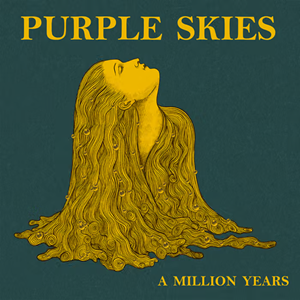
Bergen, Norway. A city whose relationship with darkness — meteorological, cultural, existential — has historically generated music of uncommon density and emotional weight. It is from this context that Purple Skies emerge: a four-piece formed in 2017 around the creative axis of guitarist Henrik Solheim and vocalist/guitarist Marius Aasen Moe, with the rhythm section of Robert Johansen on bass and Jøran Mjelde on drums completing a lineup built with deliberate patience. Initially conceived within the parameters of pure Doom, their sound evolved organically toward something more composite — fuzz-driven Heavy Rock with deep roots in the late ’60s and early ’70s, proto-Doom, and Stoner Rock, yet never fully abandoning the Atmospheric gravity of Doom’s foundational vocabulary. “A Million Years,” released April 10, 2026 via Apollon Records, is their debut full-length, and it arrives as a confident, fully-formed statement from a band that has clearly internalized its influences without being consumed by them. What strikes immediately is the coherence of vision. “A Million Years” does not operate as a collection of tracks assembled for catalogue purposes — it functions as a sustained argument for a particular kind of heaviness: slow-burning, atmospheric, fundamentally Nordic in its emotional register. There is a darkness here that is never theatrical, never performative. It is the darkness of conviction, of a band that genuinely inhabits this sonic territory rather than visiting it. “Haven” opens the record with purpose and restraint. The entry is deliberate — deep bass lines establishing the foundation before the guitars layer in their penetrating riff work, constructing an atmosphere that is simultaneously oppressive and enveloping. At just over three minutes, the track functions as both overture and full statement: slow-burning, ritualistic in its repetition, carrying the weight of proto-Doom with the directness of Heavy Rock. There is nothing superfluous here. Every element serves the atmosphere, and the atmosphere serves the listener’s immersion into what follows. “Mr. Fear” expands the palette considerably. The riff architecture is unambiguously old-school Doom — monumental, deliberate, built to endure — but Moe‘s vocal performance is what elevates the track beyond genre exercise. Dynamic and expressively calibrated, his delivery navigates between the restrained and the forceful with genuine conviction. The guitar solo that emerges mid-track is precisely that: a blade cutting through the surrounding density, sharp and purposeful, adding melodic relief without dissolving the surrounding tension. The rhythm section provides the necessary immovable foundation, Johansen‘s bass lines working in close dialogue with the riff structure. “Bitchcraft” follows logically from its predecessor while introducing greater compositional complexity. The interplay between Heavy Rock and Doom here is genuinely granite-solid — not a compromise between two directions but a fusion that draws strength from both. The tempo shifts are the track’s most distinctive feature, lending a retro quality to the overall feel while simultaneously opening space for melodic passages that contrast effectively with the surrounding darkness. The second half introduces a spoken vocal section that functions as a genuinely evocative dark prog passage — understated, atmospheric — before the guitars reassert command and drive the track toward its conclusion with accumulated riff-driven force. “Too Worn To Tell” is among the album’s most nuanced moments. Opening with fingerpicked guitar arpeggios that interweave with lead guitar lines and Moe‘s warmest vocal performance on the record, the track carries an emotional depth that references Nordic Heavy Rock’s more introspective traditions — a lineage that understands melancholy as a compositional tool rather than mere aesthetic decoration. The Witchcraft comparison is earned rather than imposed: there is the same understanding of space, of how to make a song breathe while maintaining its inherent weight. As the track develops, heavier riff elements are incorporated with care, the guitars trading in increasingly assertive passages without disrupting the track’s fundamental emotional character. At five and a half minutes, it is the album’s most fully realized song. “Quiet Flowers” shifts register slightly — a Heavy Rock track with pronounced melancholic undertones and that distinctively Nordic tonal quality that is difficult to articulate precisely but immediately recognizable. The rhythm section is particularly effective here: solid, attentive, providing the structural foundation over which Moe‘s warm vocal delivery and the dual guitar work find their balance. Folk elements surface briefly without dominating, and a sustained guitar solo in the second half provides the track’s emotional apex before the vocals return for a concluding sequence that closes with a hard rock directness. The title-track, “A Million Years,” inhabits the album’s gravitational center with appropriate authority. The movement is slow, the riff work penetrating — bass and guitars constructing a genuine sonic wall in the tradition of the heaviest early ’70s Rock. Moe‘s vocal performance here is among his most evocative on the record, and the tempo variations are handled with compositional intelligence: they are not disruptions but developments, allowing the riff architecture to evolve while the bass lines maintain their anchoring role. The second half opens the sound considerably, the lead guitar work interweaving with the vocals to create textural contrast that prevents the track’s deliberate pace from ever collapsing into stasis. This is the track that most completely articulates the band’s Doom Rock identity. “Worthless Men” is the record’s most intense sustained performance. The interplay between vocal and instrumental passages is handled with considerable skill — the lead guitar is consistently prominent without overwhelming the track’s structural integrity, the rhythm section navigating tempo changes with a fluency that reflects genuine ensemble cohesion. Moe‘s delivery here is charged with a pathos that feels earned rather than performed, and the track’s trajectory — from its opening intensity through increasingly Heavy riff passages toward a refined guitar solo that closes proceedings — demonstrates a mature understanding of song construction. The heaviest moment on the record, and also one of its most compositionally controlled. “Archaic Freeway” consolidates the album’s Heavy Rock credentials while maintaining the Doom undertones that give “A Million Years” its tonal identity. The dynamic between the more restrained verse delivery and the more open, assertive chorus sections reflects an understanding of how contrast operates in Heavy Music — not as disruption but as necessary modulation. The rhythm section is particularly active here, the drumming and bass providing a foundation in continuous evolution, and the tempo shifts push the track toward explicitly heavier territories in its later passages. Among the album’s most varied compositions, and structurally one of its most accomplished. “Red Road” closes the record on maximally Heavy terms. The opening bass drone is genuinely arresting — a decision that establishes the track’s fundamental character before the guitars enter with their Heavy Psych riff work. The structural synthesis of Heavy Psych and Doom Rock that follows is the album’s most complete integration of its constituent influences, and Moe‘s final vocal performance maintains the expressive standard set throughout. At nearly six minutes, it is the longest track on the record and uses its duration purposefully, building toward a conclusion that leaves the listener with a full understanding of what Purple Skies are capable of and what directions “A Million Years” points toward. “A Million Years” is a debut that arrives with the confidence of a band that has done the necessary work — not merely in rehearsal rooms, but in the deeper process of identifying what they actually want to say and how they want to say it. The sound is personal without being opaque, rooted without being derivative. Apollon Records have found in Purple Skies a band whose understanding of Nordic Heavy Rock’s most austere and compelling traditions is matched by the compositional intelligence to deploy those traditions in service of original, fully inhabited music. Nine tracks, forty-one minutes, no wasted motion. Recommended without reservation.
Tracklist
01. Haven (03:12)
02. Mr Fear (04:09)
03. Bitchcraft (04:04)
04. Too Worn To Tell (05:29)
05. Quiet Flowers (03:52)
06. A Million Years (04:14)
07. Worthless Men (05:23)
08. Arcahic Freeway (04:43)
09. Red Road (05:51)
Lineup
Marius Aasen Moe / Vocals and Guitars
Henrik Solheim / Guitars
Robert Johansen / Bass
Jøran Mjelde / Drums
[…] Purple Skies – A Million Years: Psychedelic, expansive, unhurried. “A Million Years” by Purple Skies is the kind of record that demands full attention and rewards every minute of it. A journey through sound that leaves a mark. [Read the full review] […]