

In the vast and often intricate map of world Progressive Rock, there exist territories that, despite being geographically distant from the nerve centres of London or Canterbury, have managed to produce gems of inestimable value — capable of shining with their own original light. Australia in the Seventies is certainly one of these places. On a continent dominated by visceral and often raw Rock, a band from Sydney accomplished the titanic feat of importing and reworking the sophisticated sonic architectures of the Old World: Sebastian Hardie. But their story is not merely one of dazzling success; it is an epic made of stylistic evolutions, legal disputes, and a rebirth under the name Windchase — a project that redefined the boundaries between Symphonic Rock and Jazz-Fusion.
— The Origins —
To fully understand the importance of this saga, one must go back to 1967. Graham Ford, a visionary guitarist, gave life to the Sebastian Hardie Blues Band. Initially, the group was immersed in the ferment of rhythm and Blues and Soul, cutting their teeth on the Sydney pub circuit and sharing the stage with legendary figures such as Johnny O’Keefe. It was an era of apprenticeship, in which the band honed its technique performing hits by the Beatles, the Rolling Stones, and soul giants such as Otis Redding. It is in this context that a figure destined for great things begins to emerge: Jon English. Before becoming an icon of musical theatre and a successful singer-songwriter, English was the voice and rhythm guitar of a band that was slowly shedding its skin.
The definitive metamorphosis took place between 1971 and 1973. Jon English left the group to play the role of Judas in the Australian production of Jesus Christ Superstar, opening the way for a paradigm shift. With the arrival of the young virtuoso Mario Millo on lead guitar and Toivo Pilt on keyboards, Sebastian Hardie decided to abandon the “Blues Band” suffix and their pop ambitions in order to embrace the complexity of Progressive Rock. It was not an obvious choice: Australia did not yet have a genuine symphonic scene. And yet, the band began composing articulated suites, eventually including in their sets a monumental twenty-minute version of Mike Oldfield‘s “Tubular Bells.” Their ambition was clear: to create music that was simultaneously cerebral and emotional, capable of competing with the great masters from across the ocean.
— Four Moments (1975) —
1975 marked the apex of this journey with the release of “Four Moments“. Produced, paradoxically, by Jon English himself, the album was a resounding success, reaching twelfth position in the national charts and receiving a gold certification. It was the first time a Symphonic Rock album had scaled the heights of the Australian market. Critics were struck by the fluidity of the arrangements and the instrumental mastery of the quartet, which now also included brothers Peter and Alex Plavsic in the rhythm section. Tracks such as the title suite or the melodic “Rosanna” displayed clear influences of Genesis, Yes and Camel, yet with a brightness and sonic clarity that were distinctly Australian. It was the first time a Symphonic Rock album had scaled the heights of the Australian market.
However, as often happens in stories of great success, internal tensions and management disagreements began to undermine the group’s stability. After a second album, significantly titled “Windchase” in 1976, the band found itself at a crossroads. A legal dispute assigned the name Sebastian Hardie to bassist Peter Plavsic, forcing Millo and Pilt to make a drastic choice: dissolve the project or start over from scratch. They chose the latter path, adopting the title of their last record as their new identity: Windchase was born.
— The Birth of Windchase —
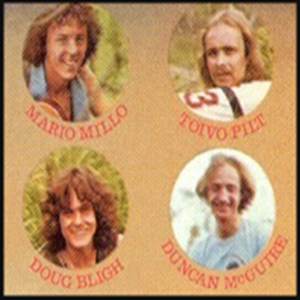
This change of name was far from purely formal; it represented a decisive sonic evolution. With the arrival of Doug Bligh on drums and Duncan McGuire on bass, Windchase moved toward Jazz-Fusion territories, enriching their Symphonic matrix with more complex rhythms and audacious improvisations. In 1977, “Symphinity” saw the light of day — an album whose very title already suggested the fusion between orchestral infinity and technical precision. The album cover itself, with its mystical imagery of UFOs and Ancient Egypt, promised a Psychedelic and transcendent journey.
— Symphinity (1977) — A Track by Track Journey —
Listening to “Symphinity” reveals a group at the peak of their creative form. The opening is entrusted to “Forward We Ride”, a piano prelude of rare elegance that recalls Jazz-lounge atmospheres, preparing the ground for the absolute masterpiece of the record: “Horsemen to Symphinity.” In this track of over eight minutes, Mario Millo‘s guitar reaches heights of absolute lyricism. The piece is underpinned by a pulsating bass line employing the tresillo rhythm, typical of Latin music, creating a fascinating contrast with string synthesisers that evoke spatial scenarios. It is a piece that fuses Carlos Santana‘s passion with the melodic delicacy of Andy Latimer, demonstrating how Millo had become one of the most gifted guitarists of his generation.
“Glad to Be Alive” shows the band’s sunnier and almost pop side, with an orchestral arrangement that some critics of the era found excessive, but which today shines with its contagious positivity. In contrast, “Gypsy” is an instrumental jewel that opens with the sound of children playing, evolving into an exotic track where the dialogue between guitar and keyboards recalls the most dreamlike moments of Focus.
One of the album’s Experimental peaks is without doubt “Lamb’s Fry.” Introduced by the sizzling sound of a frying pan and the bleating of a lamb, the track transforms into a driving Funk-jam in the Phrygian mode. Here, Toivo Pilt‘s Fender Rhodes electric piano and Doug Bligh‘s drums create a hypnotic rhythmic carpet over which Millo can unleash himself in solos laden with flanger effects and controlled distortions. It is testimony to a band that was not afraid to take risks, moving away from the clichés of the more rigid Prog.
They were not mere imitators of European models; they managed to infuse into their compositions a sense of space and light that is quintessentially Australian.
The album’s close is a return to a more intimate dimension. “Non Siamo Perfetti” is a brief but masterly composition for solo acoustic guitar, which lays bare Millo‘s classical training, while “Flight Call” seals the work with a refined Pop-Prog structure, embellished by Mellotron carpets that bring to mind the bucolic atmospheres of the early Sebastian Hardie.
— The End and the Legacy —
Unfortunately, 1977 was also the year in which the winds of history began to blow in the opposite direction. The explosion of Punk and New Wave suddenly made long suites and instrumental virtuosity less appealing to the masses and to the recording industry. Windchase dissolved in October of that year, leaving “Symphinity” as an isolated yet extraordinarily powerful testament.
The post-Windchase years saw the key players take different paths, each maintaining a consistently high profile. Mario Millo established himself as one of Australia’s greatest composers for film and television, winning six industry awards for iconic soundtracks such as Against the Wind — with the celebrated theme “Six Ribbons” — and Brides of Christ. Toivo Pilt continued his sonic research in the field of Electronic Music and Progressive chill with the project Tramtracks. Yet the legacy of those magical Seventies never faded.
In the Nineties, the call of Progressive Rock made itself felt once more. The classic Sebastian Hardie lineup reunited in 1994 for the ProgFest in Los Angeles, an event documented on a live album that confirmed how deeply their music was still loved at an international level. New generations of listeners began to discover these Australian gems through word of mouth and reissues, recognising in Millo and Pilt genuine precursors. In 2003, the band had the honour of opening the Australian concerts of the giants Yes — a circle that closed, ideally, on itself. And in 2011, almost unexpectedly, “Blueprint” arrived: a new studio chapter that demonstrated how the creative spark had never been extinguished.
— Conclusion —
Today, looking at the history of Sebastian Hardie and Windchase means recognising the value of artistic perseverance. In an era in which music was often confined to rigid schemas, these musicians had the courage to dream on a grand scale, building sonic cathedrals in the middle of the cultural desert of their time. They were not mere imitators of European models; they managed to infuse into their compositions a sense of space and light that is quintessentially Australian. Tracks such as “Horsemen to Symphinity” or “Lamb’s Fry” are not merely exercises in style, but emotional journeys that continue to offer new nuances with every listening.
In a musical world that moves faster and faster, stopping to listen to the interwoven textures of Toivo Pilt or the lyrical phrasings of Mario Millo is an act of cultural resistance. Their ability to unite the complexity of Jazz with the majesty of Classical Music, without ever losing sight of melody and emotion, remains a luminous example. Sebastian Hardie and Windchase will remain forever the secret giants of Pacific Prog, custodians of a sound that, despite the passing of the decades, continues to defy the logic of time with its timeless beauty. Their story teaches us that it does not matter how far one is from the centre of the world: if you have a vision and the technique to realise it, you can create something that speaks to the heart of anyone, in any corner of the planet. And as the final notes of “Flight Call” fade into silence, the awareness remains that the journey begun in the pubs of Sydney in 1967 has never truly ended — it lives on in every groove of those vinyl records, now become treasures for collectors and dreamers alike.
— Lineup —
Mario Millo / Lead Guitar, Vocals
Toivo Pilt / Keyboards, Fender Rhodes
Duncan McGuire / Bass
Doug Bligh / Drums
— Discography —
(1977) “Symphinity” [Infinity]
(1977) Glad To Be Alive 7” [Infinity]
(1977) Flight Call 7” [Infinity]