

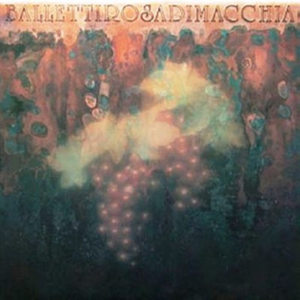
Within the vast and often impenetrable landscape of Italian Progressive Rock, certain names transcend mere sound to become genuine historiographical enigmas. While institutions such as Premiata Forneria Marconi and Banco del Mutuo Soccorso stand as monumental pillars of the genre, an obscure undercurrent of “phantom releases” has, for decades, fueled the imagination—and drained the wallets—of dedicated collectors. Among these, no story is as peculiar and compelling as that of Ballettirosadimacchia.
For years, their sole self-titled album was regarded as a lost “Holy Grail” from the mid-1970s—a mythical artifact circulating through international record fairs at staggering prices, cloaked in an almost sacred aura. Yet, behind the grooves of that elusive vinyl did not lie an obscure provincial Italian band, but rather one of the most refined aesthetic mystifications ever conceived in music history.
— Temporal Misdirection: The Construction of a False Memory —
For over two decades, the accepted narrative—cemented in rare record catalogues—placed the album’s release between 1974 and 1975. This dating was far from incidental: those years marked the creative and commercial apex of Symphonic Progressive Rock, and the album’s sonic identity aligned seamlessly with the stylistic grammar of that era.
The record appeared under the Rockit Enterprises label, bearing the catalogue number RIES 74—a detail that further reinforced the illusion of authenticity and chronological precision.
However, as research methodologies evolved and analytical scrutiny deepened, inconsistencies began to surface. What had long been traded as an original 1970s rarity gradually revealed a different truth: the album was in fact recorded and distributed much later, most likely in the late 1980s or, more plausibly, in the early 1990s.
— The Geopolitics of Mystery: Canada, Germany, and the Japanese Revelation —
What makes the Ballettirosadimacchia case truly unique is the intricate web of misinformation surrounding its production. The liner notes confidently claimed that the LP had been pressed in Canada and that its recording sessions were overseen by a German producer.
This deliberately international framework—Italian musicians, Canadian pressing, German production—served a precise purpose: to justify the album’s extreme rarity within Italy and to amplify its mythic status among collectors.
Reality, however, proved far more exotic. Linguistic analysis and the investigative efforts of dedicated “Prog archaeologists” eventually dismantled the illusion. Ballettirosadimacchia were not Italian at all—at least not in any authentic sense.
Authoritative sources now converge on a striking conclusion: the project originated in Osaka, Japan. The band appears to have orchestrated this elaborate historical forgery as an act of deep admiration for the Italian progressive scene, a genre that has long enjoyed a devoted following in Japan. The adoption of carefully crafted Italian pseudonyms—Tonino Leo Ucchi, Antonio Sassada, Gianni Mazzi, and Marcello Taddeo Matteotti—was the final layer in a meticulously designed deception aimed at pre-internet era collectors.
— Sonic Anatomy: Mellotron Textures and Vocal Dislocation —
From a purely musical standpoint, the album stands as a remarkably accomplished example of Symphonic Progressive rock, driven by a sophisticated use of vintage keyboards. The lineup reveals a group of highly skilled multi-instrumentalists:
Tonino Leo Ucchi: Vocals, Bass, Acoustic Guitar, Flute, Keyboards (including Mellotron)
Antonio Sassada: Electric and Acoustic Guitars
Gianni Mazzi: Piano, Organ, Moog Synthesizer
Marcello Taddeo Matteotti: Drums, Percussion, Additional Keyboards
Instrumentally, the record displays a convincing command of progressive idioms: lush Mellotron layers, fluid Moog passages, and carefully structured arrangements evoke the golden age of the genre with striking accuracy.
Yet, the illusion begins to fracture when the vocal element enters. Ucchi’s voice is marked by an unmistakably foreign accent—almost disorienting in its phonetic distortion—which renders the lyrics frequently unintelligible. Although formally written in Italian, the texts are riddled with grammatical and syntactical errors, both in the singing and in the liner notes, further confirming the project’s non-native origins.
A telling anecdote, frequently cited among collectors, captures the listener’s initial confusion: some buyers reportedly attempted to adjust their turntables from 33 to 45 RPM, convinced that the vocal delivery was the result of a playback malfunction. Only after repeated listens did the realization emerge—the record was not defective; it was simply performed by musicians with no true command of the language.
— Tracklist Analysis: Nine Fragments of an Eastern Dream —
The album unfolds across nine tracks, forming a coherent symphonic narrative despite its enigmatic origins:
Ascolta! – An opening statement that functions almost as a threshold, inviting the listener into a suspended state of disbelief.
Sandiego – A rhythmically dynamic piece echoing British progressive structures, filtered through a distinctly non-Western sensibility.
Altre Guei Colli – Linguistic distortions reach their peak here, transforming the title itself into a semantic puzzle.
E Tutto un Sogno – Perhaps the album’s conceptual core, seemingly reflecting the very illusion upon which the project is built.
Interludio – A purely instrumental passage, where organ and piano weave intricate, baroque-inspired textures.
Oggi – A more linear composition attempting to emulate the lyrical balladry of early Italian prog.
Dalla Mattina al Pomeriggio – A compact suite showcasing the rhythmic interplay and compositional discipline of the ensemble.
Suono – A timbral exploration dominated by Moog and Mellotron atmospheres.
Se ti Piace – A closing piece that leaves the listener suspended in a state of fascinated ambiguity.
— The Survival of the Myth: Reissues and Cult Status —
Once the true nature of the project was unveiled, the album’s value did not collapse; rather, it evolved. Ballettirosadimacchia became a cult emblem of the “forgery-as-artwork” phenomenon.
Subsequent reissues appeared in Japan and Korea, some featuring entirely blank white covers—as if symbolically erasing the fabricated narrative that had once defined the record.
The definitive institutional recognition arrived in 2008, when the Japanese label Tachika released the first official CD edition. Presented in a refined mini-LP format, the reissue meticulously reproduced the aesthetic of the original vinyl, preserving the very illusion that had deceived collectors for decades.
— Conclusion: The Importance of Being an Enigma —
The story of Ballettirosadimacchia ultimately reveals a fundamental truth about Progressive Rock: mythology and narrative are often as essential as the music itself. Whether viewed as ingenious fabricators or as devoted Japanese musicians paying homage to Italian prog, their intent becomes secondary to the outcome.
What remains is a work that defied temporal and geographical logic—a record conceived in Japan in the late twentieth century, yet capable of convincing generations of experts that it had emerged from Italy in 1974.
In an era defined by total access to information, Ballettirosadimacchia endure as a compelling reminder of how deep the shadows can run within the grooves of a cult record.
— Technical Data (Original Edition) —
Title: Ballettirosadimacchia
Label: Rockit Enterprises (Cat. RIES 74)
Format: LP (Vinyl)
Credited Origin: Canada / Germany / Italy
Actual Origin: Osaka, Japan
Presumed Release Year: 1974–1975
Actual Release Period: Late 1980s / Early 1990s
Lineup (Pseudonyms):
Tonino Leo Ucchi / Vocals, Bass, Acoustic Guitar, Flute, Keyboards
Antonio Sassada / Guitars
Gianni Mazzi/ Piano, Organ, Synthesizers
Marcello Taddeo Matteotti / Drums, Percussion, Keyboards