

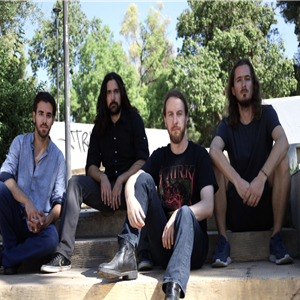
From Athens, Greece, Hypostasis have spent years quietly refining their craft — and their debut full-length album, “Birth of a Mask,” due in early May 2026, makes a compelling case that the wait was entirely worth it. Progressive Metal with emotional depth, conceptual ambition, and a sound that carries echoes of Pain of Salvation and Symphony X while remaining distinctly their own — we sat down with the band ahead of the release to dig into the story behind the record, the scene, and what comes next.
Let’s start at the beginning. How did Hypostasis come together, and what was the initial vision for the project?
We all met at school – in fact, most of us have been playing together since highschool. We have changed names and styles a few times, other members came and went, but the core group remained the same. After having disbanded our latest project for a year or so, we were all out sitting in a bar, in a contemplative silence. One of us blurted out “we should make a band again” and everyone agreed in a split second; that’s when Hypostasis took form.
Your 2016 EP introduced you to the Athens scene. Looking back at it now, what does it represent for you — and how much has changed since then?
The EP was a very important experience for us. We had just played a couple of shows, and the three songs of the EP were ready to go. It was our first recording experience as a band, and a very chaotic process as a whole. 10 years later, I (Romanos) can honestly say that there are things that make me cringe when I listen to the EP – but it’s an achievement I am proud of, nonetheless. It’s part of the journey that lead us here.
There was a significant hiatus between the EP and “Birth of a Mask.” How did that time shape the band, both musically and personally?
“Birth of a Mask” is something that has been in the works for nearly 8 years, but something always got in the way. Personal responsibilities, family, work, studies, somehow every step forward was followed by another step back. So, the basic ingredients were there from the beginning, but one is hardly the same person they were 8 years ago. When we revisited the material for “Birth of a Mask” this last time, we realized that it no longer represented who we were, both as musicians and as people. So we set to work rewriting our songs, writing new ones, reworking the lyrics, expanding the concept, until it resonated with us in our present form. This was a very difficult process; we had to reimagine songs that had been there for years, and make them work for us again. In the end, I believe our efforts paid off.
The title “Birth of a Mask” is striking. What does it mean conceptually — and how did the album’s central theme emerge?
“Birth of a Mask” was initially the result of a brainstorming session back when we were looking for a band name. Konrad threw out the idea, and it stuck with me immediately. We decided against it as a band name, but at that moment I was determined we would build our work around this theme. The Mask is the persona one presents to the world – a coping mechanism, a shield from pain, and at the same time a means of alienation, a threat to one’s self. To put on a mask is to present and act as someone else – if it stays on too long, what is the difference between your real self and your adopted personality?
The press material describes a “deeply scarred, deeply human soul” at the heart of the record. How closely does the narrative reflect personal experience?
Naturally, some of the narrative is based on lived experience, and some is filling in the gaps of the story, or dramatizations of situations or states of mind. The album’s narrative is purposefully vague in parts. There’s a reason there are no distinct, named characters or voices, no narration, and no absolute clarity on what events take place; it allows the listener to be part of the narrative, to form their own ideas of what is happening. In this process, they are also free to apply their own experiences to the songs, and empathize with the album’s main figure in their own way.
Lyrically and musically, you describe the two as “fundamentally intertwined.” Can you give us a specific example from the album where the music and text work together in a particularly direct way?
The verses in “Mirror” is a great example of this. Contrasting the two verses, you’ll find that the first one is more confident and aggressive lyrically – obligingly, the drum beat is in-your-face simple, and the guitars are offer a consistent backdrop between riffs. The second one, however, differs vastly in tone – the guitars start and stop abruptly, the drums are more erratic, all aligned with the vocals, which have taken a darker, creepier turn.
The tracklist seems to suggest a clear narrative arc — from “Departure” to “Phoenix.” Was that journey mapped out from the start, or did it take shape as the songs were written?
The general idea has been there all along, mapped out; there were song names before a single note was written, in some cases. That’s not to say that everything was pre-planned exactly as it turned out – quite the contrary. But there was always a guiding line to keep us in frame.
Is there a track on the record that surprised you — one that ended up somewhere completely different from where it started?
Well, we set out to write something resembling a ballad and ended up with “Mirror” – so that was quite a shock. Interestingly enough, the main riff of “Silver Stars”, which is the actual ballad of the album, was written in an attempt to kickstart the composition of “Mirror”. Some big swaps there, to be sure.
The album features additional vocals from four contributors — Agis Kontos, Penthesilea Kavallieratou, Irene Mantopoulou, and Chrysanthi Provata. How did those collaborations come about, and what role do those voices play in the album’s narrative?
We knew almost from the beginning that we would like to feature voices other than our own on the album. As the music and concept started taking a more definitive shape, we had a clearer picture of what we would like to have. We profiled the types of vocals we needed and the character of each voice, and set out to fill those roles. Luckily, there were people in our social circles who matched our needs. Each vocalist featured on “Birth of a Mask” has a distinctive tone that complements the concept and composition in a unique way.
Production and mixing were handled internally by Konrad, with mastering by George Neratzis. What were the key decisions made in the studio that defined the final sound of the record?
Since we recorded everything ourselves, we had to make the best of what we had for each sound source – which was very basic studio equipment, for the most part. We believe in getting good performances and correct mic placements over expensive gear, and that is what we did, starting with the drums. We recorded the drums in our rehearsal space, using the hall and bathroom across from it for ambient sound micing. No external drum samples were used – just a few we got from our own kit, for reinforcement. After the drums were done, we did the guitars, bass, vocals, and lastly all the additional layers. Having clarity and punch while also maintaining a sense of rawness became the main overall focus of the production and mix from early on. The album deals a lot with the very flawed sides of human nature, and we tried to represent that through the sound as well. When it came to mastering we decided to go with George Neratzis who has done a lot of great work, including ‘In the Passing Light of Day’ by Pain of Salvation, a band and album very dear to us. I think he did a great job on our record, understanding our vision and giving it the final polish it needed.
Progressive Metal can sometimes become overly technical — “pattern-defying” is a phrase you use yourselves. How did you balance compositional complexity with emotional accessibility?
We never let a musical idea go through without considering the context. Riffs are great, and complexity is a good way to spice things up, but you can’t lose sight of the bigger picture. The good thing is that we never felt like we had to sacrifice complexity for accessibility, or vice versa. Our writing was much more organic than “let’s write a prog riff” or anything of the sort – if it sounded good to us, we wrote it. If everyone agreed, it was in; if not, we’d tweak it until it worked.
You mention “wide, atmospheric flows” alongside “gripping, memorable hooks.” Bands like Pain of Salvation and Communic walk that same line. Were those references conscious touchstones, or did they emerge naturally?
Our influences are comically diverse, we couldn’t possibly list them or, for that matter, set out to write “something that sounds like X”. That would be a waste of time, and the result would almost certainly be subpar. In fact, we still struggle to compare “Birth of a Mask” with a certain band or aesthetic. “Progressive metal” is a ridiculously wide spectrum, which is part of the reason we believe we are classified under it. “The Craving” is not a prog song, though, neither is “Visions”. You won’t find much of the overly technical passages and solos common in prog, or many djent-y elements of modern prog. As far as we’re concerned, “Birth of a Mask” is Music as we wanted to make it.
Will there be any singles or preview material ahead of the May release? What can listeners expect before the full album drops?
The singles are all out by this point: The music video for “Mirror” was released on April 17th, and the lyric video for “Visions” has been out since March – the videos are both on YouTube, and the songs themselves are available on most streaming platforms. It’s full steam ahead for the album release now!
You’ve recently resumed live activity after the hiatus. What has it felt like to bring this new material to a stage — and how has the audience responded?
Since this is an independent release, we are pulling all the strings here – and we greatly miscalculated how much this would distract us from preparing for live shows. So we haven’t yet, to our great regret! We are in the middle of rehearsals, but there are still deadlines to hit and so much work to be done, so we’re doing our best in the middle of a storm, so to speak.
Looking back at your early live shows alongside bands like Mad John The Wise and Kosmogonia — how would you describe the Athens Progressive and Heavy Music scene then versus now?
There has been a huge increase in talent these past years, which is great for the scene and very encouraging for everyone involved, I believe. And it’s not just Athens, Greek bands in general have been putting out excellent material, and this includes prog (check out ORIA’s “This Future Wants Us Dead” for just a taste). There’s real promise and momentum here, and this can only be described as a positive change.
Greece has produced a number of distinctive Heavy and Progressive acts over the years, yet the international spotlight doesn’t always reach Athens as quickly as it might. How do you see the current state of the scene — both locally and within the broader European Progressive Metal world?
Honestly, I don’t think the spotlight needs to reach Greece at this point – Greece reaches the spotlight instead. It’s true that in the past the was very little representation abroad (pioneered by giants like Rotting Christ and Septicflesh), however this is not the case today. Even if we limit ourselves to prog, you’ve got bands like Need, Mother of Millions, Sunburst, Calyces, Herta, (and many more, I’m sure) touring Europe and beyond. Greece is no longer unknown in the metal world, and there is real opportunity here – we have seen it firsthand.
And finally — what does the next chapter look like for Hypostasis beyond “Birth of a Mask“?
We want to get our music out there, and we want to put ourselves out there. Ideally, we’re looking to play live as soon as we can, setting our sights locally at first and seeing what we can do to reach out further. We are really proud of our new material, and we want to bring this enthusiasm to the stage.
“Birth of a Mask” is due in early May 2026. Keep an eye on Hypostasis — this is a band with something real to say, and the music to back it up.