

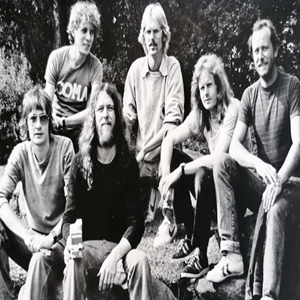
Few records carry the weight of genuine obscurity the way “Financial Tycoon” does. Born from the far northern edges of Denmark in the early 1970s, Coma was never a band that sought approval — they provoked it, or ignored the question entirely. Rooted in collective improvisation, Dadaistic humor, and a restless refusal to stay still, they produced one of the most singular debut albums in the European Progressive underground. Nearly five decades later, PQR-Disques Plusqueréel is bringing “Financial Tycoon” back to vinyl for the very first time — remastered by the band themselves, expanded with over five hours of live material, and pressed in four limited color variants. Before the record arrives, we sat down with the members of Coma to retrace the story behind it.
Coma emerged in the early 1970s from Frederikshavn, a town far from Denmark’s main cultural centers. How did that geographical periphery shape the band’s identity and musical attitude from the very beginning?
It was like a musical cheese clock in the beginning. We had to figure things out ourselves. We were very much in agreement on the experimental approach to form and content, and we shaped and inspired each other without the interference of other musicians.
The initial impulse behind Coma is closely tied to saxophonist Uffe Markussen. How did the group coalesce around him, and what did those early free-form rehearsal sessions at Frederikshavn Gymnasium actually sound like — what was in the room, musically speaking?
A lot of wild and almost insanely strange music/sound, which in passages was quite stressful, even for the participants, to endure listening to. But of course also with moments that were really funny, or had the potential to be included in a composition.
The lineup was notably fluid in those formative years, with musicians coming and going. How did that instability — or openness — end up defining Coma‘s sound rather than undermining it?
The great change of musicians in the beginning did not have any effect on the sound, but the desire to improvise and experiment was a common feature of the group that survived the initial phase and which crystallized in what became COMA.
The press material places Coma alongside Secret Oyster, Burnin’ Red Ivanhoe, Supersister, Kandahar, and Zappa as key reference points. Were these conscious touchstones at the time, or is that a framework that makes more sense in retrospect?
We were aware of our sources of inspiration, but at the same time had a keen eye for our own musical identity.
Coma‘s compositional method was genuinely collective — one member would bring a fragment, and the others would reshape it entirely. Can you walk us through a concrete example of how a piece evolved through that process, perhaps something that ended up on “Financial Tycoon”?
The title tracks are a good example of how vastly different musical themes, which we all contributed, could end up as a complete number, despite different keys and tempi. We spent a lot of time adding and putting the elements together,and finally ended up with the recorded track.
Humor, irony, and a Dadaistic sensibility were described as structural principles in your music — not decoration. How did that manifest in the actual writing and arranging? Was there ever tension between the sardonic and the serious?
We were serious about form and content in the music. The humorous, and at times, sarcastic element lay in the communication.
Although “Financial Tycoon”was released in 1977, the material had been fermenting since the early 1970s. How much did the album change between those first rehearsals and the final recording at Ringstedduring Easter 1976?
A lot. We rehearsed intensely and adjusted the events continuously. Unfortunately, we don’t have rehearsal recordings from the first years of COMA.
The recording took place over an intense single week — tracking, overdubs, guest musicians, even filling a stage with planks to capture the rhythmic sound of sawing. What do you remember most vividly about that session?
I remember how much fun we had recording some wild chords on the grand piano and then turning the tape over and playing it backwards. When the basic tracks were recorded, we could relax a bit if you didn’t have to do dubs. It was interesting to follow the process as the recording progressed, and more and more elements came into place in the project.
The album features a remarkable range of guest contributors — marimba, violin, trumpet, xylophone, flugelhorn. How did those additions come about? Were they planned or more spontaneous decisions made during the session?
Recording with guest musicians was carefully planned in advance. The musicians had previously been sent sheet music.
The title “Financial Tycoon”— and the name Coma itself, drawn from a Frank Zappa lyric — both signal a very particular worldview. What were you actually trying to say with this record, thematically and conceptually?
That was a sarcastic comment on the capitalist system, which should be left to the listener to analyze and interpret.
Coma‘s live performances were notoriously unpredictable — from near-hostility to standing ovations, sometimes within the same night. What’s the most extreme audience reaction you can recall, and what caused it?
We were hired to play at a party for librarian students, as a dedicated fan was both the organizer of the party and librarian students. In the end, out of 90 spectators, we played for two!
The show at Ranum Seminarium — where a Folk Music audience confronted Coma‘s Dadaistic approach head-on — is mentioned as a notable low point. What actually happened that night?
We played a set. Then we agreed with the board to stop, because people were screaming and screaming like crazy!
You also played Roskilde Festivalin 1976 and 1977. What did it mean for a band like Coma to appear on that stage, and how did those performances differ from your usual circuit?
The concert at Roskilde Festival meant a lot. Our name was established in the circles that were interested in experimental music. Subsequently, it became much easier to book jobs. We were extra excited to deliver a sharp musical show, and luckily we succeeded.
This is the first ever official reissue of “Financial Tycoon”— remastered by the band, pressed in four color variants, and expanded with a bonus audio DVD containing over five hours of live material from four seminal shows. How did the collaboration with PQR-Disques plusqueréel come about?
PQR records contacted Viggo Steincke, who handed over the project to Flemming Friberg, who together with Klaus Thrane and George from PQR records has handled all the preparatory work in connection with the reissue.
You remastered the album yourselves. What was that process like — returning to these recordings after nearly fifty years? Did anything surprise you, or sound different than you remembered?
It was an intense game of ping pong between Klaus and Flemming, where files with sample mixes and suggestions in large quantities were exchanged over a few months. A few years earlier, Flemming had listened through all the tapes, so there was already an idea of where the gold was. We were pleasantly surprised at how good the music was.
The decision to include such an extensive live document alongside the album is significant. Why was it important to you that this reissue captured Coma in performance, not just in the studio?
The music was constantly evolving, and we were constantly writing new material, so the opportunity to release the many hours of extra music is a gift that we are very grateful to PQR records for making available.
After Coma dissolved, its members went on to remarkably diverse paths — Professor Fanocca’s Laboratorium, composition, sound design, the Jungle Orchestra, Folk bands. Looking back, what did Coma give each of you that no other project could have?
In general, it has given everyone a solid musical experience, knowledge and skills. The years with COMA were an intense, and sometimes demanding experience, and the experimental approach to composing, harmonizing, arranging and producing music is something we have all taken with us in our further work.
The European Progressive and Jazz-Fusion underground of the 1970s produced an enormous amount of music that still hasn’t been fully excavated. Are there Danish or Scandinavian contemporaries from that era that you feel deserve the same kind of reissue attention “Financial Tycoon” is now receiving?
Yes, I remember the Finnish group Tasavallan Presidentii as quite exciting.
Fifty years on — is there anything in today’s musical landscape, any band, scene, or movement, that strikes you as carrying something of what Coma was doing? Or does it feel like a genuinely different world?
The music scene has changed a lot. Today, there are a lot of copy bands, a number of cool solo artists, but only a few close-knit bands with original material. There has been a lot of innovation in the electronica genre. These are mostly studio projects.
We thank the members of Coma for their time and generosity. “Financial Tycoon” is released May 01, 2026 via PQR-Disques plusqueréel — available in four limited vinyl editions, each numbered to 100 copies, with a bonus audio DVD.
Available On PQR Direct webstore:
LP+Audio DVD, lim. to 100 copies in gold on white splatter vinyl: https://pqrdirect.my-online.store/product/coma-financial-tycoon-goldwhite
LP+Audio DVD, lim. to 100 copies in yellow on orange splatter vinyl: https://pqrdirect.my-online.store/product/coma-financial-tycoon-lpaudio-dvd-lim-to-100-copies-in-yellow-on-orange-splatter-vinyl
LP+Audio DVD, lim. to 100 copies in black on yellow splatter vinyl: https://pqrdirect.my-online.store/product/coma-financial-tycoon-lpaudio-dvd-lim-to-100-copies-in-black-on-yellow-splatter-vinyl
LP+Audio DVD, lim. to 100 copies in gold on clear splatter vinyl: https://pqrdirect.my-online.store/product/coma-financial-tycoon-lpaudio-dvd-lim-to-100-copies-in-gold-on-clear-splatter-vinyl