

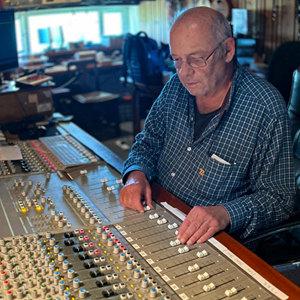
Marc Hadley has spent decades at the intersection of Jazz discipline and Canterbury instinct — trained on Bebop at the Guildhall School of Music & Drama, rooted in ethnomusicology, and shaped by years inside the London Jazz and World Music circuit. His path crossed Jack Monck‘s, and from that meeting came The Relatives, the Anglo-Dutch band that brought him into orbit with Pip Pyle, Phil Miller, and Richard Sinclair. “Virtually” (2013) was the document of that collaboration. “How to Cut Water,” out June 07, 2026, is its heir — and something considerably more.
An album of instrumentals and extended songs recorded largely in Cornwall — where Hadley has lived since 2004 — it draws on Jazz, Fusion, Folk, Rock and World Music, featuring a cast that reads like a roll call of the Canterbury Scene’s living and departed: Richard Sinclair on vocals, Pete Lemer, Fred T Baker, and — in the album’s most poignant moment — Phil Miller, whose playing on the hidden track “Fat Cats” inside the closing “Amazonia” stands as his last studio recording before his death in October 2017.
We spoke with Marc Hadley ahead of the release.
Marc, your musical path is remarkably layered — Guildhall, Ethnomusicology at SOAS, Bebop, the London Jazz scene. When you look back, how did that formal training eventually lead you toward the Canterbury orbit rather than a more conventional Jazz career?
The formal training was crucial with hindsight, because I became familiar with harmony theory and reading Jazz charts. When I began to play various people’s compositions – often in a recording session context because I had a parallel career as a studio engineer and producer – I was able to learn all kinds of material and perform it quite quickly – I became fluent in the language, if you will. And because I was fluent, I could also suggest additions or alternatives. Apart from the sax, I also played piano and synths. That also helped me to create textures and arrange, so I could begin to assimilate some of the rather advanced ideas about time, harmony and melody that were all present in the Canterbury music that I had absorbed as a teenager or young adult. Much later when I met Phil Miller. I learned that he had initially only acquired his musical knowledge from his pianist brother, Stephen, and then people like Dave McCrae in Matching Mole, and Dave Stewart. He was (like many of that first wave of Canterburians) a talented ‘player by ear” but became an autodidact, reading music theory concept books by people like George Russell.
You first encountered Jack Monck, and through him, Pip Pyle, Phil Miller, and Richard Sinclair. Can you take us back to that initial meeting with Monck — what was it about that connection that felt different, musically speaking?
That’s not a simple answer. I was aware of Jack as a bassist going right back to Oxford in the late 1970’s due my role as a local Festival organiser. The Global Villae Trucking Company were a favourite on the 70’s free festival scene and had played at the annual Mayfly festival several times. When the ‘Globs’ split , the singer Jon Owen formed his own band and recruited Jack. So I probably saw him play with The Jon Owen Band in Oxford around 1977-78. So his was a face that stuck in my mind. I ran into him in various other gig situations but finally we found ourselves in the same group, an African band from Sierra Leone, Otis Thompson‘s “Sayinoh”, by which time I was a jobbing horn player on the London World Music scene. We struck up a working friendship and he recruited me into his own live project, ‘The Chan-Monck” group. Thus was something of a departure for me because it involved original songs with a Jazz/World Influence, featuring extended improvisation settings- therefore, something that fitted our mutual commitment to music from The Canterbury Scene. This would have been around 1986, not long before I went to the Guildhall to take a postgraduate diploma in Jazz and Rock. I wasn’t at that point aware of his close friendship with Phil Miller, although his other childhood friend Pip Pyle was in our orbit and through Jack, I actually made his musical aquaintance at Sunday lunchtime sessions in a well known pub in Stoke Newington, North London. Pip and Jack had been a well known blues rhythm section in the British Blues scene in the late 60’s, so jamming Jazz standards with them was a great grounding for me. They had formed the basis of The Miller brothers band Delivery, who are considered part of the Canterbury “family”. It was a later version of Delivery that recruited Richard Sinclair after he left Caravan, along with his cousin David. It then morphed into Hatfield & the North.
The Relatives and the “Virtually” album (2012–2013) feel like the direct creative ancestor of “How to Cut Water.” What was the experience of making that record, working with Phil Miller, and collaborating with Richard Sinclair on “On My Mind“?
The Relatives as a band actually resulted from the Phil Miller connection. All the CS bands toured Holland, from the Soft Machine , to Matching Mole, Hatfield & the North, and then the National Health and In Cahoots. The mastermind behind the facilitation of gigs and logistics was Henk Weltevroeden, a musician from the Rotterdam area. He became great friends with Miller and Dave Stewart. A childhood friend of his,Willem Van Droog, needed a place to stay in London to take an architecture course. Henk asked Phil if he knew of a lodging situation, and Phil suggested he contact Jack, who had a spare room. Willem was a keyboard player with an interest in Jazz, CS music and original composition, thus a writing partnership with Jack came about. Jack and Willem hooked up with some other Rotterdam musicians and recruited me on sax. We became “The Relatives” and did numerous stints playing original music – including pieces of mine- in Holland and Belgium. Several albums were produced between 1989 and 2013. “Virtually” was the last of these. following a year in which Phil himself joined the lineup for a short Dutch tour. “Virtually” was actually produced in Falmouth, Cornwall, at the studio of drummer and producer Damian Rodd, who is the featured drummer on the record. Phil did come to join Jack, myself and Damian in Cornwall, but in fact his parts were largely recorded remotely in Phil’s own studio in London, many of the tracks were assembled by flying overdub files into the digital project- hence the title. One of my songs needed a vocal and Phil happened to have phone contact with Richard Sinclair in Italy – he ran the song past Richard, who liked and added his vocal take in Italy. I downloaded the file and it was imported into the project that became “On my mind”. For me as a writer, player and producer with a history of Canterbury fandom going right back to my school days in the early 1970’s, to have these high-calibre contributions to tracks I was producing was incredibly fulfilling of musical dreams, and also very validating: it showed that my own work sounded entirely credible when performed by players like these.
Phil Miller‘s contribution to “How to Cut Water” is extraordinary — his playing on “Amazonia / Fat Cats” turns out to be his last studio recording. How did those sessions come about, and what does it mean to you to carry that legacy forward on this album?
It’s really a progression on from the Relatives, who toured “Virtually” in SW England and then split. Phil and Jack began informally playing new tune ideas at Phil’s London home, and I suggested recruiting a London -based drummer I knew, Paul Dufour. They started having regular rehearsals at Phil’s with Paul, and I commuted up from Cornwall. It developed into a kind of workshop group in which we worked on each others’ tunes. Thus, Phil made contributions to the arrangements of Jack’s material and mine. Over 2015-17, we developed two sets and took them out to play live. The studio session from which Fat Cats is taken was recorded as a demo to help the emergent quartet find gigs. One of the other songs from the session was a version of Secret Island. Songs from the live set included There but for the grace of God go I, and Phil’s roughly -titled “Thing in five”, which after his death I renamed “Yours for a Fiver.” He left behind a full written arrangement for it, which I used as the source to later record the track in Falmouth last year, later adding the keyboard and guitar parts thanks to Phil’s former In Cahoots collaborators, Pete Lemer and Fred Thelonious Baker.
The album took shape over many years and many collaborations in Cornwall. How did the geography — the landscape of the southwest — influence the music and the writing process?
I think there’s a definite oceanic theme there, particularly in the more ambient moments. Secret Island is on one level about my surroundings at the far end of the European continent in the Atlantic, and there are also references to Arthurian legends. Sonicly, I would say that the setting for my version of Calyx also reflects the mysterious shifting nature of sea and sky. Green World also hints at the beauty and purity, and illuminates my reasons for locating in West Cornwall from London.
The tracklist is strikingly diverse — from instrumentals like “The Note Whisperer” and “Calyx” to extended song-forms with multiple vocalists. How did you approach the sequencing and the balance between the two?
The process was fairly random, TBH. It’s light on instrumentals- the two featured on HTCW are both by Phil. My interest used to be in instrumentals but a lot of the work I did after moving to Cornwall was in theatre, and in education. I moved very much towards the idea of storytelling and narrative in music. Also I did a stint of absorbing and studying Indian music, in which the voice is the primary instrument. As a keyboard player and producer I worked with singers a lot, and also as an education facilitator I was lucky enough to work with young singers among the Truro Cathedral choir. I learned a lot from that interaction and there are at least three former choristers among the artists featured on the album. The sequencing was unplanned. I finished all the tracks and then experimented with the sequence via playlists in my PC. I wanted to find contrast, but also moods where the end of one song would follow logically to the beginning of another. I have been influenced by the way the first Hatfield and the North Album had this way of stream of consciousness morphing from one idea quite briskly to another. That itself was proceeded in my experience by very much the same kind of process in Robert Wyatt’s work, and the spontaneous ordering of materials in the earlier Soft Machine albums and performances.
The vocal lineup on this record is genuinely extraordinary — Richard Sinclair, Billie Bottle, Angeline Morrison, Louisa Edmondson, Mal Darwen, and several others. How did those collaborations develop, and what did each voice bring to the material?
These were all the results of a quite random process…some actual working collaborations from bands or sessions I had been involved in…in some cases, the result of hearing their work and making approaches to them. I’ve been around a long time and worked with many different people. The album produced over 8 years draws on my interactions with an awful lot of people. It distils my career and recent life into 60 minutes of music. There are a lot of my friends on this record.
Pete Lemer appears on additional keyboards — a musician with deep roots in the Canterbury and Free Jazz worlds. What was it like having him involved, and how did his contribution shape the sound of the album?
Pete only appears on Yours for a fiver, he was the last but one player I drew in, Fred T Baker being the final piece of the jigsaw. He is a prolific producer of music and has his own studio, so it was all very easily done remotely. We did actually play together at Phil’s memorial gig in Hackney, but that was the only time we met in the same physical spaces. We talked on the phone a lot and it was he who provided the album title at a point when I was thinking of just naming the album “Yours for a fiver” and I am hugely grateful to him for that.
“There but for the grace of God go I” opens the record at over five minutes — a bold statement. Can you walk us through what that track is trying to say, and why it felt like the right way to start?
It has a good opening theme- I wrote it originally as The Note Whisperer, but the Hatfields had a way of reintroducing themes in different costumes, and that’s also a common approach in film or theatre scores. Phil liked it and helped me configure the way the chords support it and the occasional shifts from 2/4 to 3 /4 time; he said it reminded him of Alan Gowan’s writing. As a five minute track, as with some of my other tunes, it works by being two different tunes welded together. It’s not the same thing for five minutes. That’s very much the case for some of the other tunes- Away with the Fairies and Amazonia, for example. As a story, it’s perhaps autobiographical, referring to a couple of people I was involved with but also drawing attention to the way that we all walk a fine line between managing our lives and losing the plot. And not judging others harshly for their failings, because their fall from grace could so easily have been ours.
Marc, your track “There But For The Grace Of God Go I” opened PRJ’s Compilation Vol. XVIII. How does it feel to have that piece represent you to a new audience?
That’s exciting because I would very much hope for my music to break out of the record shop genre ghetto. My approach to music is that anything “good” is to be listened to, and I want the freedom to incorporate anything that I like from any source into what I do, if I can render it authentically or in a way that respects the tradition it came from. I would like to think that audiences who have no exposure to the Canterbury or Prog era music could hear interesting and attractive things in it and be entertained.
The hidden track “Fat Cats” sits inside “Amazonia” as the album’s closing secret. Why a hidden track, and what was your intention in placing Phil’s last recording there rather than front and centre?
There was no intention other than to feature Jack’s Fat Cats tune, because otherwise I might have spent more time recording a new version – but that wouldn’t have featured Phil, who contributed quite a lot towards the arrangement, including the organ parts that he added himself.
You wear multiple hats on this record — composer, performer, engineer, producer. How do you manage the tension between being inside the music and shaping it from the outside?
I have always been all those things, a multiple hat wearer. However, it is important to have a co-producer and someone very technically adept. You then have an alternative critical pair of ears, someone who can facilitate ideas which you can conceive of but don’t know how to implement, and also be critical when you have gone too far, or to spur you on when you haven’t gone far enough. Robin Tyndale-Biscoe was the ideal counterbalance and objective listener with me on this project.
The Canterbury Scene is often spoken of in the past tense. But this album features several of its living architects. Do you feel the scene has a genuine present tense, beyond nostalgia?
Yes. The CS isn’t IMO a museum piece from a past century: it’s a music that filters various music genres through a certain approach or methodology. It looks to synthesise and provoke, and break rules while also referencing a petty rigorous set of rules. It is in one way profoundly English but also a vehicle through which an Australian, quite a few Europeans and the odd American or Japanese person processed their take on Englishness. On ‘How to cut water’ I believe I kept the source influences but used some quite up to the minute tech to frame it and create a few new textures. The synths I used range from legacy Moogs and Prophets through to Pete Lemer’s Osmose keyboard and my Groove Synthesis Third Wave, which are pretty recent creations.
Alongside the Canterbury core, the lineup includes musicians from Cornwall — people you’ve played and recorded with for over twenty years. How important was that local community to the making of this album?
Very. I think that’s one of the factors shaping the way it sounds. It doesn’t get much more Cornish than Neil Davey’s bouzouki work. The project is just as much a product of Cornwall as it is an example of the Canterbury legacy. Perhaps there are even parallels between Canterbury and Truro…?
Your background in ethnomusicology and world music comes through in the album’s broader palette. Can you point to specific moments on the record where those influences are most audible?
Amazonia, Sky, Green World and Secret Island. Sky has that very African 12/8 groove component…. Amazonia is referring to the Atlas Mountains and Berber people, but also medieval Spanish music, French and English baroque and more recent Mediterranean music. Secret Island references both Cornwall and the Mediterranean. Green World has nods to Brazil, and There but for the grace of God has a bossa nova section.
“Green World” and “Amazonia” suggest an environmental or ecological thread running through the writing. Is that a conscious dimension of the album?
To an extent, yes, but see my answer to the question on landscape and geography. “Amazonia” is slightly misleading…the lyrics and narrative are referencing the legendary female warrior caste, and for “Amazon” , we must consider the language and ethnicity of the Magreb: Tamazight. Rather than the river in Brazil…although the Canterbury Scene could be compared to the Amazon as its flow is powered by the waters of so many tributaries.
You’ve had a long parallel career as a recording engineer and producer, including your time at Dartington College of Arts and AMATA at Falmouth University. How did that technical knowledge shape the sonic identity of “How to Cut Water”?
That parallel career enabled me to personally record quite a lot of it at home, and to understand the production possibilities and how certain textures and FX could be incorporated. My co-producer Robin Tyndale-Biscoe actually teaches music tech at AMATA. One of the piano parts was actually recorded there!
The album will be released physically in June 2026. What format will it take, and was the physical edition something you felt strongly about from the beginning?
CD. I would have loved to do a vinyl version…depending on how well the release fares, maybe I will. I would have to decide a different sequence of tracks to suit the separate “sides” format, and due to the programme time restrictions of vinyl, some of the album tracks in the form we presently hear them would have to be dropped. That’s a tough call.
Looking at the full scope of “How to Cut Water” — is this a statement that closes a chapter, or do you see it as the beginning of something new?
It may close a chapter, but it’s acquainted me with Fred Baker. I love guitar in my work, and I might hope to work with him in the future – he’s is known for his bass playing but he’s one of the best guitarists i’ve ever worked with. I haven’t really got any more material to work with ATM! However, I am now working on putting a console-based studio together with old British hardware tech. It may even feature multi track tape! This project would fulfill a notional project in which I will engineer the majority of the album including the mix myself, using actual faders and knobs. I hope to make it less virtual and more real. I would try to follow the models established by Robert Wyatt and Kevin Ayers: pop songs at the heart but rendered in a very odd way.
For listeners coming to the Canterbury scene for the first time through this album — what records would you recommend they explore alongside it?
Go to the sources. Early Soft Machine, Caravan, Matching Mole, HATN, Gong, Kevin Ayers, National Health, In Cahoots. If you listened to one record only: Rock Bottom by Robert Wyatt. It’s mostly all there in those two sides.
Finally, Marc — Phil Miller, Pip Pyle and others are no longer with us, but their spirit is very much present in this music. What do you hope listeners take away from “How to Cut Water,” beyond the notes?
I’ve tried to make the music unpredictable, colourful, sometimes emotional, interesting. I’d like people to find the humour in it. It’s possibly a bit hidden, but it’s there.
“How to Cut Water” is the kind of album the Canterbury scene has always been capable of producing — unhurried, emotionally intelligent, technically assured, and quietly radical. For Marc Hadley, it represents a lifetime of musical relationships, a deep love for the Cornish landscape, and a final, tender tribute to Phil Miller — gone since October 2017 but very much present here. The album releases June 07, 2026.
Pre-Order “How To Cut Water” on Bandcamp: https://marchadley.bandcamp.com/album/how-to-cut-water