

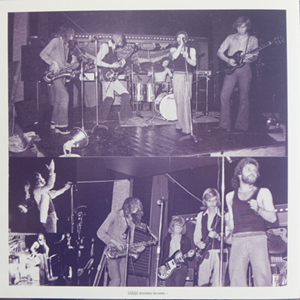
Among the countless bands that emerged from the British underground in the early 1970s, Cargo remain one of the most elusive and compelling. Formed in Burton upon Trent by guitarist and songwriter Andrew Perrins, with roots in Helter Skelter, the band developed a powerful hybrid of Hard Rock, Psychedelic edge and Progressive/Jazz‑Rock ambition.
Featuring Neillian “Sped” Spedding (lead guitar), Alan “Nala” Wright (saxophone), Graham Hair (drums), Dave Kent (bass) and the charismatic vocalist Terence “Ticker” Davies, Cargo quickly gained a reputation as an explosive live act, supporting Sam Apple Pie, Stray, East of Eden, Greenslade, and even Queen during their formative years.
In 1973, Cargo recorded a demo acetate titled “Delivering The Goods” at Zella Studios—a recording so rare that only one known copy survived. Despite serious interest from Island Records, the band refused a deal offered only to selected members, bringing their short but intense journey to an abrupt end.
Now, over fifty years later, “Delivering The Goods” has finally been restored and released by Guerssen / Sommor, complete with newly remastered sound and detailed liner notes by Austin Matthews, allowing Cargo’s long‑lost legacy to be heard at last.
Cargo existed in a scene overflowing with talent. How did the band originally come together in Burton upon Trent, and what was the initial vision behind Cargo?
“I had travelled extensively in Europe with a ‘soul’ band called “Yellow Tricycle Road Show”, entertaining the troops at US army and air force bases. For my own amusement I was listening to ELP, Yes, King Crimson, Soft Machine etc. I had also joined a band called Barrabas in Leicester and we shared a flat and listened to Deep Purple, James Taylor, Carole King and so on. My musical tastes were very catholic therefore and having returned to Burton I was working with a harmony group called “Notation” (I liked to sometimes have a little food with my meals :-), but living in my van, I suddenly had this creative burst of musical ideas and had a strong desire to get them out into the world. Burton had a very strong musical ethos back then and we all used to congregate at “The Queens” pub (still there). It was there I met Sped (Neillian Spedding) and he asked me to join Helter Skelter, of which I had never heard, to play bass. We did one gig in a horrendous club in Hucknall. We had to carry the Hammond up the fire escape – six flights of stairs and when we got to the top – the damned thing wouldn’t go through the door and we had to take the door off its hinges. The first few songs (all covers) went down a storm and then Sped blew all of his speakers. After that the group fell apart.
Anyhow, I respected Sped’s lead guitar playing enormously and so played some of my songs to him and Nala and we agreed to get together in one of Speds’ dads’ garages. It was a very fortuitous time because another friend of mine, a world class drummer, Graham Hair, was between bands and I talked him into joining us. Anyone listening to the album will immediately realise what a key player he was. Nala suggested Dave Kent to play bass – and we advertised for a singer and in walked Terry “Ticker” Davies. The good looks, bullet belt and tight trousers meant he was in.
So that’s how we came together – the vision was to eke out a living playing live, ride the material and hopefully get a record deal.
We almost pulled it off !“
Your sound combined Hard Rock aggression with Progressive and Jazz‑Rock elements. Was this fusion a conscious artistic direction, or did it evolve naturally through live performance?
“It was absolutely the intention! Nala was a hugely creative saxophonist – along with the virtuosity of the others, it would have been criminal for me to let that go to waste.
Nothing evolved, however, because I was horribly dictatorial about the music and had it all arranged in my head. I don’t know how they put up with me but we all felt that we were creating something special and so we got along pretty well. The fact that Graham, Nala, Sped and I are all still in touch 53 years later is testament to that.“
Bands like Gentle Giant, ELP, and YES are often cited as reference points. How did Progressive Rock influence Cargo without overwhelming your heavier, more visceral approach?
“We absolutely did not want to be a ‘tribute’ band (‘though that term didn’t exist back then), however their influence caused me to get creative with time signatures, metres, sonic dissonance and so on. Sped and Nala were free to extemporise on their solo’s but the bass, drum and my guitar parts were fixed as I intended them. Obviously I could play the bass part to Dave and I used to ‘mouth drum’ what I wanted to Graham and he would then work his magic. I may have inadvertently invented beat-boxing……“
One of Cargo’s defining features is the prominence of saxophone alongside Heavy guitars. How central was Alan Wright’s sax work to the band’s identity?
“As I mentioned above, Nala was exceptional and that shines through on the demo. He is very slightly built and yet somehow all of this powerful puff emanates from him. Remarkable.“
Terence “Ticker” Davies’ vocal style has often been compared to Robert Plant. How did his presence and stage charisma shape Cargo’s reputation as a live band?
“Well, with no disrespect to his memory whatsoever, I think he was the instigator of that comparison. However – he was indeed an exceptional front man. Good looking, very masculine, iconic dress sense and charismatic personality.“
Cargo supported acts such as Sam Apple Pie, Stray, East of Eden, and Greenslade. What did those shared bills mean for the band at the time?
“What those shared bills meant was that our manager was able to sell us to the promoters who were putting those gigs on. Those guys all talked to each other as there was no other way of finding talent. We saw that as a very encouraging sign.“
You also supported Queen during their early rise. What are your strongest memories of those shows, and how did audiences respond to Cargo’s heavier Progressive sound?
“Only once at Peterborough Town Hall. It was memorable for a couple of reasons. 1. They were top of the bill BUT, they wanted to get back to London early so asked us if they could go on before us. Naturally we agreed and that is what happened. Also Ticker was trying to flog some fancy jackets to Roger Taylor while we were all backstage. It was hilarious.
The audience loved us – very different from Queen obviously but heavier and more orchestral. Also it was late and they had been drinking….:-)“
Cargo rapidly built a strong live reputation. Do you feel that the band was first and foremost a live act during that period?
“Yes. We loved to play and we were all proud of the sound that we produced. We always went down well thanks to our manager choosing the right venues. Nevertheless, the only route to fame and fortune back then was to get a record deal.“
In 1973, you recorded “Delivering The Goods” at Zella Studios. What was the mindset going into that session, knowing it was meant as a demo rather than a full album?
“Well, a couple of things. Firstly, we paid for the session ourselves which meant we had VERY limited time – literally just one afternoon. This meant compromise. If I had known then what I learned later we would have done it very differently. It was after we played the acetate to Muff Winwood at Island that he told me that what we should have done was pick one track and then worked on it until it was recorded perfectly. Instead we wanted to show our versatility and so we did them all. We were all very young and a little green I suppose. He did offer to sign Graham and Ticker, interestingly, but we had this naive belief that it was “One for all, and all for one”. So nothing more came of it. Big mistake for those guys. Who knows how their lives may have been?“
The recording survived only as a single acetate for decades. Did you ever imagine that this music would eventually be rescued and released officially?
“Frankly – No.“
Sonically, “Delivering The Goods” is raw yet powerful. How accurately do you feel it documents Cargo’s true sound at the time?
“Well, because of the time constraint we played each song only once, so the album musically is effectively ‘live’. Only Ticker’s vocal was added later and it became obvious that he had never been in a vocal isolation booth before. It discombobulated him as you can hear and he couldn’t quite pitch correctly. When we played live on stage we never heard him do that.“
The band famously came close to signing with Island Records, but declined when the deal was offered only to certain members. How difficult was that decision, and what were the band’s principles at stake?
“As I alluded early, we had a Three Musketeers approach. It felt right at the time, but looking back it was stupidly naive. If Graham had signed – who knows where they would have put him?
Best not to dwell on ‘might-have-beens’ – there madness reigns.“
Looking back, do you still stand by that choice, even knowing how it affected Cargo’s future?
“Regrets, I’ve had a few, but then again, too few to mention……..“
Cargo dissolved not long after. Can you describe the atmosphere within the band during those final months?
“Yes. We simply became disillusioned with the industry. Apart from Dave Kent who was a tricky character, we have all kept in touch over all of these years. It just didn’t feel as though we were getting anywhere at the time, so we called it a day. There was no big falling out. We just ceased to exist as a group.
Sped still plays with his band JM2 which has had myriad line-ups and I go to see them when I can. Graham’s arthritis has finally prevented him from playing. Nala is a bit of a recluse but we still What’sApp once in a while. Ticker tragically died in a traffic accident on the M1 many years ago.
As for me – I made a comfortable living in the States as a Big Band crooner for many years as well as joining a ‘Swampy-Tonk’ band – Miracle Mule. Great fun.
See my website below.“
For decades, Cargo existed almost as a rumor among collectors. Were you aware of the band’s growing cult status among Progressive‑Rock archivists?
“Absolutely not.
The only reason that the music got online was because the dear friend who took us to the studio in one of his dad’s vans went on to form a recording studio in the railway arches under Burton Station. He called it “The Track Station.” Genius. Anyhow – he must have uploaded his copy to an obscure website called “The British Music Archive”. We were all completely unaware of this until a lovely fellow called Austin Matthews got in touch.“
How did you first hear about Guerssen / Sommor’s interest in releasing “Delivering The Goods”?
“So, Austin called me out of the blue and asked if I had anything to do with a band called “Cargo”. You could have knocked me down with a feather!
I have no idea how he found me, however he was very obviously a fan of the recording and wanted to publish it if it could be remastered. Well – it couldn’t. You see back then two inch recording tape was very expensive and so Zella would have simply re-used it to record the next band who walked in the door. My acetate has been played a few times and they do not last long.
We were very lucky that Graham had asked for a cassette instead of an acetate and to my amazement he still had it. He mailed it up to me and my son and I managed to take a passable master from it. This is what we sent to Guerssen and they worked their magic to get back to an almost pristine version.
I have attached a picture of my acetate for you.
“The surviving acetate. I’ll bet most of your readers won’t even know what one of those is. Back in the stone ages you could only record stuff magnetically, so to make a record the engineer had to modulate the bass frequencies and the dynamic range so that the needle wouldn’t jump or the groove be too wide. Then the final mix would be played into a lathe which housed a heated stylus, usually made of sapphire or ruby, which cut the groove into the soft nitrocellulose lacquer coating the thin aluminium disc. This is not very durable, which is why the finished product would be made of vinyl.”
Anyhow – in October 2024 Austin messaged me to say he had a friend who owns a reissue label in Spain………….the rest, as they say…………… “
1What was your reaction upon hearing the remastered version of the recording for the first time?
“Joy. Despite the obvious shortcomings, very strong memories of our youthful exuberance came flooding back.
Delivering the actual LP to Sped and Graham was both joyful and rewarding. It is a beautiful thing for us to leave to our children.“
The release includes liner notes by Austin Matthews and rare photographs. How important was it for you that Cargo’s story was documented accurately and respectfully?
“Austin did a phenomenal job. He interviewed us each over the phone to get a complete understanding and then created a fabulous piece – well worthy of such a rare beast as this piece of vinyl.“
Finally, what would you like modern listeners—especially younger Progressive and Heavy Rock fans—to understand about Cargo and the era you were part of?
“They will find it very difficult to understand the times in which we lived.
Three channels on the TV. No cellphones. No computers in the home. No Internet. No Apple Music. No WiFi. No digital recording. No DAWs. No Netflix. No Video-on-Demand.
In order to discover new artists we had to get to the record shop, search through all the racks and then take a disc to the counter and ask them to play the record – you would then go into a booth and listen on headphones.
If a group didn’t have a record deal they simply didn’t exist. Occasionally a live gig might cause a sensation and get reported in the news.
I first watched “Woodstock” on film at an American Army base cinema in Germany.
There was another group called Cargo in The Netherlands but we had no idea about them and they had no idea about us.
There is also one now – from Romania I think.
Different times man. Different times.
Warm regards,
Andrew.“
The story of Cargo is one of integrity, talent, and timing—an uncompromising band navigating one of the most ferociously creative periods in British Rock history. “Delivering The Goods” stands not merely as a lost demo resurrected, but as a fully realized Heavy Psych/Jazz Prog statement, bursting with ambition and raw power.
Thanks to Guerssen / Sommor, and the careful archival work surrounding this release, Cargo’s music has finally escaped the confines of myth and acetate. For enthusiasts of Heavy Prog, Hard Rock, and early‑1970s British underground history, this release is essential listening—a reminder that some of the era’s most compelling voices were never meant to fade, only to wait patiently to be rediscovered.
“Cargo did, indeed, deliver the goods.”
Pre-Order the Black LP version here: https://guerssen.com/product/delivering-the-goods
Pre-Order the Color LP Version here: https://guerssen.com/product/delivering-the-goods-color-lp