

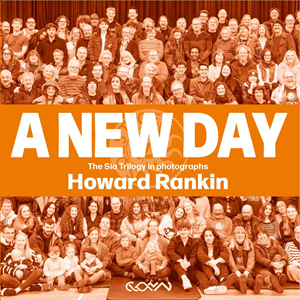
“A New Day – The Sia Trilogy in Photographs” is more than a live photo book: it is a visual testimony of a band rediscovering its centre of gravity, and of a community growing alongside it. Through Howard Rankin’s lens and Andy Glass’ renewed creative momentum, the book captures Solstice’s recent renaissance not as nostalgia, but as a living, evolving present.
— Andy Glass (Solstice) —
“A New Day” documents a very specific creative arc. At what moment did you realise that the “Sia Trilogy” wasn’t just three albums, but a story worth preserving visually?
The original suggestion for a photo book came from our drummer, Peter Hemsley, a keen photographer and admirer of Howard’s work. I felt the last five years have been the most significant in the band’s history since 1980-1985 and loved the idea of documenting this fertile period.
Seeing your music refracted through Howard’s photographs, did you recognise aspects of Solstice that even you hadn’t fully noticed on stage?
It’s always eye opening to see the band through Howard’s lens. These moments of energy and connection that are so fleeting yet now captured forever are so precious to me.
The book conveys a strong sense of joy and collective energy. How conscious is that atmosphere when you’re writing or performing, and how much of it is organic?
It’s entirely organic and an instinctive response to being and performing together. We’re just having fun doing what we love. Who could ask for more.
This period is often described as a “renaissance.” Do you personally see it as a rebirth, or rather as a long-delayed convergence of the right elements?
To be honest, although most of us have played together for decades, it’s felt like a new band to me. My creative connection with Jess is something I’ve been waiting for since Marc Elton was in the band in 1985 and, in 2020, the stars aligned for us.
Howard is both insider and observer. How does having a trusted photographer embedded in the band’s journey change the way moments are captured—or even lived?
Howard is the consummate pro. We’re not even aware of him during performances but can rest assured that they’ll be some great shots, even in the most technically challenging circumstances.
Many images show intense connection between band members. Has the expanded lineup altered your perception of Solstice as a musical and human entity?
Yes, the multi-generational nature of the line up has created a genuine sense of ‘family’ that extends to the audience too , inspiring the ‘Clann’ album title.
Live performance seems to be the emotional spine of the book. Do you think Solstice today is ultimately best defined on stage rather than on record?
I’d have to say on stage. That’s where the music fulfils it’s potential and where the shared experience with the audience makes most sense of it.
The Clann plays a visible role throughout the book. Has the deepening bond with your audience influenced creative decisions in any tangible way?
The Clann provides huge and continued motivation to work hard and create the best music we can and, thanks to Howard’s photography, we’ve been able to celebrate that contribution in our album artwork.
Some photographs feel almost ritualistic rather than documentary. Do you experience certain shows as symbolic milestones rather than just concerts?
I know what you mean and sometimes these milestones only come into focus retrospectively through the photography. A case in point is The Dome where we’re playing a small stage and Howard so brilliantly captured both the intense energy of that show and the bond with the audience. The other end of the spectrum was playing to 20,000 at Cropredy Festival. The band were on fire that day and you can see our intense joy in those photos.
Looking through the finished book, did you feel closure on a chapter—or momentum pushing you forward into the next one?
Actually I feel both. The trilogy represents a particular period of growth and huge creative satisfaction for me and the band. I’ve had to take some to time out to focus on reissues and a live album to consolidate what we’ve all achieved. It’s only now that I’m finding some time and space to start writing new music and planning the future. So now we move forward with a fantastic support network and all the optimism that generates. Onwards!!
— Howard Rankin (Photographer) —
You frame this book as a personal journey as much as a document. When did photographing Solstice shift from admiration to responsibility?
Actually, it’s always been an absolute pleasure and from that first gig I saw in 2022 its been a continuum of deepening immersion in the band. I’ve always loved taking photographs and its been a natural pleasure throughout, rather than a sense of responsibility.
How did you decide what this book should not show, as much as what it should include?
That’s a good question. I wouldn’t say that I ruled out a particular style of photo or subject. When I review my images after a gig inevitably there are plenty that don’t meet the mark from a technical point of view or from an artistic perspective. I try to judge what would be unflattering from a personal point of view too. And in curating the images for the book I obviously wanted to avoid repetition. Fortunately the spontaneous nature of the Band mean that there’s always something new that catches my eye. And of course each venue offers differing stages and lighting.
Many images capture fleeting, transitional moments rather than obvious climaxes. Is that a deliberate narrative strategy?
Yes it’s part of presenting a visually varied palette. The occasional quitter moment or expression can say so much.
How do you balance emotional immersion in the performance with the technical discipline required to capture it properly?
Another very good question. I have used the same camera system for many years ( Canon) so I am very familiar with the controls and muscle memory means I rarely have to look away from the performance to adjust anything. More profoundly, I find that the act of photographing means ALL my senses are engaged so I get absorbed in the music as well as the visual aspects. (I do often find myself dancing while photographing which is probably not readily advised from a technical point of view!)
Your access is unusually intimate. How do you maintain artistic distance while being part of the extended Solstice family?
I am very privileged that Andy has secured me many photo passes, most notably for The Cropredy Festival . And I’ve been equally lucky to be asked to do some formal Band photoshoots. When photographing I simply try to make the most of the day and being given intimate access adds to that opportunity.
Did the Sia Trilogy influence the visual language you used—colour, framing, timing—across different tours and venues?
Not consciously in a visual sense. But I’ve been following and photographing the Band over the Trilogy years and that journey has been integral to the whole narrative. The Clann album artwork has also featured on some of the backdrops onstage.
Several photographs suggest joy as a physical, almost contagious force. Is that something you actively look for through the lens?
Absolutely! Capturing the genuine spontaneous moments that epitomise the Band’s live performance is the most satisfying achievement, particularly where there is clear visual interaction between band members.
Was there a moment during the years documented here when you thought: “This photograph explains everything”?
Tying in with the previous question there are a few photos from The Dome in London where the interaction onstage was almost transcendentally joyous.
As a photographer known also for wildlife work, do you approach musicians as performers—or as another form of living ecosystem?
That’s interesting! I guess that in both wildlife and live music photography it’s about “capturing the moment” and from a technical point of view both mean coping with different lighting conditions and movement. In the wildlife sphere much patience but readiness is required; sometimes long periods of relative inactivity are followed by bursts of action. Live music presents almost constant opportunities. But a Solstice live performance is always about unpredictable spontaneity so in that sense my readiness and anticipation is common to both genres. And in both I can take a LOT of photos on a shoot!
Now that this chapter is bound and finished, how do you personally step away from it without losing the emotional connection it created?
I was hugely honoured to be asked to produce the book and I’m very satisfied with the result. To see one’s images in print is a privilege for a photographer. And to be honest I expect that feeling will endure. The Book does end at an appropriate stage with the completion of the Trilogy and the associated tours. But Solstice Sail On and I very much hope to be part of that journey, camera in hand.
“A New Day” ultimately stands as a rare portrait of artistic alignment: music, image and community moving in the same direction. Whether viewed as documentation or as emotional cartography, it captures Solstice not at rest, but in motion—mid-journey, eyes open, and very much alive.
Purchase Howard Rankin – “A New Day: The Sia Trilogy in Photograps” book here: https://solsticeprog.uk/solstore