

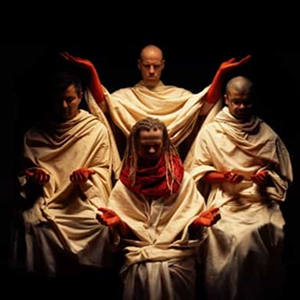
With “Cult of the Sun,” Black Sea Of Trees deepen their commitment to Progressive Metal as a narrative and philosophical medium. Drawing from ancient belief systems, desert symbology, and existential collapse, the Melbourne-based quartet deliver a concept album that confronts devotion, power, and annihilation through immersive long-form composition and stark emotional shifts. Released today as their second full-length, “Cult of the Sun” expands upon the atmospheric foundations of “The Spiritual Beast,” moving into harsher terrain both sonically and thematically. We spoke with the band to explore the ideas, structures, and intentions behind this uncompromising work.
Black Sea Of Trees have always approached albums as self-contained worlds. Looking back to “The Spiritual Beast,” what lessons from your debut directly informed how “Cult of the Sun” was conceived and written?
At the time of writing TSB I was also learning how to sing, and this profoundly changed the way I write music. Beforehand I was coming at it purely from a guitarists point of view, and only had the instruments on my mind. Once I started singing I found it filled the gaps and helped me finish compositions faster. Maybe it offers a different point of view or maybe it makes parts feel more complete, which enables me to write faster and not succumb to writers block. I also started writing lyrics when I started singing, so the story quickly went from something abstract to something tangible. All of these factors helped CotS immensely, the process was way faster and I think this album feels a bit more refined.
Your music consistently balances heaviness with reflection rather than sheer aggression. How conscious is this equilibrium when you begin shaping a new record?
The story dictates the structure and intensity. In terms of heaviness and reflection, I think TSB leant more heavily in either direction, whereas CotS seeks more of a middle ground. However, from a composition perspective CotS is a process of building and then falling apart. It’s a mix of preplanning and the factors naturally emerging during the writing process.
Philosophical inquiry and spirituality remain central to your work. Do you see “Cult of the Sun” as a continuation of earlier questions, or as a deliberate breaking point in your narrative identity?
It’s definitely a continuation of philosophical inquiry and spirituality, TSB focused more on introspection and the self whereas CotS focuses on giving oneself to an external force. I think in BSOT, the self is the central theme on which all albums will revolve around.
“Cult of the Sun” is inspired by the rise and downfall of Akhenaten, filtered through a fictionalised lens. What drew you to this figure as a foundation for a modern Progressive Metal narrative?
When I heard about Akhenatens story I imagined it in this heightened state similar to a myth or folklore, with all of the cultural and spiritual colour of his time. From my perspective, I thought it was an interesting story to tell, this individual who went against the religion of his time, found a new god and failed in pursuit of his vision, all to be nearly expunged from history. There is a tonne of philosophical symbology in the sun, the moon, desert landscapes, spirituality, power and dreamscapes that I thought would be cool to explore sonically. I also connected to the emotional imprint of his story that I mirror with my experience of being an artist. The sun god to me is my obsession with creating, it feels like a divine gift that has lead me nowhere. I’ve been on the artistic path for over 18 years and although I’ve succeeded in creating a lot of art, I have continuously failed to be a successful artist. So I used his story as the conceptual framework and my experience as the emotional heart of Cult of the Sun.
The album charts a journey from divine selection to total annihilation. Was it important for the story to resist redemption or transcendence?
Definitely, the downfall and obliteration of Akhenaten’s story was half the reason I connected with it in the first place. Divine selection and total annihilation are precisely the themes of the personal side of the story I’m trying to tell. Plus we did redemption and transcendence in our last album so it was exciting and cathartic to explore the dark pessimism.
Throughout the record, faith is portrayed as both euphoric and destructive. How do you personally interpret the psychological release found in unquestioned belief, as explored in tracks like “Servant to the Sun”?
I think the thing that induces euphoria in these instances is the abdication of responsibility. There’s this childlike sense of everything’s going to be okay now, someone else knows what to do and is in control. Kierkegaards void is too much for some people to bare. Not having to worry about the future or make decisions would be a huge load off of anyones mind. This song really puts the “cult” in CotS, as all cults offer this deal – submit your individuality and freedom of thought and I will tell you what to do and lead you to your “purpose” and “bliss”.
The moment where the sun transforms into a black hole marks a profound conceptual shift. What did this symbol represent to you on a philosophical level?
In a religious sense it symbolised times in humanity when “god” has abandoned his followers, and it’s a critique on monotheistic religion. Where was the Aten when Akhenaten was being purged from history? Where was Yahweh during the holocaust? Where was Astvats for the Armenians? Where is Allah in Gaza? In an atheistic sense it was taking a look at how humans anthropomorphise natural universal phenomena. Did the sun god really betray the king and turn into a vortex of destruction? Or was it just a natural process that the character attached meaning to? This is what comes to mind for me when I listen to the last song, Eclipse.
“A Red Dawn” establishes the album’s emotional and thematic gravity with a sense of paralysis that erupts into violence. How did you approach structuring this opening statement?
All of the songwriting is anchored in the emotions of the character and the specific point of the story. A Red Dawn follows that journey, starting from hopelessness to newfound power, and ending in vengeance and rebirth. The composition is all over the place, dynamics, riffs, vocals, crescendos – there is a lot of emotional ground to cover! The song signifies the end of one life and the beginning of another, there’s a finality about it which I think gives it the impression that it could be used as an album closer. It’s contrasted next to Servant of the Sun, which introduces the eastern elements, and that composition has its shit together. The character has direction, momentum and power. The whole album is a process of building up to break it all down.
“Prophecy” presents the entire narrative arc through acoustic textures and spoken word in an ancient language. Why was it important to explicitly reveal the story’s outcome so early?
At this point in the story the main character is at the height of his power, which is when warning signs tend to appear for leaders. This song is more about the nature of power and hubris. Giving in to ones ego and acting without wisdom creates a path to self destruction that is so predictable. Humanity has told this prophecy all throughout time and it continues to be ignored to this day. So telling the prophecy this early on in the album is highlighting that point. But I don’t think it gives away too much for the audience as it’s cloaked in ambiguity and an ancient language.
“Visions of a Crimson Moon” unfolds through cyclical motifs and Psychedelic disintegration. How did repetition and gravitational tension inform the songwriting of this piece?
Cyclical themes really ramp up in the middle of the album as the sun deity grows its power over the king. Lead guitars bend notes out and back into tune, creating a sonic circular pattern. The drums roll around the toms in a trance like state. Compositionally, diminished chords lead us into the dream and those same chords reversed pull us back out. Cult of the Sun doubles down on cycles, the composition starts and ends with the same riff. A ringing three chord progression continuously interrupts the composition and the tempo – the kings realisation and freewill is at odds with the suns power, its gravity firmly pulls him back into place.
“Omen” introduces Middle Eastern scales and flamenco-influenced guitar work. How did you integrate these desert elements while avoiding stylistic caricature?
I enjoy a lot of foreign films/music and I think that’s given me somewhat of an idea on how to strike the balance (I hope). But also this is a BSOT world, so our distinct sound always needed to be the anchor to everything. I was trying to achieve BSOT with a sprinkle of the east, I never wanted to go full egyptian with darabukas, ouds and neys.
The title-track, “Cult of the Sun,” confronts self-deception and complicity. Was this song conceived as the emotional core of the album?
Yeah for me, title tracks indicate the heart of the albums concept. It always coincides with self awareness or creating change on new found wisdom. For CotS, this realisation unfortunately has come too late. The album highlights the pitfalls of giving oneself over to external powers, and acting from a place of emotion and ego, rather than wisdom. The king was lured to his own demise by an external power and in turn all of mankind share in his doomed fate.
“Field of Reeds” subverts the idea of paradise through restraint and denial. How challenging was it to convey such finality with minimalist instrumentation?
It’s funny, there’s a musical duality within me where I love intricate complexities that stretch the psyche, and then sometimes there are the simplest tones or melodies that cut straight through the bullshit and hit that emotional point, like an arrow to the heart. I feel like those emotional songs can’t be planned for, so when it comes up you have to use it.
“Eclipse” closes the album in acceptance rather than confrontation, ending with the recorded sound of a black hole. What did silence represent to you as the final statement?
In the story that’s it, there is no answer. It’s a sober look at humans anthropomorphising a natural occurring phenomenon. It ends on the questions: What’s the point of religion/spirituality? What’s the point in aspiring towards something? What’s the point in living? Where do all these things lead you in the end? And for me it represents the end of the artistic projects journey, great you made an album! Where did that get you? What was the point in doing it? There has never been anything on the other side of my creations, they just float off into the ether. My life remains unchanged – well my bank account has changed ha! But I think a lot of people can relate this to a myriad of life’s problems, when everything in your mind and body is telling you this is a sure thing, only for it to fizzle out, never gain traction or just end, just because! I overwhelmingly feel it about my art at the moment but I’ve also felt this way about my relationships, my career, family etc.
Influences such as Opeth, Cult Of Luna, Russian Circles, and Karnivool are often cited when discussing your sound. How do these reference points function during songwriting without becoming stylistic anchors?
I have stopped using our influences as references, I’m now concentrating on cultivating our own unique sound. The Spiritual Beast was closer to our roots of dark forest Opeth and I wanted to explore a completely different landscape for this album, and I’d like to do something different for the next. I can understand why people would be confused when they hear a desert album after citing our references but I think it’s better to just consider them as a FFO. I think the main inspiration from these bands is that they harbour a sense of restraint, authenticity and timelessness which I’m always striving for (maybe less so with Karnivool). There’s a palpable depth that you can really dig into, they give an air of an old novel on folklore that I find really respectable, as opposed to something trendy.
Your use of clean vocals, falsetto, and extreme vocals feels narrative-driven rather than decorative. How do you decide which vocal register serves a specific emotional state?
Sometimes the different vocal techniques represent different characters like in TSB. But in CotS they mostly represent the emotional state of the main character. Falsetto = hopelessness, clean = contemplative, strong clean = emotional, growls = hopelessness, desperation, out of control etc. The decisions for this just come naturally, finding their place in the song, but they do dictate how the lyrics should be written.
Given the album’s dynamic range and conceptual depth, how do you envision translating “Cult of the Sun” into a live environment?
We approach the live environment a different way to the albums. For us, the album is about sitting down and escaping into a story. Live shows are still about immersion but it’s about the audience, we compile our best live songs and thrash out. It’s more about the songs themselves than the storytelling.
From your perspective, how does the current progressive metal scene support—or challenge—bands committed to long-form storytelling and conceptual albums?
Half of the scene seems to understand what we’re doing, they approach the music with an open mind and let it take them. They judge it on the goals set out by the band themselves and seemingly enjoy the experience. The other half approach it with a closed mind and seem to project what they think we should be doing or sounding like. Their minds fight against the journey and they scorn us for not reaching goals we were never aspiring to. There are prog albums and there are prog concept albums, they are two different things and should be judged accordingly. We are treating this as an art form and we utilise all of the sonic tools to express a story and immerse the listener in an experience. We approach music more like a film or theatre rather than a pop album of hooky songs.
With “Cult of the Sun,” Black Sea Of Trees reaffirm Progressive Metal as a medium capable of both mythic scale and intimate philosophical weight. Refusing resolution or comfort, the album stands as a deliberate meditation on belief, collapse, and human complicity. It is a record that demands attention rather than compliance—one that lingers long after the final eclipse fades into silence.
Purchase “Cult Of The Sun” on Bandcamp HERE
Read our Review of “Cult Of The Sun” here: [Review] Black Sea Of Trees – Cult Of The Sun