

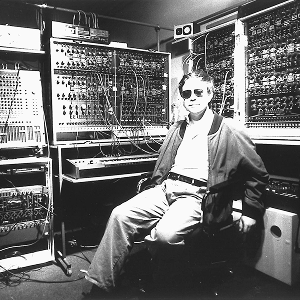
While Paul Haslinger provides the architectural and creative backbone of noion, Christian Wittman represents its poetic and sculptural soul. A founding member of the legendary French ensemble Lightwave, Wittman has spent over four decades exploring the “geography of the unconscious,” moving from the modular Cosmic explorations of the 1980s to a refined form of “ambient chamber music.” Based in Paris, Wittman’s work at Nina Studio has long been at the crossroads of sound design and surrealist philosophy. With the launch of noion and the dual release of “Mallarmé” and “Borges,” he invites us into a realm where silence is as vital as the notes themselves. We spoke with Christian about the “automatic writing” of sound, his shared history with Haslinger, and why literature remains the ultimate compass for his electronic explorations.
Christian, you have been a key figure in the French Electronic scene since the founding of Lightwave in 1984. How does the launch of noion feel different from your previous label experiences, such as with Hearts of Space or Signatures?
I don’t know if I was a key figure, but thank you…! Since Lightwave’s early days, we’ve weathered the massive shifts in the music industry. We were first signed to “traditional” record labels, like Erdenklang, which allowed us to release our first CD, “Nachtmusik,” in 1990. Then came Hearts of Space, with the “Fathom” sub-series, for slightly experimental ambient music, where we found ourselves alongside the big names of the California scene—Steve Roach, Robert Rich, and Michael Stearns. Then came “Signatures,” a label created by Radio France, which marked a new phase in our music, as we moved away from space music and dark ambient toward a more abstract and experimental form of chamber music, combining electronics and acoustic instruments. This took us up to the early 2000s… Then came the crisis of independent labels and the rise of streaming platforms, the dominance of the mainstream, and a reluctance toward musical experimentation, which closed many doors… Like many others, I opted for self-production in the early 2020s, using Bandcamp and a DSP that gave me access to streaming and download sites. These changes made musicians independent, free to create, and gradually building their audience. The rules of the game, however, are ruthless, even rigged, in an ecosystem driven by opaque algorithms and dominated by Spotify. To understand what goes on behind the scenes, you must read Liz Pelly’s enlightening book, *Mood Machine: The Rise of Spotify and the Costs of the Perfect Playlist* (2025). The diagnosis is terrifying… The tidal wave of AI-generated music today is introducing another major upheaval—a tsunami, in fact—that is hitting all players in the music industry with full force: labels, publishers, artists, instrumentalists, as well as the designers of virtual instruments and sample libraries… As our collaboration project with Paul Haslinger began to gain momentum (in the spring of 2025), we approached a number of labels. But we finally opted for a different path: creating our own label, noion music, and taking full control of every aspect of our music’s production and distribution. Creative independence, control over our compositions at every stage, control over publishing, control over visuals and artistic identity… With Paul, we fully embrace going against the tide of the major currents that, day by day, are upending the entire music ecosystem. Rather than going with the flow and losing our (artistic) soul, we’ve opted for a consistent approach and a long-term plan, without ignoring the difficulties that await us in the short term. There is something exhilarating about building a new label with strong artistic ambition and envisioning its gradual development over the years. We have a small team with us that helps us approach this project as rigorously and professionally as possible in terms of management and promotion…
noion is described as a platform for “Atmospheric Minimalism.” From your perspective in Paris, how do you see this aesthetic fitting into the broader European tradition of “modern classical” and electro-acoustic music?
Paul and I have followed parallel paths, even though Paul has had a much more prominent professional career and media exposure than I have. For his part, he started with the up-tempo, percussive electronic music of Tangerine Dream in the late ’80s, before successfully branching out into film and video game soundtracks in Hollywood—a world that offered creative freedom but also came with its share of constraints and stylistic clichés. At the same time, he developed a more personal and experimental solo project, gradually refining his music toward more intimate atmospheres. As for me, with Lightwave, we broke away from our early image—a French clone of late-70s Tangerine Dream, both in terms of instrumentation and music, quite Berlin School-esque, with sequences, etc. We shifted toward a more experimental sound, on the one hand by emphasizing abstraction and electro-acoustic atmospheres, and on the other by involving guest musicians on our albums and in our concerts, particularly Jacques Derégnaucourt (viola, voice), Renaud Pion (wind instruments), Pierre Chaze (electric guitar), and Jon Hassel (trumpet), as well as Paul himself for several projects, which led us toward a form of mixed and hybrid chamber music… For my solo music, in parallel with and following Lightwave, I believe I pursued two main directions. One was ambient in the vein of Brian Eno and Harold Budd, who remain my absolute references; their albums are the ones I would take with me to a desert island, and not a week goes by without me listening to their music… The second direction led me toward “atmospheric classical,” as Stephen Hill—our label manager during the Hearts of Space/Fathom era and still a radio show programmer on the American public radio network—called it. I’ve always been passionate about new music—from the New Albion label in San Francisco, the ECM New Series, and more recently from Another Timbre and Kairos, not to mention the albums by Ólafur Arnalds, Nils Frahm, Max Richter, and Jóhann Jóhannsson. It’s true that there’s something very European about the latter, which also connects to the ECM New Series productions, and I’m also very inspired by composers like Arvo Pärt and Valentin Silvestrov. On the American side, the minimalist musicians of New Albion have also influenced me a lot—Pauline Oliveros, Stuart Dempster, Ingram Marshall…. That doesn’t stop me from really loving Steve Reich, Philip Glass, Terry Riley, and John Adams, but I haven’t pursued those directions. As a French musician, my musical sensibilities have also been shaped by listening to the works of the Groupe de recherche musicale (GRM) and Ircam, which take an exploratory and experimental approach… I’d particularly mention Michel Redolfi, Bernard Parmegiani, François Bayle, and Luc Ferrary, but I also listen a lot to Pierre Boulez and the concerts of the Ensemble Intercontemporain… So yes, I think my contribution to noion leans toward “atmospheric minimalism”—it’s a philosophy Paul and I share… “Minimalism,” in the sense that we try to refine our music, strip away the superfluous, open up our compositions, and get to the essence. Too many musicians overload their compositions, adding track after track, saturating the listening space—I’m thinking of Jean-Michel Jarre’s latest concerts, which I find unlistenable sonically and unbearable visually. With Paul, we’re going against this trend, and our mixes lean toward simplicity and highlighting what’s truly essential to a track. “Atmospheric,” too, because in our choice of sound palettes and processing, as well as in the mixing, we try to create music that breathes, that diffuses into the listening space like colors or a scent, like a dream or memories…
The collaboration between you and Paul Haslinger dates back to 1993’s “Tycho Brahé.” After all these years, what is it about your creative “alchemy” that makes this new partnership so effective now?
Between Paul and us—Lightwave and me—there is above all a forty-year friendship, built on mutual esteem and respect, and shared trust. This friendship was unlikely between a member of Tangerine Dream with an international following and us, musicians from the French underground… But it has grown stronger over the years, during my stays in California and Paul’s visits to Europe. And between Los Angeles and Paris, the internet now allows us to forge multiple creative connections and create a kind of virtual studio, a shared musical workspace, despite the distance and the time difference. Yes, indeed… creative alchemy… building itself through the back-and-forth exchange of tracks, stems, mixes, and ideas across the Atlantic. It’s a fascinating creative process, because it’s unpredictable, resulting from our interactions, our suggestions, our feedback, our edits, our approvals… We speak the same musical language and therefore have an intuitive understanding of one another. We also trust each other enough to approve or reject what the other is doing. Paul’s editing and mixes based on my basic tracks extend and deepen my initial ideas, while enriching them and sometimes radically reorienting them. The resulting music is truly a shared creation, and it’s often hard to tell who did what in the final composition. It’s a bit like mixing paint palettes to the point where the original colors are unrecognizable in the final phase… Ultimately, it’s a privilege to develop such a creative collaboration, in such an atmosphere of trust and mutual understanding, and it extends the experience of Lightwave, where we also had the same kind of intuitive musical communication. The difference is that back in the Lightwave days, we worked in the same studio, in live and improvised sessions, whereas with Paul, we work remotely and on a staggered schedule.
Much of the new material was recorded at your Nina Studio in Paris. How does the atmosphere of a European city like Paris influence the “geography” of these recordings compared to the Los Angeles sessions?
Nina Studio is my home studio, set up in my living space, in the inner suburbs of Paris. Obviously, a studio’s location influences creativity: the climate, the light, the vegetation, the architecture, and also, of course, the entire social and cultural environment. But a home studio is also a very personal and intimate space, surrounded by memories and meaningful objects… I also think of it as a workshop I’m accustomed to; I have my work routines there, my tactics and strategies for composition and recording, my favorite tools and instruments…. My studio, moreover, is surrounded by my extensive library of literature and the humanities. I believe this environment contributes significantly to my musical creativity, enriching it with all my reading and my own writing…
For the “Mallarmé” project, you mention capturing the “random, abstract essence” of the text. How do you translate the visual spacing of words on a page into “recurring patterns” of sound?
Our album consists of three parts, each a journey through different sonic and harmonic landscapes, featuring interplay between echoes, transitions, contrasts, and symmetries that evoke the leaps and rebounds of successive dice rolls triggering different harmonic events. We wanted to play with the effects of continuity and rupture, and with forms of sonic ricochets punctuating the listening space. And as if by a mirror effect, our music aims to break the predictability of listening, just as Mallarmé’s text subverted the process of reading: just as the reader of Mallarmé was meant to hear the music of his text (some sources report that he composed his poem by strumming piano chords for entire nights), so too should the listener of our music, ideally, visualize juxtapositions of forms, breaks in line, syntactic ellipses, etc.
You’ve cited “automatic writing” from the French Surrealist movement as a major influence on these albums. Can you explain how you apply this “relaxed state of consciousness” to the highly technical world of modular synthesis?
Unlike strictly programmed music, with synchronized rhythm tracks, etc., or music that is written in advance and performed from a score, Lightwave’s music—and my solo music—relies heavily on improvisation, that is, on unreflective and unconscious creative flows, driven by the internal logic of what we play and hear. Back in the Lightwave days, there were two, three, or four of us improvising in the studio, live. We’d start the tape recorder—first stereo DAT, then ADAT multitrack—and play live, building the composition in the moment, interacting with one another. The first side of *Nachmusik*, for example, was actually recorded live during a single nighttime session, with nothing planned in advance. In my solo work, I record track by track, but I try to maintain the same spontaneity. At the start of a session, I choose an instrument and go through different sounds… At some point, I settle on one of them and start recording: that sound guides my playing on the keyboard. For the second track, I start with a different instrument, and I play over the first track, on the fly, reacting to what’s already been recorded. And so on. Next comes the real composition phase: I make a rough mix and edit each track on the fly, mainly by deleting isolated notes or entire patterns, creating silences, dialogues between sounds, a progression, and recurrences. This editing process is very intuitive; I essentially read the layered MIDI tracks, reshaping each one in relation to the others, and immediately listening back to each edited section. These are therefore chains of intuitive, uncalculated decisions, made with a kind of floating attention that actually resembles the writing practices of the French surrealist poets, in particular states of consciousness that let the flow of words—and, in my case, sounds—run free. I think Paul works in a similar way when it comes to editing and mixing the tracks from our respective stems. It’s also with this same spirit that we experiment with different track sequences and settle on a final one we both agree on.
In “Borges,” the music is described as unfolding like a “labyrinth.” As a composer, how do you build a sonic structure that feels “infinite” and “layered” without losing the listener in the complexity?
That’s an interesting question… When we look at a painting or a piece of architecture, when we read a text, when we listen to music, do we focus on the details and the complexity of their interconnections, or do we have a more holistic perception? It depends on our modes of perception—whether analytical or synthetic. Borges’ compositions aim to reflect the dizzying dimension of his writings: we did indeed have labyrinths in mind, with contours, detours, corridors, and staircases that make one lose one’s sense of space and time. We also thought of mirror effects—reflexivity is important in his texts—causing sounds to bounce and deepening perspectives, creating sonic illusions. I thought of Escher’s architecture but also of Jurgis Baltrusaitis’s beautiful writings on mirrors, anamorphoses, and the fantastic. Needless to say, we did not seek to illustrate Borges any more than Mallarmé, but rather to offer a form of free interpretation that approaches their specific poetic worlds. We used sound rather than words or images to attempt a form of immersion in the quintessence of their writings.
The concept of “tonal poetry” is central to these releases. Do you consider yourself a musician who uses machines, or a poet who uses sound as his primary alphabet?
I do not consider myself a technician or an engineer, nor even a musician in the academic sense, but rather a tinkerer, in the sense that Claude Lévi-Strauss gave to the term: my approach is defined less by calculation and planning, or technical mastery of machines, than by intuition, the subversion of instruction manuals, unorthodox experimentation in programming and assembling sounds, and unforeseen and sometimes provoked accidents. So yes, I do like the image of the poet who writes with sounds: I do indeed conceive of my music as a form of writing—not narrative, but descriptive and introspective: it describes landscapes, possible worlds that may be internal and psychological, but also have shapes, colors, materials, smells, and soundscapes. I also conceive of this “tonal poetry” in the form of gestures and movements, that is, as painting and sculpture of sounds, where I work with forms, surfaces, volumes, lines and curves, and colors. In other words, machines and technology are not ends in themselves; I am not a synthesizer fetishist, but I consider that I have a palette of tools—brushes, sculptor’s chisels, basic materials—from which I can freely draw for a given recording session. The mix of tools, their occasional chaining, their feedback, and their incompatibility sometimes are the secrets of my sound and musical craft…
Lightwave was famous for recording in unique locations, from the Gasometer in Oberhausen to the Choranche caves. Do you feel that the band will eventually return to these “site-specific” recordings, or is the focus now purely on the “inner world” of the studio?
Yes, we’ve put on some extraordinary concerts, providing the soundtrack for sound installations in exceptional venues, where we were assisted, in particular, by our friend Michel Geiss, who was a close collaborator of Jean-Michel Jarre during the early part of his career. In Oberhausen, we provided the sound for an art installation designed by Anne and Patrick Poirier. They had created a miniature city—an industrial site crisscrossed by railroad tracks—which spectators could view through telescopes set up around the perimeter. Every movement of a telescope triggered a track of our music, creating an interactive soundscape that constantly renewed itself from the hundreds of tracks we had recorded—tracks designed to be mixed in every possible combination (thanks, Brian Eno, for the concept lol!). In Choranche, we provided sound for underground galleries with soundscapes that followed the audience’s progress from speaker to speaker—guided by speleologists—and blended with the roar of the waterfalls… And upon their return to the large chamber of the underground lake, we treated them to a live concert, with all our instruments set up among stalactites and stalagmites… A completely crazy project, if ever there was one… It was Michel Geiss again who oversaw the entire technical production. And after several days, torrential rains over the Vercors mountains caused the underground rivers to swell; the water level rose, threatening to submerge the cave’s only exit, so the audience had to be evacuated urgently, and all our equipment had to be raised in a panic to avoid getting soaked…! Since Oberhausen and Choranche, a lot of water has flowed under the bridge, so to speak… For noion, in 2026, technologies have obviously evolved, and so have concepts… Paul and I are thinking about possible performances based on our music. Traditional concerts, with laptops and screen projections, no longer make much sense to us. So we need to move toward installations or immersive productions, in collaboration with multimedia artists and architects, in venues other than traditional concert halls. We’ve made preliminary contacts with creative partners. Now we need to find festivals or institutions likely to take on our projects… We’re not short on ideas; we want to break away from the concert format in the traditional sense…
You’ve worked with avant-garde giants like Jon Hassell and Hector Zazou. What did those collaborations teach you about “sculpting” sound that you still use in your solo and collaborative work today?
Hector Zazou marked an important moment in our journey… We shared the same studio for a few years, a loft located in a repurposed industrial site. He listened to us a lot, and we also listened to his music a lot… He invited us to participate in some of his projects, and we were lucky enough to appear on three of his major albums, Les Nouvelles Polyphonies Corses, Sahara Blues, and Chansons des mers froides. We have one exceptional memory: when we improvised live in the studio with Ryuichi Sakamoto. We had moved all our instruments to the Davout studio in Paris; Sakamoto arrived and sat down at the piano, and we improvised. Zazou extracted and edited parts of that memorable session… We also met David Sylvian, with whom we co-wrote a track that appeared on the first version of the album… I think Hector Zazou taught us new ways of working, a certain rigor. He also encouraged us to step outside our musical comfort zone to adapt to more complex projects, as collaborators and sound designers… We worked with him on an album project in the style of The Orb and KLF, a project that wasn’t finalized but for which we still have the demos… A very unusual sound and style for Lightwave! As for Jon Hassell… He’s been one of my favorite musicians for years… I’ve seen him in concert many times; his discography is also on the playlist I’d take to a desert island. Taking part in this concert as part of the Présences Electroniques festival at Radio France was a unique musical and human experience. Jon brings to his breath, to his trumpet playing, a kind of immemorial memory, emerging from the depths of time, somewhere between Africa and Asia. He has a unique sound—a chant, a lament, human breath—or perhaps it is the breath of the winds, or the breath of every living being, human, vegetal or animal. Working with him on the Shift concert was a privilege. We recently rediscovered the recordings of the rehearsals for that concert, and we’re hopeful we’ll be able to release them on noion soon…
Your recent solo work, like “Views of Mind,” leans toward “ambient chamber music.” How did that introspective style bleed into the more expansive, genre-defying textures we hear on “Mallarmé” and “Borges”?
My solo music has naturally evolved since I started posting it online in 2022. I think I’ve gradually moved away from the space music and dark ambient atmospheres of the Lightwave era, toward a more minimalist and airy approach—more atmospheric and experimental… I’m trying to engage in a more experimental and demanding approach, moving away from the clichés of ambient music to gradually subvert them, asking listeners to make the effort to step outside their comfort zones at times… The most important thing for me is to follow my own creative path, without compromising for what might be more or less commercial or mainstream. I’ve never been concerned with fitting into the narrow confines of popular ambient playlists. I’ve gradually moved toward a hybrid style of music, combining electronic sounds with sampled acoustic instruments, enriched by various spatialization techniques. I’m thus moving toward a form of music that’s both minimalist and contemporary, blending various influences—particularly that of Morton Feldman in my recent recordings. My music leans toward slow evolutions, compositions that are both aleatory and based on combinatorial algorithms. During my recording sessions, I envision sculptures in motion, somewhat like large mobiles where colorful, sound-producing objects are in perpetual rotation along different orbits and rhythms. These new approaches led to the basic tracks for “Mallarmé” and “Borges”; they are at the heart of the aesthetic that Paul and I are trying to develop in noion.
In your early days, you utilized legendary machines like the Polymoog and the RSF Polykobol. How has your relationship with your instrumentarium—specifically the ARP 2600 and modular systems—evolved since the 80s?
Indeed, since the early days of Lightwave in the second half of the 1980s, we have witnessed a spectacular evolution in electronic instrumentation. We started out working with analog synthesizers, modular systems like the ARP 2600 and the RSF, or the Korg 3300. Then we saw the arrival of the first MIDI synths, samplers, and the first sound editors and DAWs on computers. Next came the first virtual instruments, and Native Instruments’ Reaktor played a major role in my setup, alongside hardware instruments. We still have a few hardware instruments in the Lightwave studio, which is now located at Christoph’s house in the countryside, but we’ve sold most of them over the years. My current studio is entirely virtual. Virtual instruments have seen exponential development and can now adapt to all genres of music, even if the most commercial genres, like techno and IDM, are favored. Having composed for a long time with analog and modular instruments—where we had to build the sound ourselves using complex wiring and often minute adjustments—has given us real expertise in sound programming. From this perspective, certain virtual instruments open up unlimited possibilities, particularly when they feature algorithms for randomizing their parameters. I’m particularly interested in specialized and experimental instruments created by independent developers, often within the MAX environment. They allow for the generation of highly sophisticated sound textures, often by hybridizing different technologies—granular synthesis, sampling, random retroactions, and so on. I am also a heavy user of sound processing plugins, often multi-effects, that offer experimental sound transformation chains. These processes are an integral part of the final result: they sometimes radically transform the initial sound material. I am thinking in particular of GRM Tools and Ircam’s fantastic Time Stretching application. So I would say that, paradoxically, VSTs and processing plugins come together to form a sort of modular, evolving, and reconfigurable system, where the sounds and stems from the recordings enter into truly fascinating feedback and modulation chains. From my perspective, new digital technologies, while they may encourage a certain laziness due to the immense sound libraries available, also offer tremendous creative possibilities, just as adventurous as the analog synthesizers of the 1970s.
Does the “minimalist simplicity” you embraced for these albums also extend to your live setup, or do you prefer a more complex, “orchestral” array of electronics on stage?
The last concert Lightwave gave had a relatively light setup, with MIDI keyboards and computers for both videos and virtual instruments. I haven’t given any solo concerts to date, because I haven’t been offered the opportunity, and to be honest, I’ve preferred to focus on composing and recording in the studio. As for possible live extensions of my work with Paul, we’re considering various options, including bringing in classical instrumentalists to perform with us and interacting with them using different stems and atmospheres that we could mix and spatialize in real time. The venues and setting of these performances would of course play an important role, as would the accompanying multimedia elements on stage…
Are there any “hidden rarities” or unreleased archives from the Lightwave era that might find a new home or a new interpretation through noion?
We have dozens of hours of unreleased recordings: studio sessions, and sometimes live recordings. Christoph spent months transferring everything to a hard drive, indexing it, and sometimes restoring it. This allowed us to revisit all our musical work since the late ’80s, and we were sometimes surprised by the quality of these studio improvisations. Yes, clearly there is a lot of material that deserves to be released, and there is a first album project in the works, for a possible release this fall on noion music.
What advice would you give to young electronic musicians who are interested in “deep, mindful listening” but find themselves overwhelmed by the fast-paced, “tumultuous” nature of the modern industry?
That’s a difficult question, because who am I to give advice to today’s young electronic musicians? The current situation has immense advantages, but also immense challenges. Among the positives are the ability to set up a home studio at a low cost, the abundance of virtual instruments and sample libraries, and an ecosystem that makes it very easy to put your music online—directly on platforms like Bandcamp and Subvert, or through a digital distributor like Distrokid, Symphonic, or Tunecore—giving you access to all streaming and download platforms. This ecosystem makes life considerably easier for independent, self-produced musicians. The flip side, of course, is the exponential tidal wave of new tracks flooding platforms every day, amplified by AI that allows some to upload hundreds (thousands?) of new tracks daily. How do you stay afloat, how do you survive in this torrential flow? How do you catch the attention of streaming platform algorithms and get featured on influential playlists? The first, easiest answer is to go with the flow, follow the trends of the moment, and create that “how-to” music that sends Spotify stats through the roof: music for napping, for sleeping, for doing math homework, for studying physics and chemistry, for brushing your cat, for cooking pasta, for eating a hamburger, for running in the countryside, for running in the city, and so on and so forth. This means molding yourself into a mold, giving up anything too personal, any rough edges, any dissonance, anything that steps outside the very narrow confines of the playlist. If you’re willing to make these concessions, then yes, the number of streams can skyrocket… but at what cost! You’re anonymized in playlists that endlessly stream a continuous flow of sound without anything to distinguish or recognize the musicians… You’re no longer a musician, but a product, repurposed by Spotify’s “Mood Machine.” So what to do? It’s a matter of choice, goals, time horizon, and personal philosophy… My own answer has been to stay true to myself and not create impersonal, run-of-the-mill music. I aim to chart a coherent path by creating music that I love and that reflects who I am, music that aligns with stages of development, experimentation, and exploration. In short, I make music that interests me, that challenges me, that makes me think and imagine. You have to have the means to do it—not rely on music to make a living—and give yourself the time, but also prioritize a base of followers and listeners who are genuinely interested in the music, in short, listeners who actually listen and aren’t just consumers of background noise. I’d add that any independent musical endeavor must be accompanied by intense promotion on social media; it’s the only way to break out of anonymity… And the younger generation of musicians certainly has a better grasp than I do of the ins and outs of TikTok, Instagram Stories, and Facebook…! Being comfortable working with multimedia files, Reels, and other videos is definitely a major asset!
Finally, Christian, if “Mallarmé” is about “chance” and “Borges” is about “infinity,” what is the next literary or philosophical territory you’re eager to explore with Paul?
I can already reveal that the next literary world Paul and I will be exploring is that of the Comte de Lautréamont, the enigmatic author of *Les Chants de Maldoror*, a dark and wild epic, laced with black humor and tinged with provocative nihilism… We have two other major projects in the works, each of which will span several albums, but I’d rather keep you in suspense for now…!
Through his work with noion, Christian Wittman continues to prove that electronic music is not merely a technical exercise, but a profound “way of being in the world.” By bridging the gap between 19th-century poetry and 21st-century sound design, he provides a necessary sanctuary of “clarity, silence, and space.” Whether he is sculpting textures in his Parisian studio or exploring the mathematical precision of a modular sequence, Wittman remains a dedicated “sculptor of unknown worlds.” “Mallarmé” and “Borges” arrive on July 10, marking not just a release, but the start of a new, contemplative journey for anyone willing to listen deeply.
Purchase “Mallarmé” on Bandcamp: https://noionmusic.bandcamp.com/album/mallarme
Purchase “Borges” on Bandcamp: http://noionmusic.bandcamp.com/album/borges