

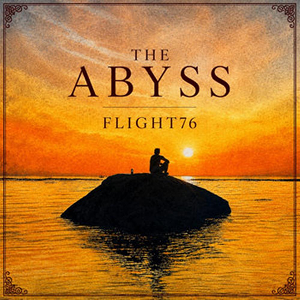
In the summer of 1975, five teenagers in Hastings, Nigel Wade, David Cash, Paul Tampion, Tim Falla, and Ian Wright, called themselves Flight. Their collective existence lasted barely a year: one headline show at the Hotel Queens before a crowd of roughly five hundred fellow locals, a single demo cassette pressed to tape, and then the sudden uprooting that Punk delivered to every corner of the British province by 1976. The five drifted apart into their respective adult lives, the cassettes shelved, the four-track Fostex deck gathering dust. What Ian Wright has done since then is less a reunion than something rarer and more deliberate: a continuity of intention strung across decades of under-the-radar work, migrating from those analog cassette machines to modern digital DAWs without ever letting the material go cold. Flight76 is the name that marks that seam, archival recordings recovered from the original sessions, grafted onto newly written compositions and contemporary arrangements, all executed by Wright as sole performer, composer, and producer under the self-described credit of Everything. The trajectory over the past two years has been deliberate and layered. “Continuum” (October 2025) tested the waters with “Legend of a River,” letting the young, unpolished voices of the original band float beneath present-day production. “The Nightmare of Reason” (November 2025) proved the format could sustain a full double-length concept album. And now “The Abyss,” released 14 July 2026, arrives as the most fully realised statement yet. Equally significant is the role of Nigel Wade, Flight‘s original vocalist, who in the interim has built a respected career as a watercolour artist. His paintings supply the entire visual identity of the album’s packaging, and his lyrics-sharp, imagistic, quietly devastating-thread through the record alongside Wright‘s compositions. It is, in every meaningful sense, a duet across fifty years. The title-track sets the emotional coordinates without ceremony. There is no vertiginous plunge here; the abyss is presented as a condition, an existential weight the listener must learn to inhabit rather than flee. Musically, the piece descends slowly, wrapped in atmospheric keyboard textures and guitar lines rich in dynamic swells. The lyrics trace a border where edges dissolve, where echoes blur into what might be called a gravitational stillness. The track moves unhurriedly, enveloping the listener in a build of dreamlike keyboard melodies and a warm, expressive vocal delivery, before resolving into a refined guitar solo and a final, unadorned piano statement. It is a quiet, precise way to say: we are here, and it is deep. An unambiguous homage to Henry Purcell‘s 1680 song, “Music for a While,” reworked into a hymn to music’s temporary power to lift darkness and “banish my night.” Delicate arpeggios, interlocking harmonic voicings, and a slow emotional crescendo frame the piece as a refuge of light set against the fraying of time. Compared to the opener, the sonic palette shifts: the guitar-keyboard interplay carries a weightier, more insistent Progressive Rock pulse, anchored by a solid, elaborately patterned rhythm section over which Wright‘s vocal finds a notably commanding register, making full use of his range. The album’s most architecturally complex suite, “(Life is a…) Near Death Experience,” stretching past nine minutes to build a case that life itself is a brief “near-death experience,” a temporary interlude between two states of non-existence. Rather than collapsing into despair, the lyrics express a fierce, almost stubborn gratitude: “blessed coincidence, glad we came.” The composition cycles through continual time-changes, symphonic openings, and passages of considerable instrumental breath. Wright demonstrates his most technically assured side here, Symphonic Prog gestures married to modern, occasionally harder-edged textures, intensity sustained across the full duration. Sung sections and instrumental passages trade places in a structure that never overstays its welcome, the rhythm section in constant evolution while guitar and keyboard orchestration spiral through intricate melodic development. The vocal performance, again, lifts the architecture into emotional territory. Epic in scope, reflective in tone. Humans are cast as the “Kings and Queens” of their own histories, chasing shadows, painting rainbows across indifferent skies. The song weaves driving vocal lines with virtuosic instrumental passages that remain, crucially, in service of the melody. Classic Prog scaffolding, Melodic through-lines, a distinctly personal modern touch: the vocal carries a compelling directness before the piece opens into denser, more elaborately interwoven guitar-keyboard passages. Suggestive, dynamic, and thoroughly satisfying in its architecture. “As If… (Stars That Never Fade)” is a dreamier, more kinetic entry. The narrative pursues dreams inside a world of distorted forms, through theatrical masks, neon light, and cosmic longing. The individual is assimilated to a star fated never to fade. The compositional approach here is deliberately softer and more direct than its predecessors: the elaborated passages yield space to more immediately accessible, enveloping melodic territory. The song reveals Wright‘s strongest singer-songwriter instincts, balanced against dynamic shifts and intense solo insertions that braid into the warmly delivered vocals. Melodic Progressive Rock with a pulse. Literary and philosophical in lean, “The Best of All Possible Worlds” draws more explicitly on Voltaire‘s Candide satire than on Leibniz‘s optimistic metaphysics. The lyrics cut at blind, dogmatic optimism, “keep smiling, if it’s broken it must be so,” set against the world’s accumulated injustices. Musically, the composition is both ironic and sharp, resolving in its final movement by pitting the grand deception against the pragmatic simplicity of cultivating one’s own garden, planting something good in the soil. The track foregrounds Wright‘s British roots: near-Folk-Rock textures layered over a 1970s-classic Prog atmosphere that recalls the more progressive instincts of Strawbs, all filtered through a distinctly personal melodic sensibility. A fine display of Wright‘s dual gifts as songwriter and multi-instrumentalist. Solemn, enigmatic, and wry, “The Hour Appointed,” affectionately parodies the clichés of “trad prog,” ancient stones, sacred symbols, veils, processions, transforming the anticipation of a mythic event into a meditative reflection on the illusion of enchantment itself. Over six and a half minutes, the piece layers the artist’s most elaborately textured sound with his signature melodic drive. Time-changes and solo interludes of guitar and keyboard interlace with a vocal delivery that is both melodic and charged. The structural patience is notable: the arrangement earns its epic register through restraint rather than volume. “Rock-a-Nore” is a a poetic, geographically specific homecoming to the Hastings coastline, the beach, and the neighbourhood of Rock-a-Nore. The lyrics are tactile: fishing boats, tar, the clatter of pebbles, the unstable boundary between land and sea where “time moves sideways.” The music tracks the tide. The sound is textural and rhythmically grounded, sensorially immediate. Vocal lines stack and layer; guitar arpeggios braid into a rhythm section that returns to the band’s most overtly British sonic vocabulary. It is a tribute to a city and a shoreline, delivered in a musical crescendo that sways and settles the way the sea against Hastings’ coast inevitably does. “Schadenfreude” is nearly eight minutes of rarefied, almost hypnotic atmosphere, investigating the ambiguous pleasure one takes in another’s fall or failure. Certainties slip, words dissolve like cracked mirrors. The arrangement builds its intensity slowly, deliberately, over the full length of the track, before culminating in a sustained, intense guitar solo that carries the listener through the second movement to the close. The restraint in the early passages makes the later release all the more effective. The album’s most pointed social and cultural critique, “Sentience.” The lyrics grapple with the erosion of perception and independent thought in an existence mediated by screens, plastic, and recycled digital language, “trading thought for a digital haze.” The musical response is commensurate: tauter textures, tighter rhythmic patterns, incisive riffs, and a drumming groove with real forward momentum. The vocal sits at the centre of the first movement, enriched by effects, before the piece pivots into a dense, sustained instrumental second section that develops the central theme without releasing its grip. Tension is maintained throughout; the architecture never slackens. The closing track “Endless Abyss” carries lyrics written by Nigel Wade, the original singer, and the album’s central metaphor is reframed in strictly personal, intimate terms: regret, loss, the persistent residue of lov, “falling through the memory of your kiss.” The guitar melody and vocal interpretation close the record on a note of aching beauty, answering the opener’s tonal world while evolving it into a more overtly Symphonic Prog register. It is a coda that leaves the listener wanting the disc spun again. “The Abyss” confirms what the preceding two releases had been working toward: Flight76 are no longer a footnote to a 1975 Hastings band that played one show and vanished. They are a coherent, contemporary Art-Rock and Progressive Rock act with a distinct stylistic vocabulary and a conceptual through-line that only tightens with each record. The album’s deepest strength lies in the dialogue it stages across five decades—between a four-track Fostex cassette and a modern DAW, between a watercolour painter’s eye on Hastings’ coastline and a studio engineer’s control of space and reverb, between Purcell and Voltaire in the text and the Goya, Kafka, Keats, and Proust allusions that populate the wider Flight76 catalogue. Wright‘s command of the studio is mature and purposeful; nothing here sounds like it is trying to be 1975. Everything sounds like it remembers 1975. This is a record I would place unreservedly in the hands of any reader of Progressive Rock Journal and, more broadly, in the ears of anyone who loves the classic language of Progressive Rock in productive conversation with its modern inheritances. The production is excellent throughout. The songwriting is assured. And the project’s underlying engine, friendship, patience, and an unbroken, unshowy passion for the act of making music, comes through with a genuineness that no amount of technical polish could replicate. “The abyss,” it turns out, is not a place you fall into. It is a room you build, tune, and learn to sing in.
Tracklist
01. Abyss (05:18)
02. Music for a While (05:13)
03. (Life is a…) Near Death Experience (09:16)
04. Kings and Queens (08:47)
05. As If… (Stars That Never Fade) (05:08)
06. The Best of All Possible Worlds (06:08)
07. The Hour Appointed (06:36)
08. Rock-a-Nore (06:00)
09. Schadenfreude (07:59)
10. Sentience (06:29)
11. Endless Abyss (04:53)
Lineup
Ian Wright / Everything
I had the chance to interview Ian about the band’s legacy and the new release. Read the interview here: [Exclusive Interview] Flight76: Inside the Infinite Void and Musical Evolution of “The Abyss”