

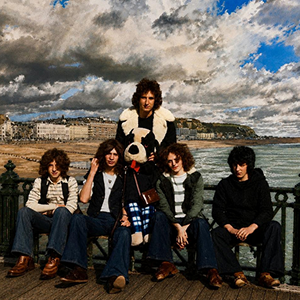
When teenage Progressive Rock outfit Flight disbanded in the summer of 1976 after playing a single concert in Hastings and leaving behind a lone cassette tape, few could have predicted their story was far from over. Nearly half a century later, multi-instrumentalist Ian Wright and original vocalist/artist Nigel Wade bridged that vast gap in time, transforming an abandoned 1970s chapter into Flight76, not as a nostalgic reunion, but as an ongoing creative continuum.
Following the releases of ”Continuum“ and the double-album “The Nightmare of Reason,” Flight76 returns with their fourth release, “The Abyss.” Merging intricate Progressive arrangements with philosophy, literature, UK coastal heritage, and restored archival recordings, the album explores the quiet gravity of human existence. We caught up with Flight76 to discuss the making of “The Abyss,” their evolution from 4-track cassette recorders to modern DAWs, and what it means to create Progressive music across a 50-year interruption.
Flight originally formed in Hastings in the summer of 1975, played one remarkable concert at the Queens Hotel, recorded a demo cassette, and split up by 1976. Looking back, what made that brief teenage chapter so musically potent that it refused to stay buried for nearly half a century?
The excitement of being in a band and making music never left me but was first kindled by the friendships and interest of the group of friends that came together in that first band. The music we covered and that we wrote went through a hiatus in the years immediately after our brief “life” as a group and we all went off in different musical and other directions but the intense inteerest in Prog and Rock generally always remained and returned slowly but surely.
Rather than describing Flight76 as a traditional reunion or a brand-new project, you frame it as a “continuation” of a dormant path. How did the realization dawn on you that those 1976 tape fragments, such as the original guitar and Nigel Wade‘s teenage vocal on “Legend of a River,” could physically co-exist alongside modern studio production?
Over the years I dabbled in recording as well as composing and playing but went for decades without any good means of producing anything decent because of, yes, lack of talent but also poor tech to achieve anything reasonable in terms of sound. In more recent years, from about 2000 on, computer production tools began to enable much more refinement in the capabilities of my home studio. The past 10-15 years have seen that improvement scale tremendously to a level where I can produce audio almost as good as pro setups. This also includes technology allowing me to take old material and rescue some it – though not all as there is a lot of the old live recoding that is simply beyond help. That’s what happened with Legend, for example, first starting in 2020 or so with some mediocre attempts and then gradually improving, notably by adding overdubs to audio restored by good software like Izotope RX.
Nigel Wade’s involvement forms a fundamental bridge between past and present, contributing both his 1970s recorded voice and his watercolour artwork for the Flight76 covers. How did re-integrating his visual art shape the aesthetic identity of Flight76 from the outset?
Nigel’s an incredible artist with a style uniquely his own. He offered to wotk with some of his art for covers and the offer was impossible to refuse. It cements the aesthetic of the band and its past with the direction of the music moving forward. The image for The Abyss cover is such a profound image illustrating the emotions intended by the album and the title track, although it’s not Nigel’s favourite of his works, there could be no other choice as far as I was concerned!
Your new album, “The Abyss,” arrives after the broad dystopian and literary scope of “The Nightmare of Reason.” “The Abyss“ feels noticeably more psychological and reflective. Was this shift toward more internal, existential themes a conscious change in direction?
Simple answer – no… I make some deliberate choices in what I want to do with tracks more specifically than with albums as a whole – certainly at the outset of putting an album together (though I’m working on a couple of concept albums right now but, who knows, they may not emerge to see the light of day). Nightmare did end up with a loose concept, certainly for Side 1, but Abyss didn’t start out as a holistic theme.
The title track “Abyss” treats the abyss not as a sudden catastrophic drop, but as an enduring condition that one must recognize and learn to live alongside. What inspired this particular philosophical view of the “abyss“?
“Endless Abyss” brings Nigel Wade back as a lyricist, approaching the album’s core theme from a deeply personal angle of loss and recurring memory. How did his lyrical piece come together in tandem with your title track?
I can answer these two questions best together. “abyss” started out a a wholly instrumental, almost ambient, track without lyrics. Nigel suggested it needed some and provided his ideas. I didn’t see a decent way of fitting them to the track but was inspired by his words to write my own with inspiration from a lifetime’s experience of living and dealing with all the best and worst that existence offers. Nigel’s lyrics for “Endless Abyss” spoke to me more driectly with reference to a couple of specific experieces and inspired a somewhat different piece of music.
In “Music for a While,” you explicitly pay homage to Henry Purcell. How did Purcell’s Baroque piece inspire your approach to constructing tension and resolving light within a Progressive Rock arrangement?
I’m particularly inspired by Purcell’s music but clearly could never hope to write anything as clever. However, I really like the mathematical precision of his work that manages to evoke emotion and enthralls with detail and that’s what I’m attempting to honour and mimic in my slightly more modern way.
“(Life is a…) Near Death Experience” offers a compelling perspective: viewing life as a brief, vibrant interruption between two states of non-existence, yet celebrating it with gratitude. What led to this particular line of thought?
It just seems to me that it is exactly what life is… a brief spark of wonderful consciousness between bookends of oblivion. Given that we’ve all [not] experienced the oblivion once already, why fear the oblivion to come? By the way, this tracks shows my pathetic attempt to emulate the keyboard styles of two great players: Francis Monkman (particularly off Curved Air’s Second Album) and Mike Garson (on a couple of Bowie albums for sure). An odd pairing possibly. I’m a guitarist essentially (and not a good one) and only a novice “piano plonker“ so I apologise to my influences.
Voltaire’s Candide informs “The Best of All Possible Worlds,” taking aim at forced complacency and blind optimism in the face of chaos. How did you translate Voltaire’s sharp satirical edge into the music’s dynamic shifts?
I’m not sure I did manage to invoke Voltaire musically but I made my best effort to provide relatively simple musical ideas to match the very simple satire of Candide and Voltaire’s wonderful rip on Leibniz. At the very least, it’s a song I can like.
“Rock-a-Nore” anchors the record in a very specific physical location, the Old Town coast of Hastings with its shingle, fishing boats, and shifting sea margin. What does returning to Hastings geographically signify for Flight76?
Hastings was suffused in every aspect of our development as teenagers and schoolkids. It’s a strange dichotomy of a town, a real mish-mash of evocative geography and urbanity, artistic intent and ambition, and utter degeneracy. In other words, it’s a lovely town with plenty of flaws. None of us can escape the environment was were moulded in and either escaped or were entrapped within.
On “The Hour Appointed,” there is a ceremonial, enigmatic quality that seems to gently parody traditional “Epic Fantasy” Prog tropes. Was it enjoyable to play with some of the genre’s more theatrical conventions?
“The Hour” is just a bit of fun poking at some of the exhuberant lyrical whimsies of past fantasy prog. I have no idea what any of it means, as I’m sure is exactly the case with all of the proggers and their fanciful lyrics.
“Sentience” addresses a pressingly modern concern: human thought slipping away into a digital haze of screens and machine-mediated language. How do you view the relationship between organic human creativity and digital technology in contemporary music-making?
I view it with increasing concern and a high degree of cynicism. Sentience doesn’t really mean what people generally take it to mean, particularly as far as intelligence is concerned. It’s more associated with senses, feelings, stimulus, and reaction. The key, essential difference between human creativity and technology is biology and the fundamental difference between organic chemistry and chunks of metal and wire. Well, at least that sounds like a plan…
Tracks like “Schadenfreude,” “Kings and Queens,” and “As If… (Stars That Never Fade)” cover a broad emotional spectrum, from sharp social observation to uplifting reflection. How do you approach sequencing an album with such contrasting moods so it feels like a unified piece?
Interestingly, these are all quite old songs – “Kings and Queens” in particular. I’m not sure they fit the album but, as I mentioned earlier, I don’t start with a concept and just have songs that I want to let loose somehow. After that, it’s a question of whether they sound good or not in a particular order. I really don’t think they sound “unified”?
Your recording journey traces the transition from Fostex 4-track cassette recorders in the 1980s to modern DAWs like Reaper and digital hardware. How has this evolution in studio technology changed the way you compose and layer complex Progressive arrangements?
I started even earlier bounding from one stereo cassette to another! Modern recording tech is vastly liberating and allows production techniques I couldn’t have imagined even 20 years ago. The same goes for the instrumentation I have at my fingertips to provide sounds that wouldn’t have been possible to include. That creates an infinitely rich pallette of audio possibilities but I still only start with simpler ideas on either guitar (predominantly) or keyboard. It is true though that I’m not a performer as such. The music is very much a production, pieced together one stitch at a time, sometimes quite laboriously and other times melding seamlessly without my realising it.
Since launching Flight76 with “Continuum“ in late 2025, you have maintained a remarkably prolific release pace. Does operating in a dedicated home studio environment afford a creative freedom that traditional commercial studios couldn’t offer?
It absolutely does! I have probably 500 to 1000 hours of musical “material” amassed over the past 40 years (most from the past 20 years). These are my raw ingredients that I use directly and enhance with tech on the computer or translate with new instrumental interpretations. I’m not working in a group so all the bad decisions are mine, that is before I share demos with others like Nigel, who often set me straight about what ideas are not working as I think they should. Plus, I couldn’t afford to work in a pro studio!
The original Flight concert at the Queens Hotel in 1975 attracted an audience of 500 fellow teenagers, an extraordinary turnout for a young local band. What memories or anecdotes stand out most from that single public performance?
There are so many – too manyto tell – and mainly traumatic ones! We plunged into performance too early but, at the same time, too late. We weren’t ready, we hadn’t rehearsed or written long enough but we were already overtaken by the trends of the time in music and fashion. It then only took 50 years to improve on those musitakes.
Given that Flight76 is currently a studio-focused project, do you ever consider bringing these compositions, or restored elements from the 1970s archive, to a live stage, or is Flight76 strictly designed for the recorded medium?
I personally could not bring live performance of the music, certainly not by myself. I would be ecstatic if other good, capable, real musicians (particularly vocalists) were ever inspired to attempt it.
Having witnessed the UK Progressive Rock era of 1975, the sudden arrival of Punk in 1976, and now today’s digital independent landscape via platforms like Bandcamp and ElasticStage, how do you see the health and spirit of Progressive Rock today?
Prog Rock has proved more enduring than any trendy, nay-sayers from 50 years ago ever imagined it would. It has evolved, taken some steps backward, many steps forward. It is immensely varied and tremendously inspired and inspirational. We’re good to go for a while longer…
With three full-length albums and a single released in under a year, Flight76 has established a vibrant current-day identity. Where do you see the project heading next as you look beyond “The Abyss”?
I really don’t know. It seems to have a life of its own. For me it’s simply a way of having fun and getting out some demons of creativity with no other intent or ambition. If others end up enjoying some of it or any of it, I find that extremely gratifying. I have two album ideas and some demos in the works. As my trove of past music is mined clean, I still seek out new noises to play with but who knows if any of it will be worth sharing with the world?
We would like to thank Flight76 for taking the time to share their music, history, and insights with us. Flight76’s new album “The Abyss” is available now via Bandcamp and physical editions on ElasticStage. Stay tuned to Progressive Rock Journal for our upcoming detailed review of the album.
Purchase “The Abyss” on Bandcamp: https://flight76.bandcamp.com/album/the-abyss-2