

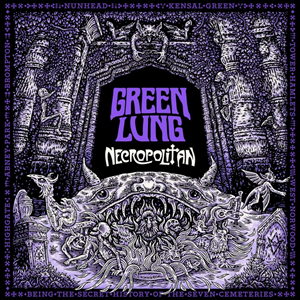
Green Lung have carved out a position in the British Heavy and Occult Rock scene that few peers can replicate: a sound simultaneously rooted in the cathedral acoustics of late-’60s and early-’70s Rock and pointedly, almost aggressively, of its own moment. From the self-released debut EP “Free the Witch” (2018) through the folklore-drenched “Woodland Rites” (2019) and “Black Harvest” (2021), and onward to the critical and commercial breakthrough of “This Heathen Land” (2023), the band’s trajectory has been one of compounding ambition without a single moment of tonal drift. “Necropolitan” marks the next step, and it is a decisive one. Recorded at the legendary Rockfield Studios in Wales alongside producer and engineer Tom Dalgety, the name behind the records for Opeth and Ghost, the album adopts a production philosophy that is, in practice, a statement of intent: live tracking, minimal overdubs, the full band captured in the room as a single organism. What emerges is an unapologetically physical record, one in which the Hammond organ and Mellotron occupy the same gravitational field as the riff, and the drum kit hits with the weight of a closing crypt door. The production strips away the layered, studio-crafted texture of earlier work in service of something more immediate, more present. The conceptual axis has shifted, too. Where previous albums drew on the heathen wilds, the peat bogs, the pre-industrial English countryside, “Necropolitan” turns its gaze inward to London and the occult architecture of the city itself. The title references the so-called “Magnificent Seven,” the great Victorian necropolises built in a ring around the capital, each one a monument to the dead that the living built to keep the corpse out of sight. The album, in turn, reads as a sustained memento mori: a lyrical portrait of death and nature claiming, patiently and inevitably, the structures of human dominion. Richard Wells‘ artwork frames the package with the same unease and grandeur that the music itself carries. The album opens with “Open the Hellmouth,” a short, wordless overture that sets the temperature of everything to follow. Layers of organ, Mellotron, and distant reverberation build a slow, fog-thick crescendo, no drums, no riff, just atmosphere pressing in from all sides. It functions as a threshold: the sound of a Heavy door being pulled open in a basement that should not have a door. Ninety seconds is all it needs. The album’s most recent single, “Dance to the Grave,” released with an official visualizer, and the track that most clearly announces the band’s current sonic territory: monolithic riffs interlaced with organ and synth lines, a drum groove with genuine sway, Templar‘s vocal cutting through the verses before the chorus opens into something undeniably singable. Occult Rock, Heavy Rock, a flick of Prog, all in service of a song that is, first and foremost, catchy in a way that should be harder to pull off at this register. The lyrical target is precise: a savage social satire aimed at the unholy alliance between right-wing politics and technocratic complacency in the face of the climate emergency, dressed as a danse macabre. The central choral section is built, you can tell, for the arena, for a crowd to be dragged into a collective, slightly terrified dance. A guitar-and-keyboard solo exchange in the second half is brief, tightly voiced, and lands the point. It is, in many ways, a love letter to the entire canon of Occult Rock, and the band knows it. Conceived as a pirate-radio hijack on a vintage ’60s broadcast, “Black Magick Radio” threads audio quotations from Lucifer’s Friend and Black Widow into its weave, grounding the fiction in the proto-Goth and esoteric geography of London: the Le Macabre bar in Soho, the Process Church of the Final Judgement in Mayfair. The ritual invocation “Eko Eko Azarak, Eko Eko Zomelak” is delivered by guest vocalists whose layered, choral weight gives the passage an almost liturgical gravity. Released as another single, the song has a restless, propulsive quality, the rhythm section is dense with tempo shifts, Wright‘s organ duets with Black‘s guitar in passages that feel genuinely composed rather than improvised, and Templar‘s vocal performance is dynamic, precise, and effortlessly in command of the tempo. It is the album’s most overtly theatrical number, and the one most likely to become a live fixture. Clocking in at a sustained 180 BPM, “Necropolitan Line” is the record’s most overt speed track, and the one that most clearly channels the Motorhead-meets-Deep Purple equation. The narrative conceit is specific: the listener is riding the London Necropolis Railway, the Victorian rail line that carried the dead from city mortuaries to the great suburban cemeteries, and the track’s momentum and staccato phrasing evoke the clatter of wheels on points. The cinematic allusion to Death Line (1972) is stated in the band’s own notes and sits naturally within the track’s noir-pulp energy. The musical heart is a neoclassical duel between Wright‘s Hammond and Black‘s guitar, both players trading phrases with a confidence that borders on the aggressive. Released as a single with an official video styled on the aesthetic of the historic German Beat-Club programme, rebranded for the occasion as Crypt-Club, it is one of the album’s absolute high points, a sprint that leaves no room for doubt. The lead single, “Evil in this House,” and the question it poses is almost too fun to resist: what would a paranormal investigation sound like if a stoner metal band conducted it? The answer arrives as a slow, impossibly Heavy Sabbathian riff, a vocal line delivered in a hypnotic, almost monotone drawl, and then, in the track’s most surprising moment, a synthesizer solo that the band has aptly described as “ectoplasmic.” It is a deliberately pastiche gesture, nodding to the haunted-house film aesthetic of the ’70s, but the execution is tight enough that the homage never tips into parody. The Doom Rock and Heavy Prog interplay in the instrumental passages maintains the album’s cumulative tension, and the chorus is the kind of hook that lodges in the skull and stays. The album’s quietest, most inward track “Together in Death,” and the one where the band’s range is most apparent. Rich keyboard textures and a measured, almost liturgical pace set the scene for a lyrical meditation on love that persists beyond the boundaries of the terrestrial body, a pact sealed in the dark of the grave, not with grief but with a kind of solemn tenderness. The song opens gently, builds in measured increments of intensity, and resolves into a solid, well-constructed Heavy Rock passage with Prog inflections. Another strong vocal performance from Templar, and another in the long catalogue of guitar-and-keyboard interlacements that have become something of a Green Lung signature. The band is comfortable here in a more atmospheric register, and it shows. The most explicitly Prog track on the record, and arguably its compositional summit, “Ozymandias.” Named for Percy Bysshe Shelley’s sonnet, the piece sets to music the fall of empires, tyrants, and grand human works before the slow, indifferent pressure of time and geology. Black‘s guitar work is built on solemn, processional progressions, Wright‘s organ swells to a near-Symphonic register that gives the track a scale the shorter numbers do not attempt. The fusion of Heavy Rock, Prog, and occult texture that defines the band reaches its most fully realized form here — a sound that sits comfortably in the lineage of the early ’70s while carrying a distinctly modern Green Lung patina. The rhythm section’s monolithic drive and the late-song interplay between guitar and keys make this one of the most rewarding repeated listens on the album. Steeped in thelemic esoterism and ceremonial occultism, “Alostrael (Be My Babalon)” is the album’s most deliberately uncanny number. The atmosphere is thick, slightly wrong, and very well constructed: a Heavy Rock foundation underpinned by a sumptuous Hammond that adds a ’70s Prog sheen to the proceedings, culminating in a guitar-and-organ solo duet that lands with real weight. The guest spoken-word performance by Riley Pinkerton “The Rat Queen” of Castle Rat band, who inhabits the ritual figure of Babalon, adds a theatrical, almost storybook dimension to the track’s sonic architecture. It is the album’s most Experimental passage, and the one that benefits most from a second, closer listen. The closer, and a deliberate departure. “To the Gallows Born” opens with acoustic arpeggios and pastoral, interwoven figurations that call to mind the great British folk-horror tradition, then grows, gradually and inexorably, into a choral finale of considerable emotional and dynamic force. The movement from the intimate to the communal, from the quiet to the full-throated, is handled with real craftsmanship. It leaves the listener suspended in the space between the gallows and the London necropolises, a fitting final image for an album that is, from first note to last, about the city that builds its dead in circles and keeps walking. “Necropolitan” confirms what “This Heathen Land” had suggested, Green Lung are operating at a level of maturity and self-awareness that places them firmly among the most compelling Heavy Rock acts working in Europe today. The production choice to play to the live room, to let the organ breathe and the rhythm section land with full weight, gives the record a physicality that the more layered productions of the mid-2020s often sacrifice. Yet the band has not lost the things that made them distinctive in the first place, the melodic hook, the macabre narrative, the comfort with the theatrical and the ritualistic. In a period when the foundational figures of British Heavy Metal are passing the baton, Green Lung are not merely heeding the call, they are answering it with a specific, well-researched, and genuinely personal vocabulary drawn from the folklore, the occult history, and the urban mythology of London. The lineage: Black Sabbath, Deep Purple, Black Widow, the NWOBHM is there in the architecture of every track, but it is filtered through an identity that is entirely their own. “Necropolitan” is a mature, assured, and genuinely thrilling record. For listeners who want Heavy Rock with Prog undertones, who value the interplay between guitar and organ, who respond to a rhythm section that plays with conviction rather than mere precision, and who trust a vocalist to carry a lyric without ever stepping on it, this is, in my estimation, one of the essential releases of 2026. And it is very much a record that rewards the live experience, several of its tracks clearly conceived as communal events rather than mere audio. Put it on, turn it up, and let the necropolis close in.
Tracklist
01. Open the Hellmouth (01:49)
02. Dance to the Grave (05:17)
03. Black Magick Radio (05:01)
04. Necropolitan Line (03:54)
05. Evil in this House (04:21)
06. Together in Death (04:31)
07. Ozymandias (05:35)
08. Alostrael (Be My Babalon) (04:28)
09. To the Gallows Born (05:58)
Lineup
Tom Templar / Vocals
Scott Black / Guitars
John Wright / Organ, Synthesizers, Keyboards
Joseph Ghast / Bass
Matt Wiseman / Drums, Percussion
Guest:
Riley Pinkerton (The Rat Queen) / Spoken Word on “Alostrael (Be My Babalon)“